48° and Clear
Image
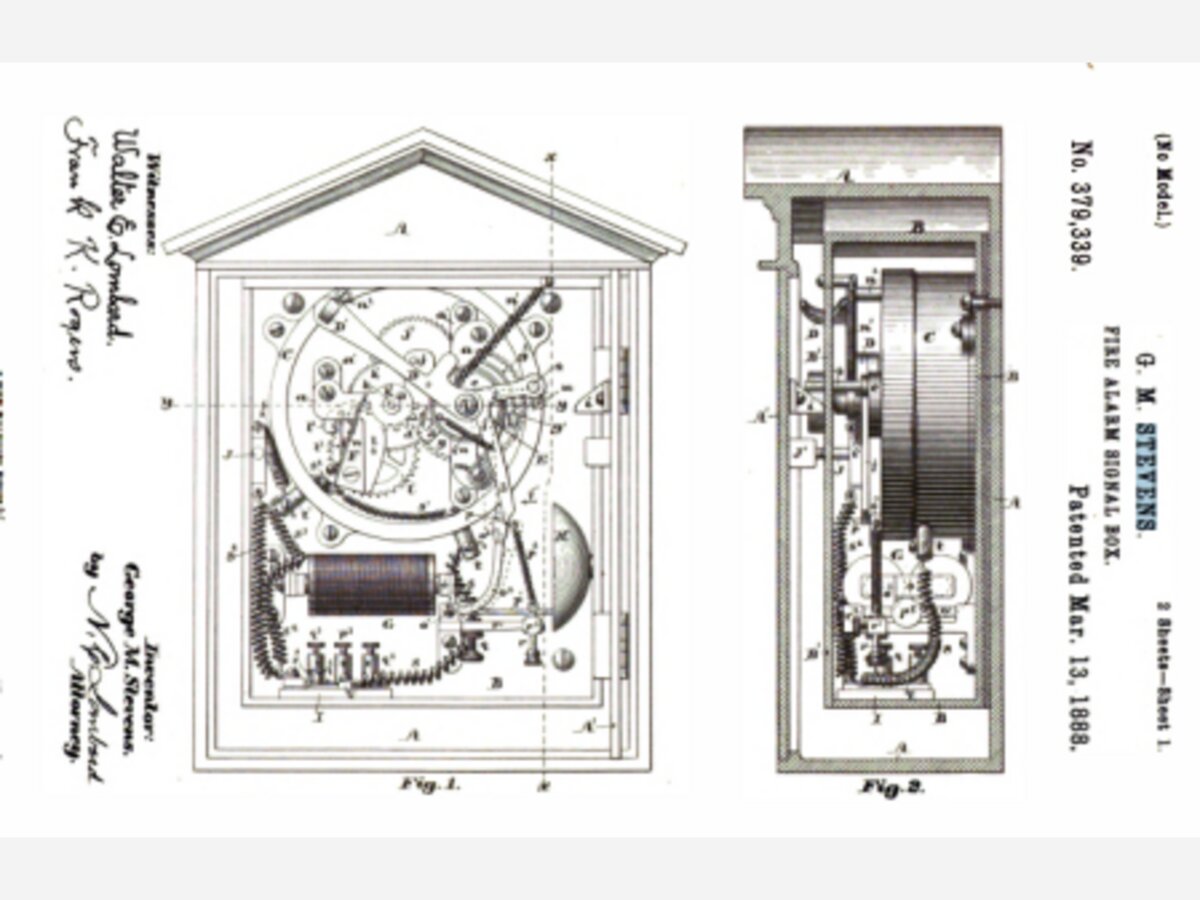



In the beginning there was the electric telegraph, known experimentally amongst some European scientists and inventors and developed and commercialized in the US by Samuel F.B. Morse in the 1830s and 1840s. That seemingly magical ability to instantly convey information attracted inventors who created specialized systems to alert fire fighters when a blaze was detected – the first such system anywhere in the world going into service in Boston in 1851.
In the following decades the technology grew more sophisticated as more creative people entered the field, one of whom was George M. Stevens, a designer and builder of clocks for church, factory, and municipal towers, and also an improver and purveyor of alarm systems. The patent drawing at the top of the article shows a call box and its internals, a basic design that became a familiar bit of the urban landscape for more than a century.
In any case, in the 1890s, growing and prosperous Franklin was investing more in its fire department and water supply to ensure it had the capability to fight the all-too-frequent fires. But rousing the fire department and volunteer fire fighters and getting them to the right location, was a haphazard, literally word-of-mouth affair.
That is until 1896 when the town began to consider equipping itself with a modern alarm system.
In May of 1896, the electric light committee, appointed by the town at its last meeting, and consisting of Messrs. Pierce, Morrissey, and Willoby, “discussed the matter of the fire alarm for the town and have received what appears to be an excellent offer on the part of George M. Stevens of Boston, who stands ready to equip the town with fire alarm boxes free of expense, stationed at Nason’s Crossing, at the Franklin House [a hotel] , and at the Catholic Church at Central Square,” the Sentinel reported.
The system was in fact put in place at the start of July, and the Sentinel suggested that knowing the alarm system was available put citizens at ease with all the upcoming July 4 festivities involving fire and explosives.
One of the many instances when the alarm proved its worth came in early October, the alarm system brought out firefighters to the barn associated with the Crescent House [hotel]. Their quick arrival prevented injury to any animals and helped ensure that the blaze was extinguished before it spread to neighboring structures.
The listener would hear a number of whistles tones, in sequence, corresponding to the box number. The Sentinel commenced running a public service announcement each issue explaining the system to readers.
* * * * * *
FRANKLIN ELECTRIC FIRE ALARM
Five Boxes and Whistle in Operation July, 1896
BOX 8 – Central street, head of Summer street
13—Corner Emmons and Main streets,
24—Nason’s crossing,
32—Corner Union and Central streets.
41—Union street near Beaver, opposite St. Mary’s Church
Two Blasts – Fire out
One Blast – Testing apparatus
___________
Directions for Giving an Alarm.
Being sure that the fire actually exists, go to the nearest box, unlock, pull down the hook and let it go. The apparatus works automatically. Close the box and remain until the firemen arrive to direct them to the scene of the fire.
* * * * *
In more recent times, as the system grew more complex, the signaling code was further refined and older residents will be happy to tell you exactly what the different signals meant back in the day.



Sunny, with a high of 74 and low of 46 degrees. Sunny during the morning, cloudy during the afternoon, clear for the evening,