Image



PERSPECTIVES
By James C. Johnston. Jr.
Let us consider the great economist, Adam Smith and his 1776 magnum opus, An Inquiry Into the Nature and Causes of the Wealth of Nations. In this seminal work, Smith states that the Law of Supply and Demand is that all important factor which determines the value of all things. If everybody wants product “X”, and very little of product “X” exists, product “X” will be very expensive. But if a huge amount of product “X” suddenly appears in the market place, its value will drop. If fewer people are interested in my wonderful cross banded mahogany Eighteenth Century North Shore Queen Anne Highboy, its value could drop from a high of $28,000.00 to a low of $2,000.00! How shocking!
Sophistication and taste enters the picture at this point, as well as real connoisseurship, in determining the value of an object. Connoisseurship is having the knowledge to know what you are looking at and appreciating that particular object de virtue for the great treasure that it is from the point of view of the subtle qualities of its manufacture. Connoisseurship takes many forms. When I look at a painting, and recognize that painting as being a Gilbert Stuart portrait, it is because I have looked at hundreds of examples of the artist’s work and know his style as it has evolved during his long career in the Eighteenth and early Nineteenth Centuries.
I once found a portrait of The Marquis de Lafayette painted by Stuart at the time that the Revolutionary War General was visiting the United States for the last time in the 1820’s. I found this small portrait at the old Norton Flea Market back in the early 1970s when the Norton venue was a great place to find “Sleepers” of all sorts from signed classic American pewter to German copper plate engravings by Albrecht Durer. I found a huge treasure trove of great things there in those “Good Old Days”, because I knew what I was looking at!
Sleepers are objects of value which are unrecognized from the point of view of their artistry, quality, and value. It is also most interesting that people are unaware that there are laws protecting both buyers and sellers of rare objects. For example, the law states that I am a person of recognized “specialized knowledge”, and as such, I cannot offer an amateur seller, who has no knowledge of art or antiques, a low price of less than half of what I expect to get for an art or antique object should I buy it with an eye to reselling it. But if an object is offered to me at a fixed price by the seller, which the seller has established as a price he desires for that particular object, I can buy it at that price as long as I do not try to force the seller to sell me that object at a lower price than the one he quoted to me initially.
Many court cases have come up during the Twentieth Century regarding this situation. In the case of a famous stamp dealer by the name of Philip H. Ward Jr., whose customer base were the Who’s Who of United States High Society, greatest philatelists of the United States and Europe, and richest people on both sides of the Atlantic. In the 1920’s he bought some very nice Post Master’s Provisional Stamps from a middle aged lady, with no background in stamps, for less than one percent of their value. This find was so spectacular, that it garnered national attention when the Post Master Provisional hoard came on the market.
The lady’s relatives found out about Ward’s sale in the popular press and brought it to her attention. She in turn got herself a good lawyer and sued Ward, who actually could have ended up in criminal court instead of civil court. The judge and jury listened to the case and decided that Ward had defrauded the Lady of many tens of thousands of dollars. The responsibilities of an informed buyer to an uninformed seller were further refined in this case. Similar cases involving Elmer Crowell decoys and other rare objects have further advanced case law regarding the sale of art and antiques over the last century.
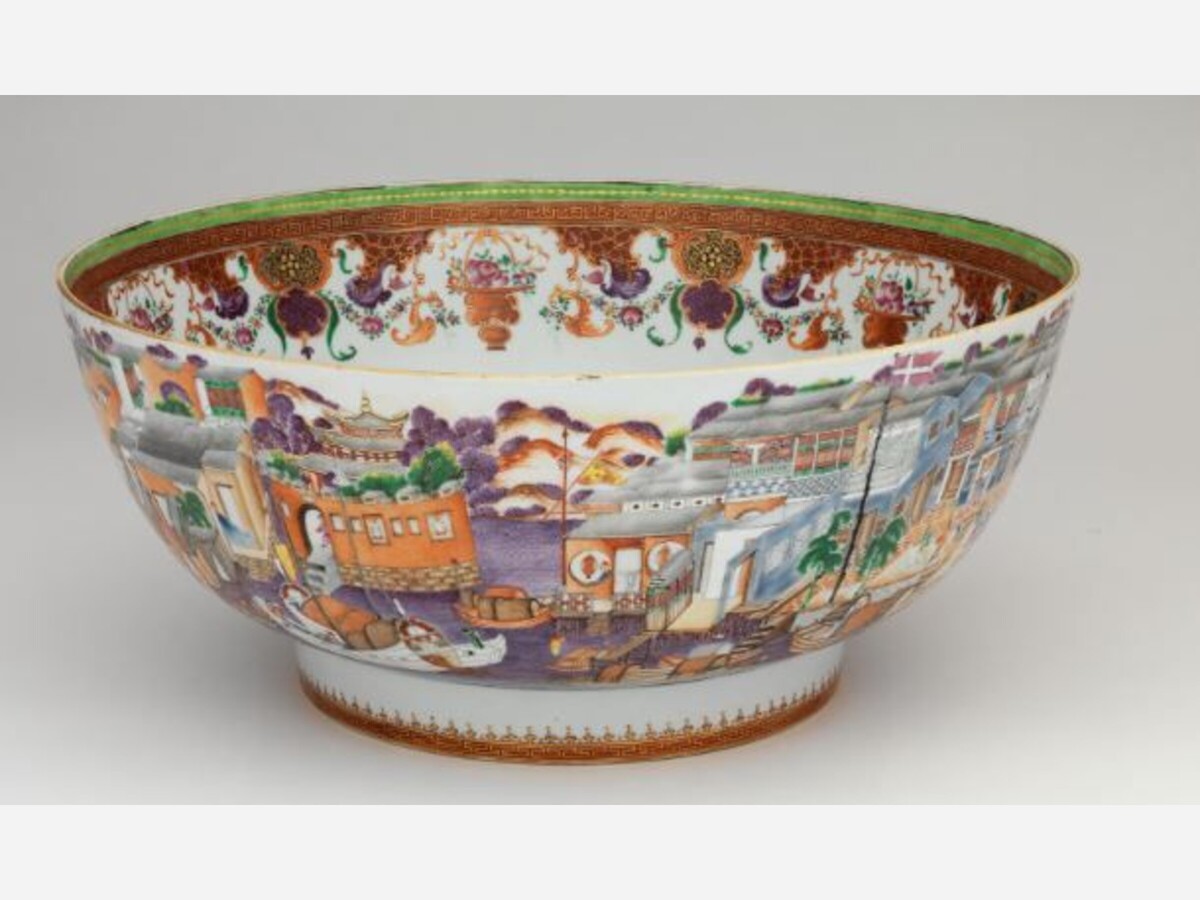
Here is another example; if a person is holding a yard sale, and he is selling a rather gaudy old bowl about 14 inches wide and 9 inches deep for $75.00, I can buy it at that price which he asks legally, regardless of what I might know about the real value of that bowl, as long as I pay his asking price and do not seek or attempt to force a lower price from him. Should the seller volunteer to sell me something cheaper than it is marked, of his own volition and not sought by me, we still have a perfectly legal “arms-length-agreement”, between a willing seller and willing buyer, under the law conforming to precedent set forth in case law as it has grown and evolved up to this present time.
Let us suppose that this gaudy old bowl turns out to be a late 18th century Ch’in Lung Export Chinese Punch Bowl depicting the Port of Canton and has a value of ten thousand dollars or significantly more. Has any law been broken? The answer is “no”, because, I didn’t ask for a discount on the $75.00 asked price advanced by the seller, nor had I been paid for an opinion on the piece while acting in a role of as an appraiser at the time. It is not my duty to inform people as to the value of their property unless I am engaged to do so for a fee.
I think that I can say, with all perfect humility, that I simply know more about “Antiques and Related Things” and possess a wider range of knowledge than anyone I have ever met. This is very true as I know how to place these “appraised objects” in a social, physical, and historical context and I better-know how to access information, about these objects, than anyone I have ever known.” This is not a burst of egocentric eccentricity; it is just an empirical fact of life. When you state a fact like that, it does seem to have a very hard edge except when actor Walter Brennan said it about forty-five years ago in his television series, The Guns of Will Sonnet, as he related the fact of his prowess with his revolvers making him the best shot. He related this “truth” about himself with this phrase, “No brag. Just fact.” There is a reason that I have been hired by boards of directors of several museums to take their curators and docents on tours of their own museums to teach them about their collections.
When buying objects from persons who advertise themselves as antique dealers, one is engaging in business with people who set themselves up as professionals in the field of antiques, and therefore they are supposed to be possessed of professional knowledge of their stock-in-trade. Should they have an early Chinese Export Punch bowl for sale for $75.00, I am fully justified in asking them, “Is that your best price?”
If they counter me with a price of say sixty dollars, I am fully justified in paying this lower price even though I can drive home, pick up the phone, call a client and say, “I just picked up a gorgeous and perfect late 18th century Chinese Export Punch Bowl showing The Port of Canton. I can let you have it for $8,250.00. By the way, $8,250.00 is a very reasonable to cheap price. Under the right circumstances, you might even get several times that amount depending on how much at least two people are willing to pay for it at a really good auction. On a really good day, that punch bowl might hit a record setting price north of fifty thousand dollars or more! It is a crazy world out there. Your best clients always are very well informed about what they collect, and that is why they are willing to spend real money for fine objects.
James C. Johnston Jr. is a former Franklin selectman, Franklin High School history teacher, and author of "The African Son," a novel , as well as "The Yankee Fleet" and "Odyssey in the Wilderness," (a history of Franklin, Massachusetts). Article copyright James C. Johnston, Jr. 2023, used with permission.
Image of porcelain bowl courtesy of US Department of State



Light snow, with a high of 33 and low of 20 degrees. Light snow during the morning, clear during the afternoon and evening, light freezing rain overnight.