Image
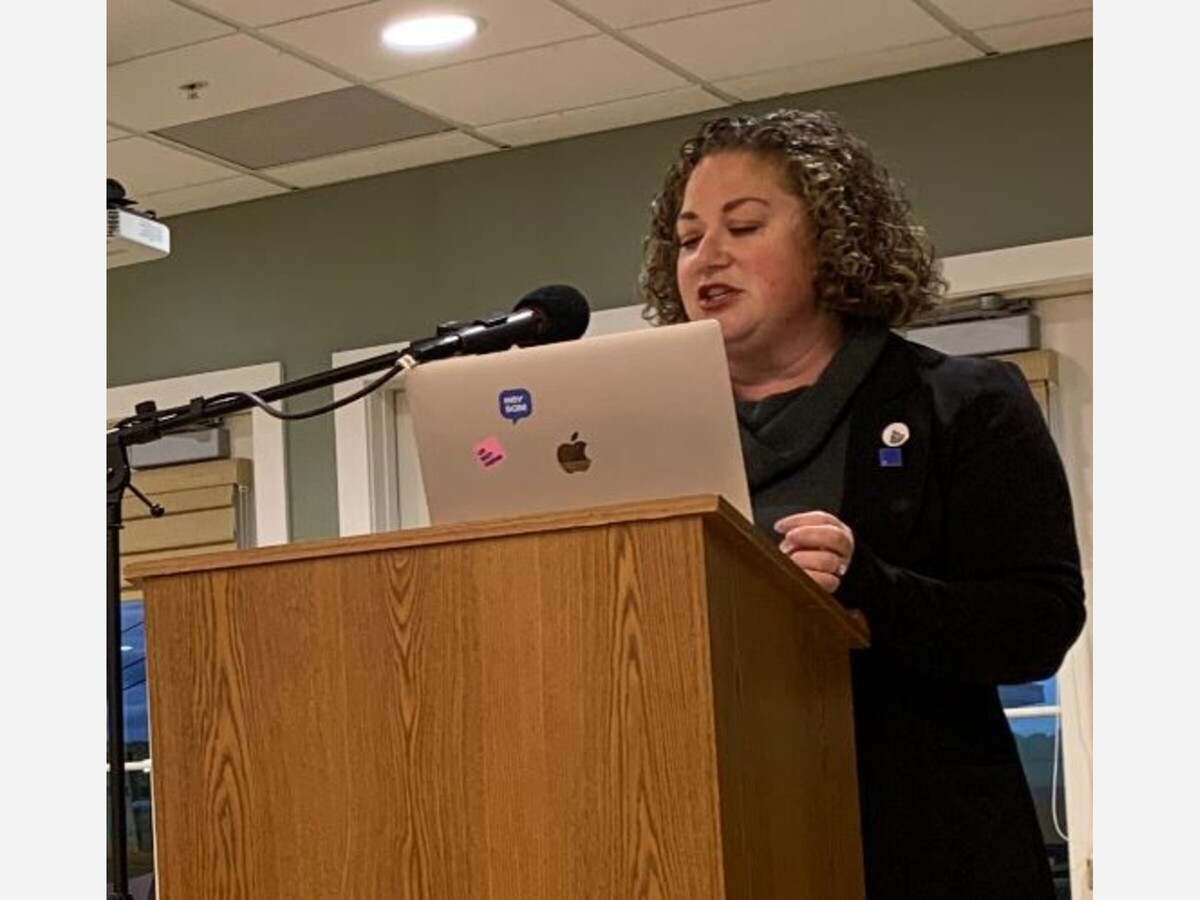



State Senator Becca Rausch’s “town hall” at the Franklin Senior Center Monday evening, started promptly at 6 pm. After a brief introduction by her legislative aide, Rausch greeted the members of the Town Council present, Tom Mercer, Brian Chandler, Debbie Pellegri, and Ted Cormier-Leger and then launched into a 20-minute review of her accomplishments.
“I'm the first woman and the first Jewish person to serve several of the [eleven] towns in our State Senate,” she noted.
Reversing the chronology of their creation, Rausch described state government as the middle child of government. “The feds are the oldest and the local government is our youngest child and state governments in the middle and we pick up basically everything that impacts your daily life, your family's daily life, your community's daily life,” Rausch said.
She said her work as a legislator fits in “three different buckets.” The first bucket is focused on the district, Franklin and the 10 other communities and all of the constituents she represents. The second bucket is the budget bucket, and the third is policy. In the first bucket, Rausch touted her community visits and government partners at the local, state, and federal level. It also included assistance with housing, unemployment and similar issues on average, involving 300 constituent contacts per month from Franklin.
She also spoke proudly of her small business advisory council consisting of a handful of handpicked small businesses, including three from Franklin: La Cantina, Escape into Fiction and 67 Degree Brewing.
One of the general wins she mentioned was money for companies in Massachusetts that want to split off composting from regular single stream trash removal.
She also emphasized her various periodic youth outreach efforts such as Youth Town Hall, consisting exclusively of minor children with no parents or other adults present.
Some of these youngsters will also get exclusive access to the senator and staff. “They will take a tour of the building [State Capital} and really dig deep on the policy issues that are most important to them. And then they make policy pitches at the end of the day,” she said.
Rausch also touched on the recently passed $56 billion budget and then the targeted tax cuts...but she warned that revenues have been slipping recently and state spending is continuing to rise – only implying but not stating what that might mean for taxpayers.
In terms of specific local spending, she mentioned $65,000 for student mental health, $25,000 for the Franklin Downtown Partnership, $50,000 for the Food Pantry $150,000 for the Franklin Center for the Performing Arts, and $50,000 for the SAFE Coalition. Funding also came to Tri-County Regional Vocational Technical School and Norfolk Aggie.
She also talked about her funding of many statewide programs and policy initiatives but said she was not familiar with the House gun control bill, [passed later in the week], because it hadn’t come to the Senate yet.
Later in the meeting, Rausch fielded a number of questions. One was with regard to her support for legalizing a 13-year-old age of consent for children as part of a broader decriminalization of sex among minors. She made light of the question and said that kids are having sex and it shouldn’t be something that risks them getting in legal trouble. “That’s why I call it the Romeo and Juliet bill,” she said – referring to the Shakespeare play in which two youth end up dead after a romantic liaison.
A different audience member followed up, asking if Rausch believed that 13-year-olds have the mental capacity to consent to sex?
“That's not for me to decide,” Rausch shot back.
Another question was with regard to the state’s migrant crisis, often blamed on the state’s Right-to -Shelter law, which does not offer shelter to single adult males. The questioner asked whether this was not a violation of the Equal Protection Clause. Rausch said, “I'm not a constitutional lawyer. There are several of them in this state who are quite good, I encourage you to ask them that question. I couldn't possibly answer.”
At one point, Mercer asked for more information on help for the Town’s migrants, especially regarding transportation. Rausch responded with a long review of conversations she had on the subject but with no particular solution except to get the migrants into the work force so they could compete with others for entry level jobs.
To a question about Capitol Hill versus Beacon Hill, Rausch said, ‘I think there’s a pretty stark difference between us and Capitol Hill right now; we haven't had an insurrection, so that's a big difference.”
Rausch cut questions short 10 minutes before the hour was up because she had to get to an event in Milford, she said, though 10 minutes later she was still sitting in her car outside the Senior Center.


Patchy rain nearby, with a high of 74 and low of 41 degrees. Sunny for the morning, partly cloudy in the afternoon, overcast during the evening, fog overnight.