39° and Clear



Image
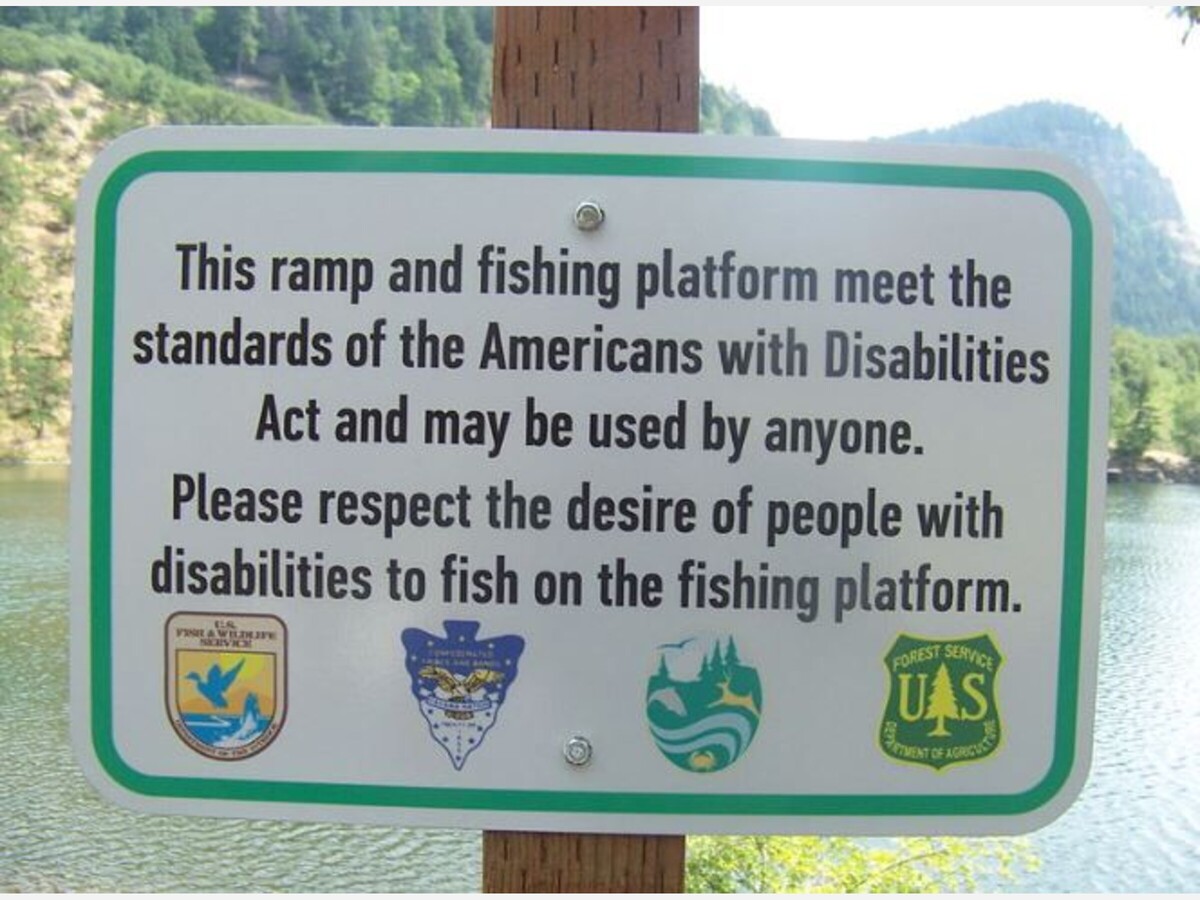
Above. a sign posted at a Washington state fishing area. (Creative commons)
Saturday, July 26th is National Disability Independence Day, commemorating the anniversary of the Americans with Disabilities Act (ADA) and we took that as an inspiration to talk with local disabilities activist, Ali Rheaume.
The ADA, signed into law in 1990 by President George H.W. Bush, is a civil rights law that prohibits discrimination based on disability. It tries to ensure equal opportunities for people with disabilities in various areas, including employment, public accommodations, transportation, and telecommunications.
The Americans with Disabilities Act has helped create a base standard for expectation of accessibility in society. And while there can always be an excuse, such as funding, time, or planning, as a reason to not make something accessible with ADA, the excuses are now more frequently turned into actions.
Long-time Franklin resident Rheaume, said it is important to understand that ADA sets a bare minimum, but does not always deliver optimal accessibility. For example, noted Rheaume, the stone pathways at the Franklin Town Common and the brick crosswalks in downtown Franklin may technically adhere to the standard as a surface that is “stable, firm, and slip resistant” and “unchanged by external forces, objects, or materials”. However, the rough surfaces can make it difficult to navigate with mobility devices and can cause vibration as devices move across it, creating a painful or uncomfortable experience. In fact, she noted, “it’s recommended by ADA to avoid those types of surfaces.”
One challenge within ADA, is that while there are laws, they’re not always followed through on. So, people can “get away” with inaccessibility unless someone files a complaint for a lack of compliance or for discrimination. “Here in Franklin, my goal is to help respectfully initiate accessibility improvement requests before they potentially become a bigger issue or barrier,” Rheaume explained.
Another point to consider is that some believe accessibility only refers to physical disabilities and the use of mobility devices. However, there are also accessibility needs, and requirements per ADA, for those who are deaf, hard of hearing, blind, low vision, or navigate cognitive or mental disabilities too. It’s great when an event or location is physically accessible, and it’s also important to consider communication, signage, sensory input, and more, she noted.
One of the biggest challenges people who navigate disabilities still face today, is that the population is still often forgotten about. “It gets exhausting to constantly have to bring up accessibility,” rather than it being thought about from the start. Either that, or someone says “yes, this location or event is accessible”, then you get there, and it really isn’t accessible at all, Rheaume explained.
What’s the solution? We create more inclusive communities for people with disabilities by inviting, learning, and designing accordingly, she said. A lot of times, Rheaume said she will hear a response such as “Well, no one in a wheelchair ever goes, so why bother with a ramp.” or “I’ve never seen anyone deaf join, so what’s the point of having an ASL interpreter.”. My immediate response to that is -- `why do you think that is so’? There is a loop that occurs: lack of accessibility leads to lack of attendance from persons with disabilities. Lack of attendance leads to an assumption that individuals navigating disability don’t care to participate. The assumption leads to a lack of accessibility plans. The lack of plans leads back to the start of the loop, she said.
Rheaume provided a list of suggestions and ideas for readers to keep in mind...
What are some ways to make public spaces more accessible?
What role can individuals play in promoting disability inclusion?

Sunny, with a high of 62 and low of 34 degrees. Sunny in the morning, overcast during the afternoon and evening, clear overnight.