25° and Clear



Image
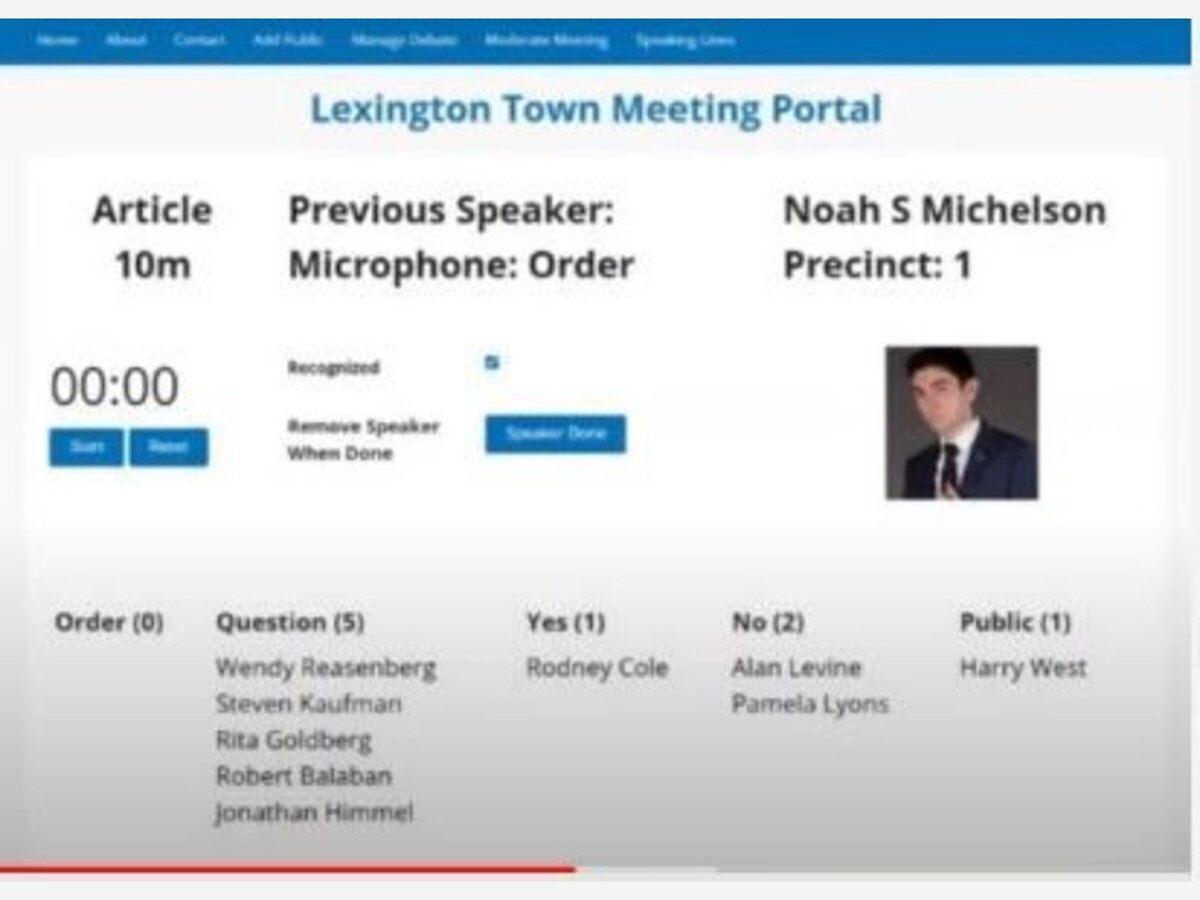
Above, image from Mass. Municipal Assn. site of the pioneering online town meeting convened by Lexington during Covid. Now, advocates want to make the change permanent and statewide.
Lawmakers and voting rights advocates are citing the potential for increased local government participation and accessibility in their push for a bill that would enable municipalities to opt-in to remote open town meeting participation.
The Rep. Carmine Gentile bill (H 2274) would authorize remote participation at open town meetings across the state, allowing town moderators — in consultation with other local entities — to call for any town meeting to be held through remote participation or a hybrid of in-person and remote participation. There would be certain basic requirements for the video or telephone conference platform used for remote participation.
The crusade is in full-swing in Wayland, a town that filed a home rule petition (H 2272) for the second year in a row requesting the Legislature give it the remote participation go-ahead. Concord is also expected to file a similar home rule request soon, according to Gentile.
While the Legislature has enabled representative town meetings to be held in virtual or hybrid format, open town meetings are still required to be held in-person.
Lawmakers, along with representatives from the Massachusetts Municipal Association and Metropolitan Area Planning Council, said Monday that eliminating the barrier of in-person participation for individuals who have disabilities, have children, are caregivers or are traveling out of town could drastically increase participation in local government.
"Particularly in elected town meeting, it has been very difficult to get many people to town meetings, and you're seeing a very select few of a town making very critical decisions for the entire municipality," Sen. Jamie Eldridge said at a League of Women's Voters briefing Monday. "This makes sense and can be done in a way that protects the integrity of voting, and I think it will really dramatically increase participation as more and more critical decisions happen at the local level."
Sen. Michael Barrett dubbed it a response during "a time when the legitimacy of government seems to be challenged at every turn."
"Facilitating direct participation in open town meeting situations is the most authentic way that a community can make governmental decisions for itself," Barrett said Monday.
Enabling remote open town meeting participation involves a litany of concerns, including how a virtual voting system could detect internet outages, ensure votes are secure and deter proxy voting.
Wayland is already preparing for the moment if or when the Legislature signs off on the concept, and has put together an Electronic Voting Implementation Subcommittee to address potential hiccups and create a proposal. A town of about 13,000 people, Wayland has 10,000 registered voters. About 2,100 come in-person to vote in elections, and around 600 routinely show up to the annual town meeting, according to Town Moderator Miranda Jones. The town was the first in Massachusetts to begin on-premises electronic voting during open town meeting in 2011, and tens of communities have followed since.
A presentation by town Subcommittee Chair Dave Bernstein laid out a proposal that would enable remote open meeting participants in Wayland to listen and participate in debate, ask procedural questions, make motions and vote.
Each remote participant would use their own smartphone or tablet and register beforehand with the town clerk to receive a personal "voter code," password and "audit code" with instructions, according to Bernstein. His presentation suggested the town's remote voting system wouldn't require participants to install any software, but instead log into a website that would give them access to real-time transcription or video of town meeting and clear action buttons on-screen.
When checking in to participate remotely, the system would take a still image of a voter. Throughout the meeting, town staff would employ an audio-video connection to reconfirm the name and address of randomly chosen voters while viewing the still image captured at check-in, Bernstein said. The image would be deleted as soon as the meeting ended, but would help town staff easily see if someone is impersonating someone else.
At frequent intervals, the remote participation web page would send an "I'm here" message to the town meeting system, enabling the system to track connected participants and detect potential internet outages. All votes would be encrypted, Bernstein said. After each vote, votes would be displayed on a public web page organized by personal audit codes, so voters could check their vote and report any discrepancies.
"Can we eliminate all inequitability? No. If someone lives someplace where there's just no way to connect to the internet, we can't help them with this solution," Bernstein replied when asked about equity in access across towns. "But I would argue that not doing anything because we can't solve the problem for everyone is the wrong balance."
The Joint Committee on Municipalities and Regional Government on Tuesday will hear testimony about both the statewide bill and the Wayland home rule. The committee's hearing starts at 1 p.m.


Light snow, with a high of 33 and low of 20 degrees. Light snow in the morning, moderate snow in the afternoon, clear in the evening, light freezing rain overnight.