55° and Clear
Image
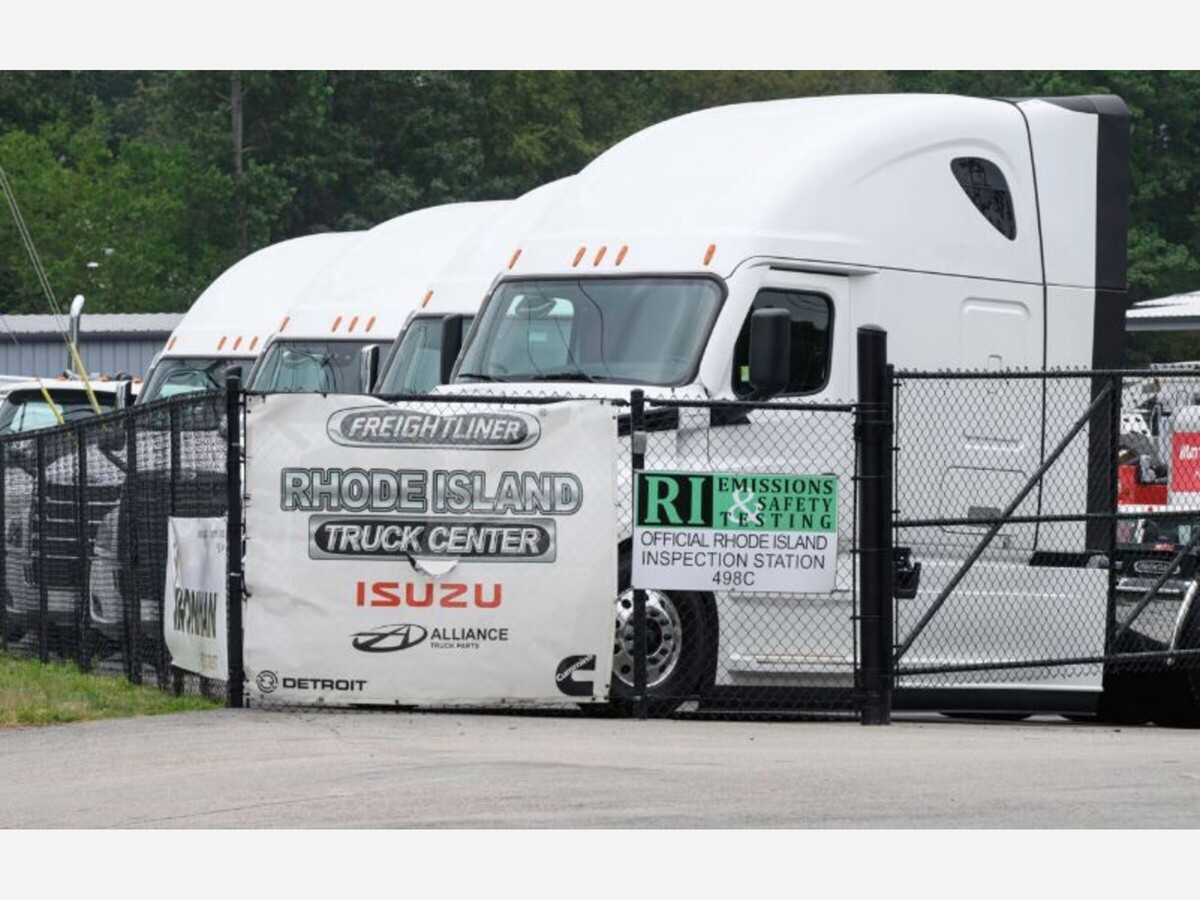



The Rhode Island Truck Center on Amaral Street in the Riverside section of East Providence is in a legal dispute with Daimler Trucks North America, LLC over a competing dealership selling the same Freightliner trucks 18 miles away in Raynham, Massachusetts. (Photo by Michael Salerno/Rhode Island Current)
Two truck dealers in different states are too close for comfort. R.I. Supreme Court weighs in.
by Christopher Shea, Rhode Island Current
August 1, 2025
Can a “relevant market area” in Rhode Island’s general law extend beyond the state’s borders?
A federal appeals panel in Boston posed this very question to the Rhode Island Supreme Court in February 2024 while considering the constitutionality of a law halting competing truck dealerships from operating within 20 miles without giving notice to the state.
The 1st U.S. Circuit Court of Appeals finally heard back with an answer Tuesday: Yes, Rhode Island’s law does reach across the state line.
“We take judicial notice of the fact that the state of Rhode Island is only 37 miles wide,” Rhode Island State Supreme Court Associate Justice Melissa A. Long wrote in the court’s July 29 opinion. “Given the state’s size, a circle with a radius of 20 miles will always encompass an area outside the state.”
The question over the reach of Rhode Island’s dealer law is at the center of a legal dispute that began in 2019 after Daimler Trucks North America authorized Advantage Truck Group to sell Freightliner-brand trucks at its dealership on Route 44 in Raynham, Massachusetts.
Advantage Truck is 18 miles from Rhode Island Truck Center in East Providence, which was authorized by Daimler to sell the same brand in 2016.
In 2022, Rhode Island Truck Center filed a protest petition against Daimler before the Rhode Island Motor Vehicle Dealers License and Hearing Board, a board created under the state’s dealer law to hear disputes between manufacturers and dealers. The five-member panel ultimately dismissed the case during the meeting held June 1, 2022, “due to a lack of jurisdiction.”
“This board lacks the authority to apply the provisions of the Rhode Island dealer law in an extraterritorial manner and therefore cannot prohibit respondent from establishing or moving a dealership outside the boundaries of this state,” wrote then-Chairman James Botvin.
The board had cited a 1994 case in which a Massachusetts-based Nissan dealership protested the establishment of a competitor in Rhode Island, only for the petition to be dropped on the grounds that out-of-state dealers lacked standing to protest under its dealer law.
Rhode Island Truck Center appealed the board’s dismissal in Providence County Superior Court, which Daimler then had moved to the U.S. District Court of Rhode Island where Judge John J. McConnell Jr. ruled in favor of Daimler on Oct. 24, 2022.
McConnell ruled that Rhode Island’s law violated the U.S. Constitution’s Dormant Commerce Clause, which prohibits states from engaging in protectionist practices against other states.
----------------------------------------------------------
We take judicial notice of the fact that the state of Rhode Island is only 37 miles wide. Given the state’s size, a circle with a radius of 20 miles will always encompass an area outside the state.
– Rhode Island State Supreme Court Associate Justice Melissa A. Long
---------------------------------------------------------
Rhode
Island Truck Center appealed to the 1st Circuit Court in Boston,
which submitted a “certified question” to the Rhode Island
Supreme Court to define the state’s dealer law. It’s a process
that doesn’t get used too often, Roger Williams University School
of Law professor Michael Yelnosky said in an interview.
The last time the Rhode Island Supreme Court answered a certified
question was in 2021 over
the definition of “civil action” under the state’s insurance
law.
For a federal court to certify a question, Yelnosky said two
things are required: First, the case must hinge on an essential
question of state law. Second, the state courts should not yet have
answered that question in any prior cases.
When a question is certified, Yelnosky said, it’s done under the
legal doctrine of “constitutional avoidance” — a way for the
federal court to resolve a case without relying on constitutional
grounds.
“A constitutional question does go away if the court had said it
only applies in Rhode Island,” he said.
But Long’s answer now means the federal appeals court must
decide on the constitutionality of Rhode Island’s dealer law.
“As a general matter, state A can’t control the matters of
state B,” Yelnosky said. “That’s a violation of state B’s
sovereignty.”
Andrew Johnson, head of communications for Daimler North America,
based in Portland, Oregon, declined to comment on the case.
“We don’t comment on pending litigation,” he said.
Joe Travers, Rhode Island Truck Center’s director of operations,
called the state Supreme Court’s answer to the certified question
“a big win” for the company, which employs 50 people.
“It’s definitely been an impact on business,” he said of
having a competitor so close to the truck center. “I’m not sure
how equitable it is for us. When you look at all the things impacting
economic conditions right now, does that justify having that kind of
saturation?
But Travers said the dealership has managed to maintain its
regular customers including the Rhode Island Department of
Transportation, along with municipalities like Pawtucket, Warwick,
and Warren. Rhode Island Truck Center also holds accounts for
numerous oil companies in the area, Gold Medal Bakery in Fall River,
Massachusetts, and the National Lumber Company in Mansfield,
Massachusetts.
“We have a pretty diverse customer base,” he said.
Not mentioned in any of the legal filings is how Massachusetts’
own dealer
law defines “relevant market area” — which is set at
an 8-mile radius between competing franchises within Bristol County.
But Yelnosky said the Massachusetts limit is irrelevant to the
federal appeals court’s proceedings since its focus is squarely on
Rhode Island’s law.
Still, he said he found it “cute” to see Rhode Island’s
small size noted in the state Supreme Court’s opinion.
“We don’t think about state lines here as much as people do in
other parts of the country,” Yelnosky said. “You can drive in and
out of two or three states in the matter of a couple hours here.”
GET THE MORNING HEADLINES.
SUBSCRIBE
Rhode Island Current is part of States Newsroom, a nonprofit news network supported by grants and a coalition of donors as a 501c(3) public charity. Rhode Island Current maintains editorial independence. Contact Editor Janine L. Weisman for questions: info@rhodeislandcurrent.com.
Our stories may be republished online or in print under Creative Commons license CC BY-NC-ND 4.0. We ask that you edit only for style or to shorten, provide proper attribution and link to our website. AP and Getty images may not be republished. Please see our republishing guidelines for use of any other photos and graphics.

Partly Cloudy , with a high of 59 and low of 37 degrees. Sunny in the morning, partly cloudy during the afternoon, overcast for the evening, clear overnight.