52° and Cloudy



Image
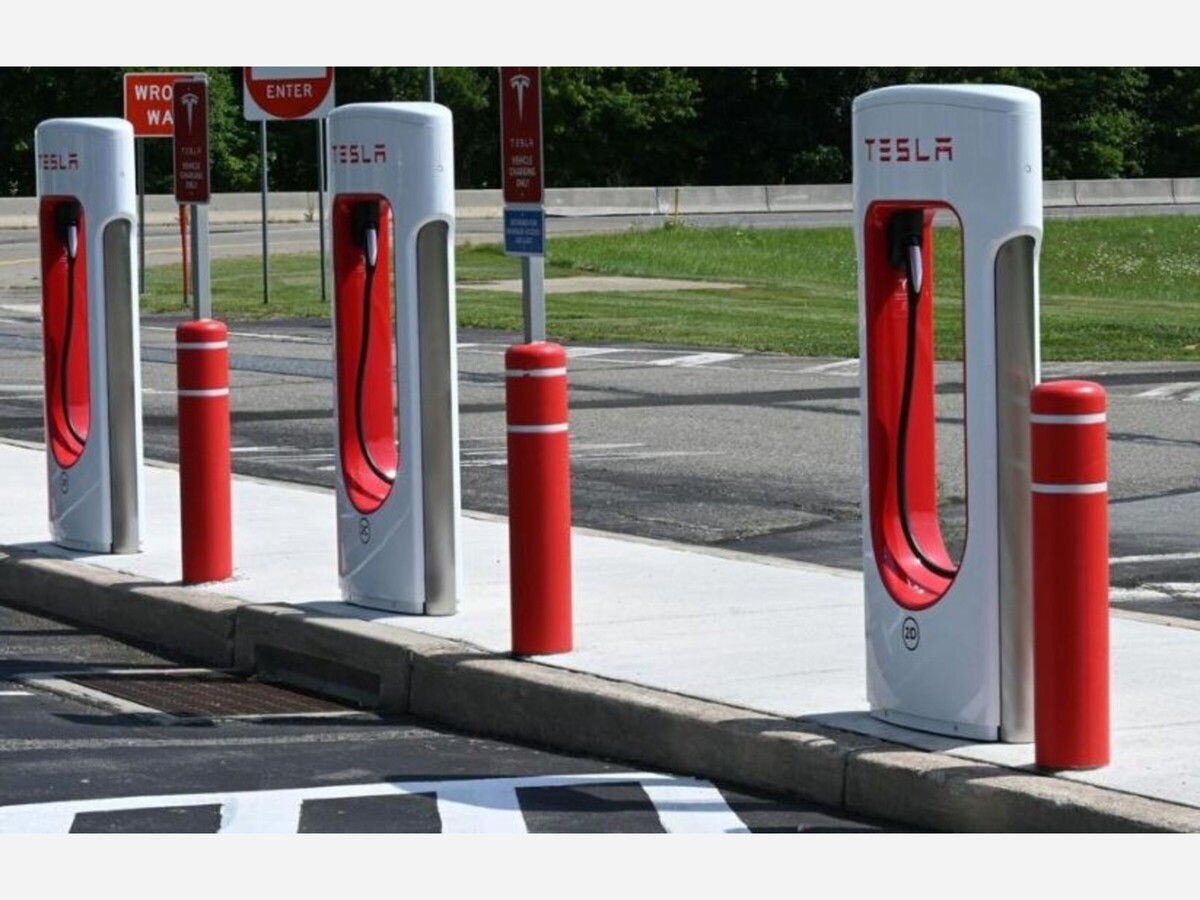
Electric vehicle charging stations at a New York service plaza. Photo by J Dean on Unsplash
SHNS
State officials say electric vehicles are gaining in popularity and this month announced a plan to roll out $46 million over the next two years to strengthen charging networks for key corridors in western and central Massachusetts and to aid the electrification of heavy-polluting trucks and large vehicles.
The Department of Environmental Protection said the money will be made available both through the creation of new grant opportunities and by scaling up existing programs -- $30 million is billed for medium- and heavy-duty charging at "strategically located hubs" and along secondary corridors for light- and medium-duty EVs, and $16 million to buy and install EV charging infrastructure at workplaces, fleet headquarters, multi-unit dwellings, educational campuses, and "public access locations."
The state said the money is meant to help address the needs laid out in the latest biennial assessment from the Electric Vehicle Infrastructure Coordinating Council, which recently made recommendations that included a call to focus on fast charging along secondary transportation corridors particularly in western and central Massachusetts and on ramping up on-street charging and charging at public transit parking lots in residential areas.
"We're making it easier for everyone to get around as more Massachusetts residents choose to drive electric," Energy and Environmental Affairs Secretary Rebecca Tepper said. "Not only are these vehicles fun to drive but they are typically less expensive to maintain than their gas- and diesel- powered counterparts. We are committed to building a cleaner environment and vibrant economy for everyone."
There were more than 35,600 new EVs (including plug-in hybrid electric vehicles) newly registered in Massachusetts in 2024, the state reported this spring, bringing the total number of EVs registered here to just more than 139,000. But the state has said it needs 200,000 EVs on the road by this year and 900,000 light-duty EVs on the road by 2030 to stay under the limit it has set on transportation sector emissions.
"Despite the growing popularity of EVs, consumers remain anxious about charging access and reliability. Addressing these concerns is critical to continued satisfaction of EV users and growth of the EV user community," the EVICC report says.
The EVICC assessment said approximately 46,300 and 105,000 publicly accessible charger ports would be needed in 2030 and 2035, respectively, to support the number of EVs the state will need to achieve its transportation sector emissions sublimit. As of this May, there were 9,413 publicly accessible charging ports operating in Massachusetts, with about 1,200 of them "fast charging" ports.
Public EV Charging Stations
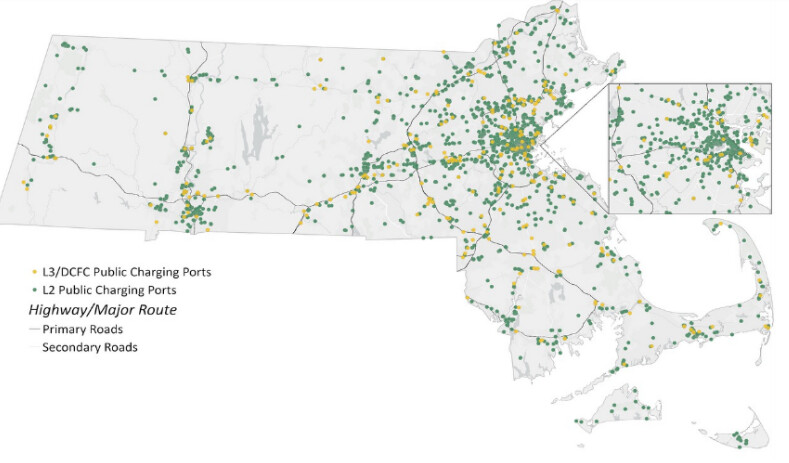
A map displays the locations of publicly available electric vehicle charging stations throughout Massachusetts. So-called fast charging ports are represented by yellow dots.
[Source: Electric Vehicle Infrastructure Coordinating Council assessment]
The assessment said the year from 2023 to 2024 saw a 169% increase in new public fast charging port deployments (382 compared to 142). The report said that the number of public charging ports at the end of 2025 "will closely mirror the 2025 [Clean Energy and Climate Plan] EV charger benchmarks (i.e., 1,300 publicly accessible fast chargers and 9,500 publicly accessible Level 2 chargers)" if that deployment rate continues. But in order to hit the 2030 and 2035 charger goals, the EVICC report said, "Massachusetts would need to triple the current rate of EV charger deployment through 2030."
There are also at least 14,229 charging ports in single- and multi-unit dwellings and for use at workplaces and by fleets, the report said. But that counts only charging ports that got help from state-funded programs and the EVICC report said "it is likely that many residential, workplace, and fleet charging ports have been deployed that are not captured in these totals."
While the state tries to maintain momentum towards EVs, the federal government under President Donald Trump is moving to deprioritize the shift to electric transportation. The chairman of the EVICC said things like the Sept. 30 expiration of a federal EV rebate, the rescission of California’s waiver to set vehicle emission standards, and the U.S. Environmental Protection Agency's proposal to repeal all greenhouse gas emission standards for light-duty, medium-duty, and heavy-duty vehicles and engines "present unique challenges to future EV charger deployment."
"Despite these challenges, many EV charging companies remain optimistic about the future of EV charging (see, e.g., EVgo 2025 Second Quarter Announcement)," Joshua Ryor, the assistant secretary of energy who chairs the council, wrote in his introduction of the latest assessment. "Nevertheless, the strategic direction, resources, and state, local, and stakeholder convening provided by EVICC will be even more important in the coming years to help maintain progress on EV charger deployment."
Healey administration officials also said the EV charging grant funding through DEP will assist state government in meeting its own goals for fleet electrification. An executive order signed by Gov. Charlie Baker in 2021 requires that any new vehicles purchased or leased by state agencies be zero-emission vehicles and sets incremental electrification targets starting with 2025 (5% of the state fleet) and ramping up to 100% zero-emission vehicles by 2050 (20% by 2030 and 75% by 2040).
Mark Fine, assistant secretary in the Executive Office for Administration and Finance, said the Operational Services Division that oversees the executive branch fleet is "working diligently" toward those goals. The entire state fleet includes more than 6,800 light-duty vehicles, more than 1,800 medium- and heavy-duty vehicles, and more than 780 assets like utility vehicles.
"Beyond helping residents, the expansion of charging infrastructure to more locations also will help Executive Departments lead by example in reaching their electrification objectives," he said.
Earlier this summer, Mass. Lottery Executive Director Mark William Bracken lamented the slow expansion of EV charging infrastructure for state-owned cars as he sought Lottery Commission approval of $430,000 in funding to cover fuel and EV charging costs for Lottery vehicles. He said the hybrids the Lottery has purchased recently are all running as traditional gas-powered cars.
"The state, in and of itself, has been slow to set up the infrastructure to be able to accomplish the goal of charging EV vehicles in a convenient manner. While we were forced to -- I don't want to say forced, that's strong, but -- required to start purchasing EV vehicles, or hybrid vehicles rather, starting two years ago, they've strictly been running off of gas," he said at the commission's June meeting.
Bracken said he understands that "it's a slow crawl" to bolster EV charging for state vehicles and pointed out that the Lottery has its own challenges on that front.
"Our biggest struggle here with the Lottery is that the majority of our cars are take-home cars, and they're not domiciled. And it's very difficult to be able to charge a take-home car domiciled to someone's residence because of the charging capabilities," he said.

Overcast, with a high of 62 and low of 46 degrees. Overcast for the morning, sunny in the afternoon, clear for the evening, overcast overnight.