30° and Light freezing rain



Image
If you have any questions about this week's report, e-mail us at bob@beaconhillrollcall.com or call us at (617) 720-1562.
Beacon Hill Roll Call
Volume 50 -Report No. 37
September 8-12, 2025
Copyright © 2025 Beacon Hill Roll Call. All Rights Reserved.
By Bob Katzen
GET A FREE SUBSCRIPTION TO MASSTERLIST – Join more than 30,000 people, from movers and shakers to political junkies and interested citizens, who start their weekday and Saturday mornings with MASSterList—the popular newsletter that chronicles news and informed analysis about what’s going on up on Beacon Hill, in Massachusetts politics, policy, media and influence. The stories are drawn from major news organizations as well as specialized publications.
MASSterList will be e-mailed to you FREE every Monday through Saturday morning and will give you a leg up on what’s happening in the blood sport of Bay State politics. For more information and to get your free subscription, go to: www.massterlist.com
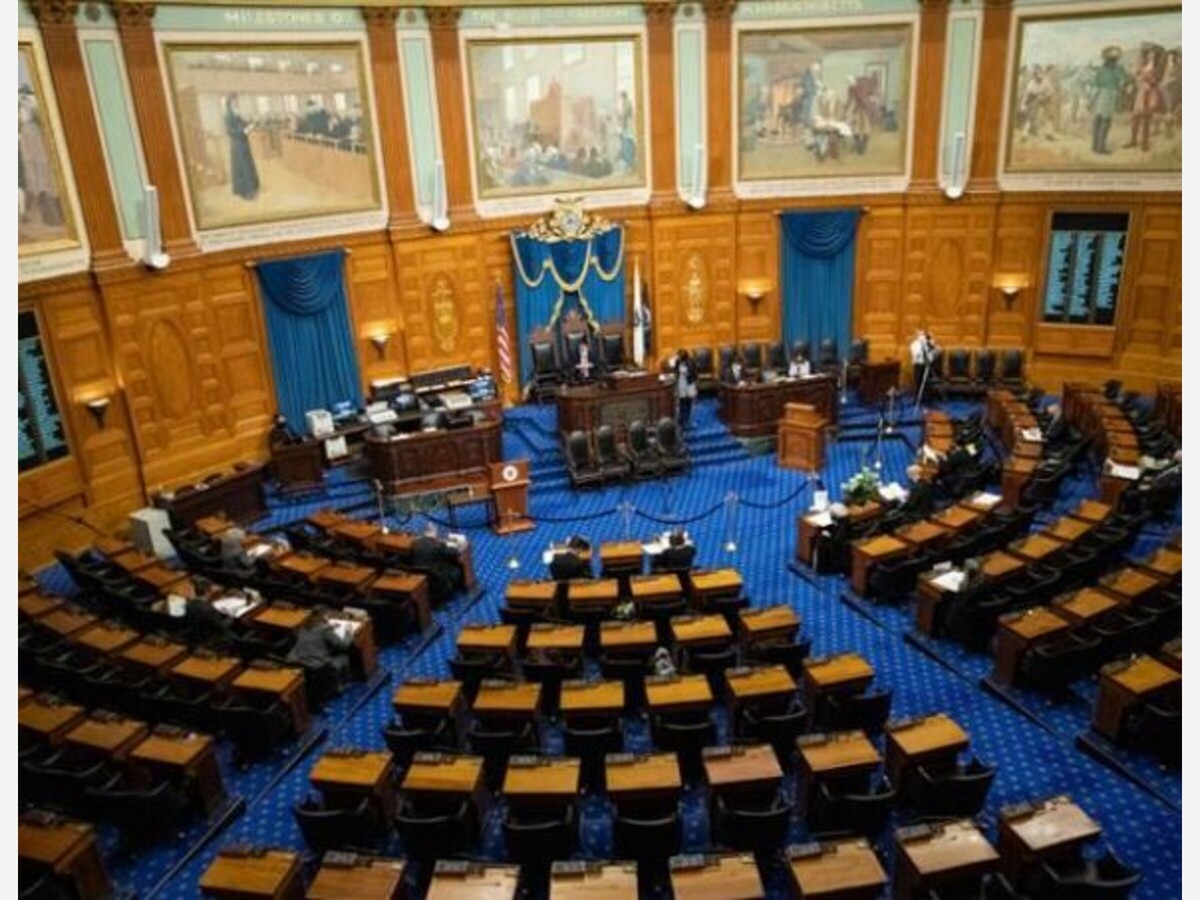
THE HOUSE AND SENATE: Beacon Hill Roll Call records local representatives' votes on roll calls from prior sessions on the $60.9 billion fiscal 2026 state budget. There were no roll calls in the House or Senate last week.
$10 MILLION FOR CITIES AND TOWNS (H 4000)
House 26-130, rejected an amendment that would repeal the state’s 2023 No-Cost Calls Law, which provides $10 million to fund unlimited phone calls for inmates at county and state correctional facilities, and would redirect the $10 million to support unrestricted local aid for cities and towns. The amendment would also establish a commission to study and develop recommendations for a fiscally constrained and sustainable alternative to the No-Cost Calls Law.
“The state’s sheriffs have collectively raised concerns about the No-Cost Calls Program’s rising costs, which Norfolk County Sheriff Patrick McDermott recently testified has already cost taxpayers $12.5 million this fiscal year,” said sponsor Rep. Brad Jones (R-North Reading). “By redirecting the money allocated to this program to unrestricted general government aid, we can assist our cities and towns that are struggling to pay for essential municipal programs and services. I also believe it’s critical to have a commission study the No-Cost Calls Program to ensure that taxpayer dollars are used more efficiently and effectively.”
Rep. Michael Day (D-Stoneham) said that the No-Cost Calls Law works because when prisoners are able to communicate with their families, to talk outside of the walls, it results in better success rates and less recidivism. He argued that this $10 million is well-spent and means we have to spend less money on our criminal justice system.
(A “Yes” vote is for redirecting the $10 million to fund unlimited phone calls to instead fund $10 million in unrestricted local aid for cities and towns. A “No” vote is for keeping the $10 million funding for the No-Cost Calls Law.)
Rep. Jeffrey Roy No
ALLOW DEBATE AND VOTE ON 2034 GAS CAR BAN (H 4000)
House 132-25, supported the ruling of the chair that prohibited admission to the House for debate and a vote, an amendment that would prevent the state from banning all gas-powered cars by 2035.
The chair ruled that the amendment should not be allowed for consideration because the House has already rejected an amendment to postpone the ban and this amendment to prevent the ban outright exceeds the amendment to postpone. They noted under House rules consideration of the amendment to ban is not allowed to be considered.
“The chair had ruled that the underlying amendment should not be taken up because the House had already rejected an amendment that would have delayed the enforcement of the [ban],” said Rep. Brad Jones (R-North Reading). “I voted against the chair’s ruling so that the underlying amendment could at least be taken up for consideration by the House.”
Rep. Mark Cusack (D-Braintree) said the ruling of the chair is correct and that a delay in the ban and prevention of the ban are similar and under House rules only one can be considered.
(A “Yes” vote is for the ruling of the chair that prohibits the admission to the House for debate and a vote, an amendment that would prevent the state from banning all gas-powered cars by 2035. A “No” vote is against the ruling of the chair and favors allowing the House to consider the amendment.)
Rep. Jeffrey Roy Yes
MBTA COMMUNITIES ACT (H 4000)
House 30-126, rejected an amendment to the current law, known as the MBTA Communities Act, which according to the state’s website, requires that an MBTA community “must have at least one zoning district of reasonable size in which multi-family housing is permitted as of right and meets other criteria including minimum gross density of 15 units per acre; and a location not more than 1/2 mile from a commuter rail station, subway station, ferry terminal or bus station. No age restrictions can be applied and the district must be suitable for families with children.”
Cities or towns that do not comply with the MBTA law are in danger of losing various state grants. The amendment would put the law on hold and not enforce it again until December 31, 2026.
Amendment sponsor Rep. Ken Sweezey (R-Hanson) said the law should be put on hold in order to allow public hearings on several bills filed to deal with this emergency. “[The] amendment addresses the emergency created by unfair enforcement of the MBTA Communities Act by this administration,” said Sweezey. “There are over 20 bills filed pertaining to revisions to the law. I support the public hearing process and look forward to the work we continue to do to help our towns but wish more consideration would have been given to granting temporary relief through this amendment.”
Rep Danielle Gregoire (R-Hanson) said the Supreme Judicial Court ruled that the MBTA Communities Act is the law of the land and is constitutional. She said that 95 percent of communities subject to this law are in compliance or interim compliance. She noted that this law is reasonable and mandates zoning changes but it does not mandate that anyone build anything.
(A “Yes” vote is for the delay until December 31, 2025. A “No” vote is against the delay.)
Rep. Jeffrey Roy No
ALSO UP ON BEACON HILL
STUDENT ID CARDS AND SUICIDE LINE (H 2221) – The House gave initial approval to legislation that would require that newly printed student ID cards for public school students in grades 6-12 and students in public colleges, include the 988 Suicide and Crisis Lifeline phone numbers and text message numbers. The line directs all callers to trained call takers who are available to provide free, confidential emotional support for those in crisis.
The measure allows schools that have a supply of unissued student identification cards that do not comply with this new requirement, to issue the old student identification cards to students until the remaining supply is depleted.
In 2024, the House and Senate approved different versions of this bill, but the legislative session ended before the two sides could agree on a version.
“Making suicide prevention resources more available and accessible will help ensure that every student is aware of the free, confidential resources that are available to them at any time,” said sponsor Rep. Jack Lewis (D-Framingham). “Since the 988 hotline was implemented in 2021, there has been massive increases in calls and texts — clearly showcasing the benefits and lifesaving support the hotline provides. Supporting this initiative is an essential part of providing young people with equitable access to critical resources, promoting help-seeking behaviors and de-stigmatizing mental health.”
REMOVE FOOD DYES FROM SCHOOL FOOD (S 1531) – The Public Health Committee held a hearing on legislation that would prohibit public schools from selling food which contains any food dyes. A school would be permitted to sell any products that might contain any food dye only if the sale of the items takes place away from a school’s premises, occurs on a school’s premises at least one-half hour after the end of the school day or is at booster sales, concession stands or other school-related events.
“Removing food dyes from the public school setting is a step toward ensuring the whole child is considered when it comes to education,” said sponsor Sen. Ryan Fattman (R-Spencer). “Science continues to show the harmful impact of food dyes on children, especially when it comes to their ability to focus which is crucial to learning. The impact of this change would be minor to school districts but major for students who are impacted by these harmful chemicals."
ALLOW DOCTORS TO DISPENSE HEARING AIDS (H 367) – The Committee on Consumer Protection and Professional Licensure held a hearing on a bill that would allow Ear, Nose and Throat (ENT) doctors to dispense hearing aids by audiologists in the ENT doctor’s office. Massachusetts is one of only two states that does not allow this. Current Massachusetts law requires anyone needing hearing aids to make a separate appointment with an audiologist outside of an ENT office to obtain hearing aids.
Sponsor Rep. Carole Fiola (D-Fall River) said the proposal would eliminate the need to make multiple appointments and would make treatment seamless and convenient to patients. “There are [currently] numerous obstacles for those who need to go to separate offices to obtain hearing aids, especially those who are caretakers, elderly or with low income, because of transportation and scheduling,” said Fiola.
BAN HOSTILE ARCHITECTURE THAT TARGETS THE HOMELESS (H 3307) – A proposal heard by the State Administration and Regulatory Oversight Committee would prohibit the state, the MBTA and cities and towns from constructing “hostile architecture” that supporters of the ban say targets the homeless and tries to push them out of certain areas. The bill defines hostile architecture as “any building or structure that is designed or intended to prevent unhoused individuals from sitting or lying on the building or structure at street level.”
“Designing public spaces that are hostile to people experiencing homelessness does nothing to address the problem of homelessness,” said sponsor Rep. Mike Connolly (D-Cambridge). “In fact, designing public spaces with hostile architecture merely sends the issue further away from public view making it more dangerous for those who need both short-term help and longer-term policy.”
Supporters say that family homelessness in Greater Boston has doubled over the last decade, shelters are overcrowded and waiting lists for affordable housing are in the tens of thousands. They note that policies that sterilize the homelessness crisis in public spaces are not only inhumane, but they also only serve to mask the problem.
According to Robert Rosenberger, an associate professor of philosophy at Georgia Institute of Technology, who has studied and written extensively on the subject, hostile architecture includes armrests that divide benches so that the bench is not long enough to sleep on, sprinklers that are turned on at night and certain trash cans. “Garbage cans … serve several functions for people living unhoused,” said Rosenberger. “Some people use garbage cans as a source of recyclable materials [which] can often be exchanged for a small sum of money. Garbage cans are also sometimes approached as a source of discarded food.” He notes that many newer garbage cans are built so that people cannot reach inside them to obtain recycled bottles or cans or leftover food.
SIMPLE LANGUAGE ON THE STATE’S WEBSITE (H 3378) – Another bill before the State Administration and Regulatory Oversight Committee would require the state’s chief digital officer to improve the web sites and services for state executive offices and agencies by requiring the use of plain and simple language consistent with the average reading comprehension level of Massachusetts, as determined by the commissioner of elementary and secondary education.
"This bill was inspired by a conversation I had with a constituent who retired from working in a state agency,” said sponsor Rep. David LeBoeuf (D-Worcester). “In his work, he noticed many of the forms, web portals and other resources used technical legal terms. This can inadvertently lead to residents filling them out inaccurately or not fully comprehending particular requirements. This bill would encourage greater partnerships between our technical services teams and state agencies to enhance user experience of online forms and find ways to make these improved forms available in alternative ways to individuals without internet access.”
“This bill seeks to clarify language used by government offices for the common person here in Massachusetts that may not understand the phraseology used by the university crowd that our current website design caters to,” said Rep. John Gaskey (R-Carver) who signed on as one of the co-sponsors of the bill. “As more and more functions continue to become web centric, we are leaving people that do not 'live' online behind and by simplifying design and language, and offering an analog alternative ensures that all people can find and do what they need to on government sites. Remember, we are by the people and for the people.”
QUOTABLE QUOTES
“All students should be taught about 9/11 and its aftermath, which is a tragic and important piece of both our state and our nation's history. I've directed the Department of Elementary and Secondary Education and the Board of Elementary and Secondary Education to work together to ensure that it is fully incorporated into school curriculum frameworks.”
---Gov. Maura Healey.
“This is the kind of common-sense policy approach we need to boost housing production and ease the affordability crisis in the commonwealth. Instead of complex mandates, new costs and taxes, or burdensome regulation of private development, the Healey-Driscoll Administration offers a streamlined, predictable approval process for the types of housing developments we can and should encourage.”
---James Rooney, President and CEO of the Greater Boston Chamber of Commerce supporting the New Streamlined Approval Process for Housing Development in Massachusetts.
“Our investments in community transportation are about connecting people to jobs, schools and services today and into the future. The projects supported through the Transportation Management Associations Program are vital to building a more reliable, resilient and accessible transportation network. I look forward to seeing this program continue to grow and serve our communities for years to come.”
--- Transportation Secretary Monica Tibbits-Nutt announcing the awarding of $3 million in funding to support projects which encourage transportation alternatives and expand workforce transportation options in communities across the state.
“We are thrilled that Hasbro has chosen Massachusetts as the home of its new headquarters, and we're ready to support the hundreds of jobs they will create here. We're proud to welcome this iconic company to Team Massachusetts — where we are number one for education, health care and innovation, and ranked the best state to live in, to raise a family, to be a woman and to be a working parent.
---Gov. Maura Healey on toy company Hasbro’s announcement that the company has signed a lease to relocate its Rhode Island operations to Massachusetts.
HOW LONG WAS LAST WEEK’S SESSION?
Beacon Hill Roll Call tracks the length of time that the House and Senate were in session each week. Many legislators say that legislative sessions are only one aspect of the Legislature’s job and that a lot of important work is done outside of the House and Senate chambers. They note that their jobs also involve committee work, research, constituent work and other matters that are important to their districts. Critics say that the Legislature does not meet regularly or long enough to debate and vote in public view on the thousands of pieces of legislation that have been filed. They note that the infrequency and brief length of sessions are misguided and lead to irresponsible late-night sessions and a mad rush to act on dozens of bills in the days immediately preceding the end of an annual session.
During the week of Sept. 8-12, the House met for a total of two hours and 17 minutes and the Senate met for a total of two hours and 52 minutes.
Mon. Sept. 8 House 11:05 a.m. to 11:27 a.m.
Senate 11:10 a.m. to 11:31 a.m.
Tues. Sept. 9 No House session
No Senate session
Wed. Sept.10 No House session
No Senate session
Thurs. Sept.11 House 11:34 a.m. to 1:29 p.m.
Senate 11:09 a.m. to 1:40 p.m.
Fri. Sept. 12 No House session
No Senate session.
Bob Katzen welcomes feedback at bob@beaconhillrollcall.com
Bob founded Beacon Hill Roll Call in 1975 and was inducted into the New England Newspaper and Press Association (NENPA) Hall of Fame in 2019.

Light snow, with a high of 33 and low of 20 degrees. Light snow during the morning, clear during the afternoon and evening, light freezing rain overnight.