

Image
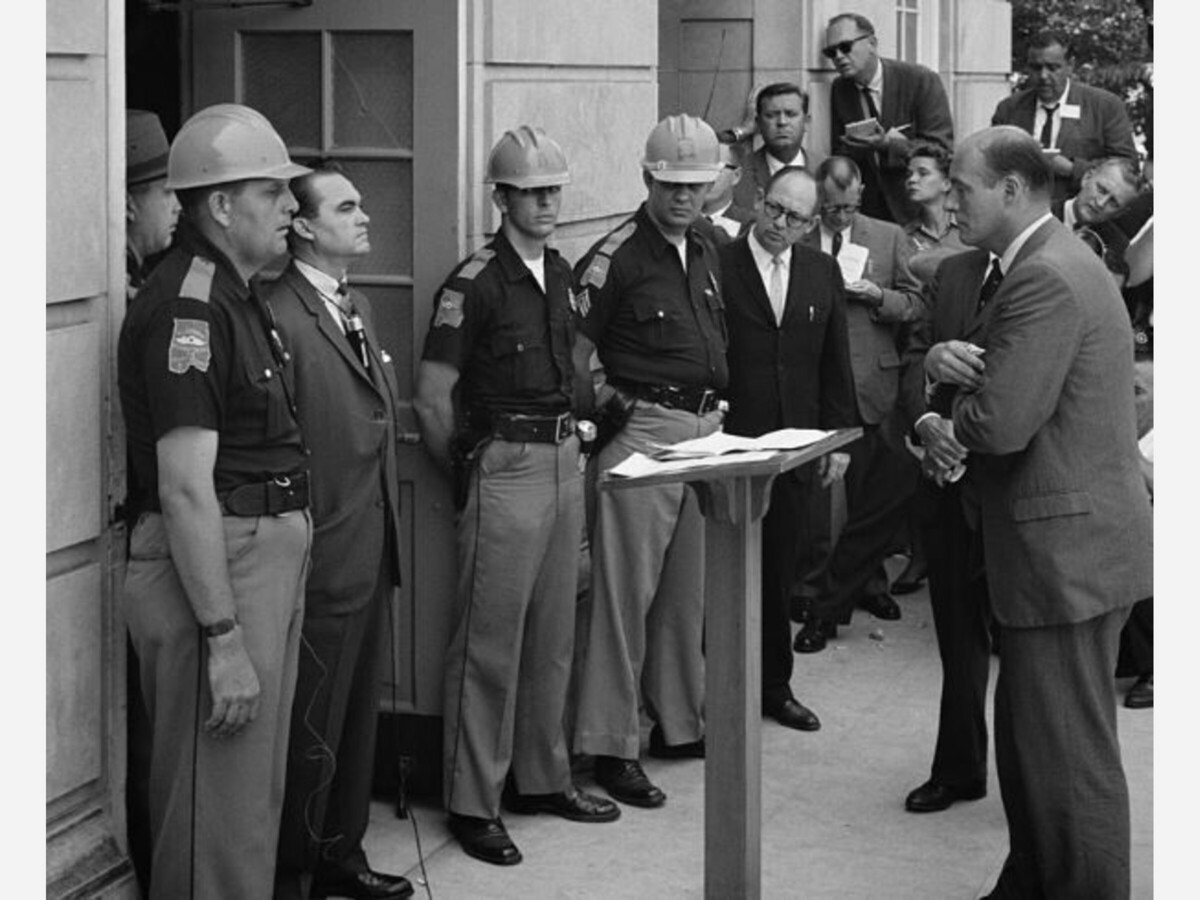
Above, attempting to block federally mandated integration at the University of Alabama, Governor George Wallace stands defiantly at the door while being confronted by Deputy U.S. Attorney General Nicholas Katzenbach-- one of the nation's many conflicts over the supremacy of the Federal Government.
To the Editor:
This being the 250th anniversary of our country’s founding in 1776, it is fitting to review current events with the perspective of our nation’s history.
Some feel that we live in a time of unprecedented challenge to the Republic and that our Federal government is overstepping. Some talk of resisting the Federal government, which others view as insurrectionist.
In 1791 trouble brewed in Pennsylvania – the so-called Whiskey Rebellion – due to high taxes imposed by the Federal government on distilled spirits which impacted the livelihood of farmers who made a profit by turning their excess grain into whiskey. Protests started peacefully but escalated. Tax collectors were intimidated and attacked and in 1794 the home of the regional tax collector was burned to the ground.
President George Washington viewed the uprising as a direct challenge to Federal law and as a threat to the young republic’s stability. He tried peaceful measures to resolve the situation – ordering the rebels to disperse, sending in negotiators, and relying on court action.
However, as violence persisted and a federal judge certified that laws could not be enforced, Washington invoked the Militia Act of 1792 and then personally led a force of 13,000 troops to Pennsylvania to quell the rebellion. That got everyone’s attention and the rebels dispersed. The show of Federal power peacefully ended the rebellion. Importantly, it showed that the new Constitution worked -- the Federal government could enforce laws and suppress internal threats.
Forty four years later in 1838, young Abraham Lincoln gave one of his earliest public speeches warning extensively about the dangers of mob violence, lawlessness, and disregard for the rule of law which he saw as the preeminent danger to the Republic, a much greater threat than any foreign enemy might be. Lincoln said “By the operation of this mobocratic spirit, which all must admit is now abroad in the land, the strongest bulwark of any government, and particularly of those constituted like ours may effectually be broken down and destroyed”
The speech’s core message was a strong condemnation of mob violence as a threat to Republican institutions and calling for renewed reverence for the laws and the Constitution to prevent internal destruction.
Of course, it was not so many years later that what Lincoln feared came to pass in the Civil War that would have ended our country and perpetuated slavery if not for Lincoln’s iron will and ruthless prosecution of the war against the southern states by the Federal government.
Throughout our history there have been states which attempted to nullify Federal law. A prominent direct attempt at nullification occurred in South Carolina over Federal tariffs in 1832-1833 which Southern states saw as favoring Northern industry. The state passed an Ordinance of Nullification declaring the tariffs unconstitutional, null and void in South Carolina. In response, President Andrew Jackson issued the Nullification Proclamation denouncing nullification as incompatible with the Union and authorizing military force via the Force Bill. Ultimately, the crisis was resolved peacefully through politcal compromise.
After the Civil War, nullification was largely discredited but Southern states invoked it again during the Civil Rights era. After the Supreme Court decision Brown v. Board of Education (1954), which declared school segregation unconstitutional, states like Arkansas passed laws attempting to nullify them. The Supreme Court rejected this in Cooper v. Aaron (1958) ruling that states cannot nullify Federal law or Supreme Court decisions.
While outright nullification remains constitutionally invalid, states still sometimes use similar rhetoric or tactics of uncooperation to resist Federal policies, such as we are seeing now in Minnesota and other so-called sanctuary states and cities who seek to exempt themselves from Federal immigration law.
Seeing the violent scenes from Minnesota we are now witness again to a history which has played out before, and we hope and pray that compromise and cooperation can again win the day as it has before. Disturbing as it is, in a certain sense there is nothing new about it in our country’s history. That does not however make it any less worrisome for us than it was in prior times.
Like us today way back In 1838, Abraham Lincoln read the news from throughout the land and lamented what he saw as a mobocratic spirit, “...something of an ill-omen, amongst us. I mean the increasing disregard for law which prevades the country; the growing disposition to substitute the wild and furious passions, in lieu of the sober judgment of courts…”
Lincoln’s solution, as it was for George Washington and Jackson and the Supreme Court, was to demand and enforce the supremecy of Federal law.
For those who wish to preserve our democratic republic, that is the framework upon which its existence depends.
In 1893 Katherine Lee Bates wrote the song, America the Beautiful, a key phrase of which is “Thy Liberty in Law” signifying that no American can be a law unto themself. Our individual freedom and liberties are not absolute but can only rightly exist alongside order, justice, and self-control
David Brennan
Franklin resident


Sunny, with a high of 71 and low of 33 degrees. Sunny for the morning, clear in the afternoon and evening,