


Image

Michael P. Norton | SHNS
With billions of dollars on the line, one of the most significant affordability and tax policy decisions of the year in Massachusetts appears headed for a showdown before the state's highest court.
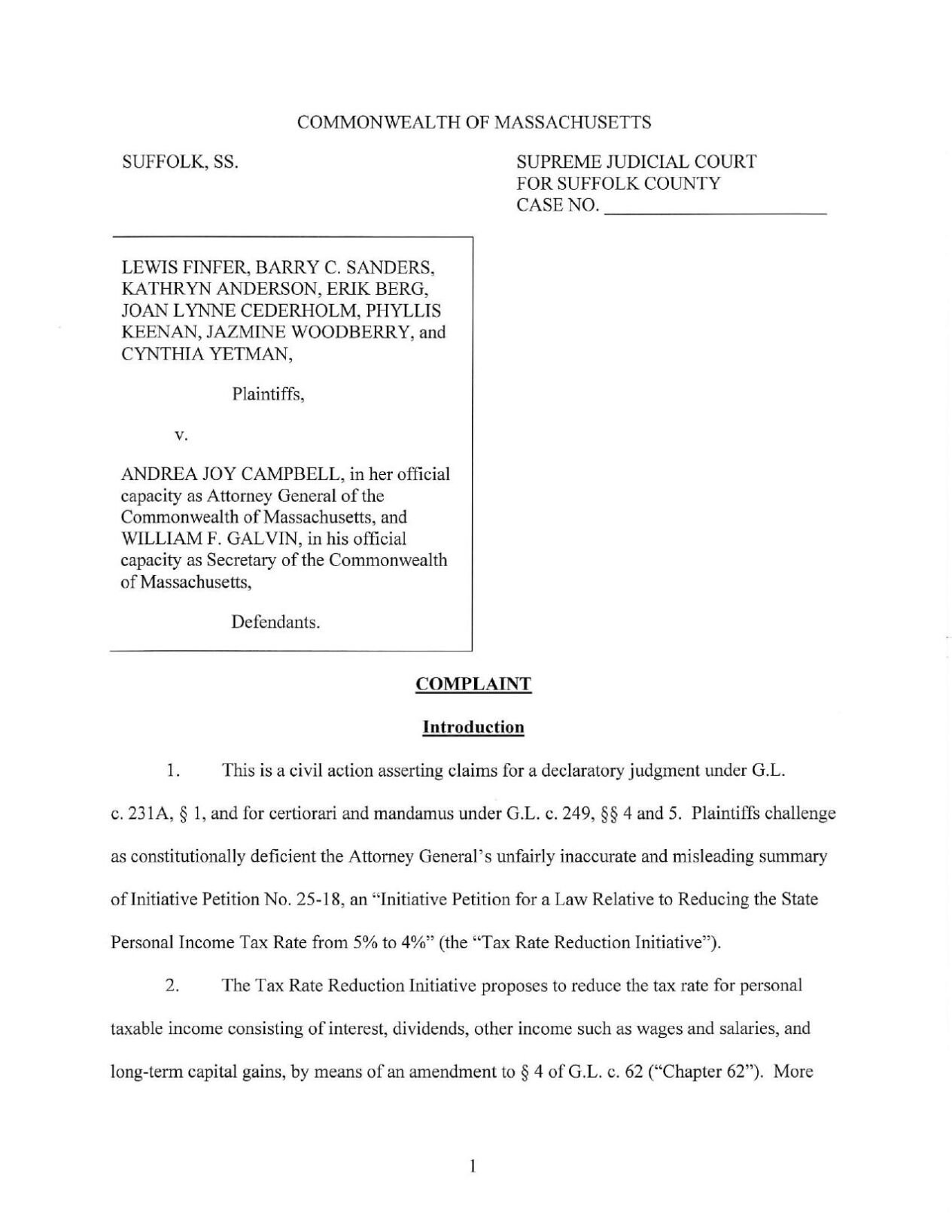
Opponents of an initiative petition that lowers the income tax rate from 5% to 4% over three years filed a lawsuit Thursday with the Supreme Judicial Court that claims Attorney General Andrea Campbell's summary of the proposal was so flawed and unfair that the measure should be disqualified from further consideration.
The state constitution requires the attorney general to prepare a "fair, concise summary" of the measure proposed. The tax cut question summary appeared near the top of the petition papers that question supporters used during the fall to gather thousands of voter signatures needed to secure ballot access.
The summary prepared by the office of Campbell, a Democrat who is seeking reelection, states in part that the proposal would “lower the tax rates on (1) personal taxable income consisting of interest and dividends, and (2) personal taxable income other than interest, dividends or capital gain income, such as wages and salaries.”
The plaintiffs assert that that portion of the summary is "fundamentally unfair," inaccurate and misleading because it only makes references to income from interest and dividends and wages and salaries, and fails to make clear that the tax reduction would apply to long-term capital gains income.
The lawsuit further alleges that the summary compounds the omission of the proposal's application to long-term capital gains "by erroneously asserting that ‘capital gain income’ is affirmatively excluded from the proposed tax rate reductions."
“With this lawsuit, we’re standing up for the right of voters to know what they’re voting on, and the right of petition signers to know what they’re signing,” said plaintiff and Massachusetts Action for Justice Director Lew Finfer.
Petition opponents say it will reduce state tax revenues by about $5 billion, forcing cuts to local aid and public services and causing teachers, police officers, and firefighters to be laid off. Supporters dispute that figure, note the phase-in approach to cutting taxes, and point to the economic stimulus the tax cut would trigger by enhancing consumer spending and laying a stronger foundation for long-term economic growth.
The lawsuit was submitted for the plaintiffs by Lisa Goodheart and Srish Khakurel of Fitch Law Partners in Boston. Goodheart chaired the Judicial Nominating Commission during Gov. Deval Patrick's administration. Goodwin Procter will represent the ballot question supporters, an official said.
"We are fully confident that the summary written by the Attorney General and her team is accurate and fair," said Chris Keohan, spokesman for the Taxpayers for an Affordable Massachusetts ballot committee.
Officials on both sides of the case said they believe a ruling might not be reached until June. That means the legal challenge would hover over the Legislature's consideration of the petition during the first half of 2026.
"While our opponents continue to fear monger, we will focus on the affordability crisis here in Massachusetts. The facts are clear. This ballot question has overwhelming support, including 75% of union households, and it will put $1,300 (on average) back in the pockets of working families across the Commonwealth at a time when it is desperately needed," said Keohan.
The lawsuit itself says the case "is not about the public policy debate over the merits" of the proposal but the announcement of the suit was accompanied by cutting comments about the proposal's merits and sharp criticism of the Massachusetts Opportunity Alliance, which is pushing the ballot measure. Petition opponents say long-term capital gains tax cut benefits will flow disproportionately to the alliance's wealthy backers.
“This initiative would bring the Trump playbook here to Massachusetts, giving the biggest tax cuts to millionaires and billionaires while the rest of us get a few hundred dollars a year and simultaneously see our healthcare taken away, our roads and bridges filled with potholes, and our schools and colleges closed," said plaintiff Joan Cederholm, a retired Weymouth Public Schools employee.
Harris Gruman, state council executive director at the union SEIU, this month formed a ballot committee called Protect Massachusetts Future to oppose the income tax cut proposal.
The Taxpayers for an Affordable Massachusetts ballot committee lists $1.6 million in in-kind contributions tied to signature drive services connected to the Massachusetts Opportunity Alliance and Adam Portnoy, who chairs the Pioneer Institute board and is a board member at the alliance and the Mass. High Technology Council. The alliance was initiated in 2023 by the high tech council board to improve the state’s business climate.
Ballot question committees may accept unlimited funds from individuals, businesses and other entities.
Gov. Maura Healey last month declined to stake out a position on the income tax cut while House Ways and Means Committee Chairman Aaron Michlewitz has called it "irresponsible."
Michael P. Norton is the editor of State House News Service and State Affairs Pro Massachusetts.



Sunny, with a high of 71 and low of 33 degrees. Sunny for the morning, clear in the afternoon and evening,