52° and Cloudy



Image
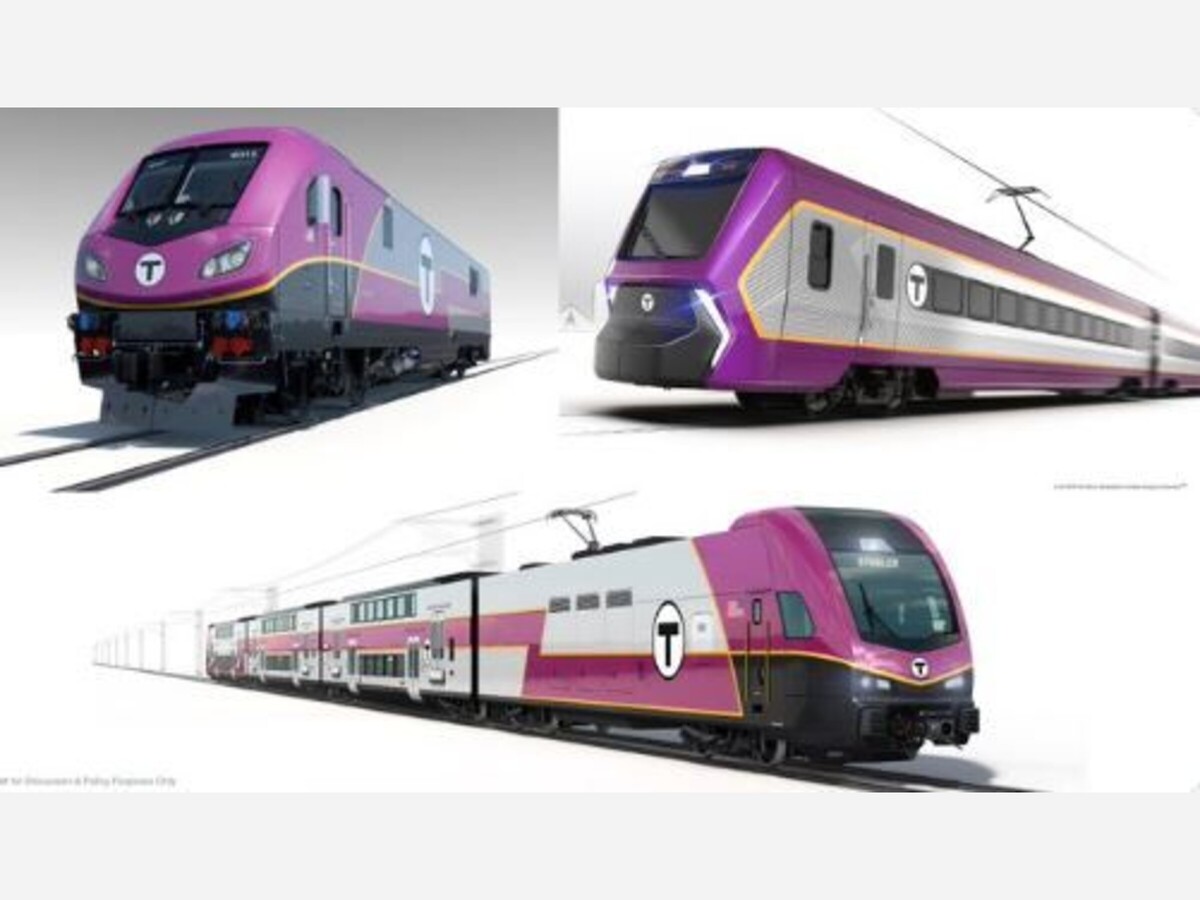
Above, illustrations of battery-electric locomotives proposed for the Fairmount portion of the Franklin line.
by Chris Lisinski, CommonWealth Beacon
August 18, 2026
THE MOOD WAS CELEBRATORY when MBTA oversight board members unanimously declared their support for transforming the commuter rail system, a blue-sky vision featuring zero emissions and more frequent service using electrified trains.
Transit advocates cheered the November 2019 move — even if the board votes came in the form of nonbinding resolutions with no funding attached — as a win. T leaders at the time said that new trains could arrive in two to four years. The votes were described at the time (by this reporter) as “historic.”
Then the COVID-19 pandemic hit, safety failures threw the T into chaos, and a new governor took office and set about transforming the agency. It seemed like the vision of a clean, frequent commuter rail system that did not rely on fossil fuels would have to wait, shifted to the back burner in favor of putting out fires and repairing those infuriating slow zones that suddenly seemed to be everywhere.
Today, the MBTA is again thinking about big commuter rail upgrades and is now inching toward a major early milestone that could serve as a proof of concept for the agency’s broader ambitions: acquiring battery-powered trains for the shortest route in the commuter rail system, the 9.2-mile Fairmount Line that runs almost entirely within Boston city limits.
It's a project years, if not decades, in the making, one that could bring more frequent transit service and slash greenhouse gas emissions in parts of the city with significant Black populations saddled with few connectivity options. But the first new vehicles will not arrive for testing of their cutting-edge technologyuntil a full decade after the vote to forge ahead with electrification, and the cost for the new vehicles on a single commuter rail line will exceed an eye-poppingthree-quarters of a billion dollars.
Did something go haywire, or is this just the price — and pace — of a fundamentally transformative project?
To Sen. Brendan Crighton, one of the co-chairs of the Legislature’s Transportation Committee, the work has “absolutely taken longer than I hoped.”
“But you also have to look back. The previous administration, I don’t believe, prioritized electrification,” Crighton said, referring to former Gov. Charlie Baker’s team. “In fairness, COVID hit, which delayed some things. So it’s frustrating, but I don’t think it’s a lack of will of this current administration.”
Today, all of the MBTA’s roughly 100 commuter rail locomotives run on diesel fuel. The fleet also features about 400 passenger coaches, which have no power sources of their own. Replacing all of those with infrastructure that can run on electric power has long been viewed as an effort that could cost tens of billions of dollars.
In June, the MBTA’s board of directors approved a 15-year, $765 million deal to lease 28 battery-powered vehicles for the Fairmount Line. The first battery electric multiple unit (or BEMU, in industry parlance) train from Swiss manufacturer Stadler is set to arrive for testing by the end of 2029, and passenger service will begin the following year.
Electric trains do not produce any greenhouse gas emissions, and officials say they’ll be able to operate with shorter headways between trips, reducing waits for passengers.
Crucially, the new trains for the Fairmount Line do not require the constant presence of overhead catenary wires or electrified third rails for power. That infrastructure is absent from most of the commuter rail system, though the Providence Line has catenary wires because it uses the same stretch of rail as Amtrak’s electrified Northeast Corridor service.
Depending on who you ask, the new technology is either the chief upside or the biggest risk in the electrification strategy.
MBTA officials say embracing battery power avoids the hassle of installing catenary along anentire line, which can be costly and can also fuel political spats in areas where neighbors view them as eyesores. Instead, they can focus on building charging infrastructure at endpoints and hanging shorter lengths of wires in select places.
Because they can run for roughly 50 miles on a single charge, the battery electric multiple units also have more flexibility, and the T could more easily expand them to other lines with less up-front infrastructure work.
Mike Muller, the T’s executive director of commuter rail, called the approach “scalable and future-proof.”
“The technology has evolved to a point now where you don’t need to put up 650 miles of overhead catenary,” Muller said in an interview, referring to the combined length of commuter rail tracks across the system. “You can put it in strategic locations of maybe less than half of that,” he said, where the overhead wires are needed for battery recharging.
Some advocates worry, however, that the technology is unproven locally. Three years ago, California’s Caltrain signed an agreement with Stadler to procure a single bi-level BEMU train for a first-in-the-nation pilot. In 2024, Chicago’s Metra system also struck a deal with Stadler to procure similar trains. Vehicles are years away from being delivered in both cases.
"It's a little bit untested in the United States, and that gives me great pause, great concern," said Brian Kane, executive director of the MBTA Advisory Board, which represents cities and towns who help fund the T. "It's also going to take a lot longer to procure, and it's going to take a lot longer to test and make sure it works. I just think there's a better alternative staring us in the face."
Catenary wires, Kane said, are a “tried and true” technology. He argued the Fairmount Line that runs from South Station to the Readville neighborhood of Hyde Park is an ideal stretch for the power cables, too, because it is not interrupted by any grade crossings where automobiles drive over the tracks, nor does it travel directly though any Main Street-type areas where the wiring would disrupt local aesthetics.
He suggests that outfitting the entire line with catenary wires would allow the T to try out the battery-powered trains, but quickly pivot to more conventional electric trains powered with overhead wires if there is a problem with the new locomotives.
“If they strung catenary along the entire Fairmont branch, they could still get battery-electric trains and test them by just not using the catenary some of the time,” Kane said. “But they’re locking themselves into this technology by not stringing catenary everywhere, and I just think it’s a strategic mistake.”
Some onlookers are frustrated by what they perceive as the lack of a big-picture plan. They worry there’s no clear vision for how the MBTA gets from a handful of battery-powered trains on one single line to hundreds of miles of commuter rail track running on electricity.
“[Electrifying] the line out to Readville is a great first step. That’s a natural fit,” said Joseph Aiello, who long chaired the Fiscal and Management Control Board, the T panel that oversaw the agency for more than six years after its creation in response to the disastrous winter of 2015. “But what happens next?”
Crighton, a Lynn Democrat, has a particular interest in electrified rail: his hometown’s fastest transit access to Boston is on the Newburyport/Rockport Line, which the 2019 MBTA board vote called for electrifying early alongside the Fairmount Line and Providence Line.
The latter is on track for some changes. T officials are procuring 10 electric locomotives, which will run using the Providence Line’s catenary wires and pull existing passenger coaches.
But electrifying the stretch of the Newburyport/Rockport Line through Lynn will take time. Muller said the T first needs to install new power infrastructure north of Boston before it can pursue electric trains on the Newburyport/Rockport Line “in a really meaningful way.”
MBTA officials have been eyeing “discontinuous” electrification, the jargon for using battery-powered vehicles that only need smaller stretches of catenary or localized equipment to recharge instead of running wires along an entire line, for at least four years. In 2024, the agency’s board approved an initial deal with commuter rail operator Keolis to start the rollout process on the Fairmount Line, projecting at the time that service would begin in early 2028.
The effort is now running about two years behind that estimate, in large part because the T wants Stadler to customize its trains to feature more wheelchair-accessible seating. The off-the-shelf design from the manufacturer features one car per train set with accessible seating, which matches federal standards for commuter rail coaches. However, the Fairmount Line today has accessible seating in all cars, and officials were hesitant to move forward on cleaner power while moving backwards on accessibility.
Muller, the T’s commuter rail chief, said the timeline has also been affected by pandemic upheaval and by major funding constraints. He noted that the 2019 resolutions from the Fiscal and Management Control Board — which dissolved in 2021 and was later replaced by the current MBTA board — were both nonbinding and unfunded.
Even as Beacon Hill steers significantly more money toward the T’s operations, the agency has little room available in its capital budget, which funds major infrastructure work and expansions.
Aiello, who chaired the board at the time of the 2019 votes, said board members “just didn’t have enough information” to dictate something more forcefully.
“We knew it was going to be complicated, we knew it was going to be expensive. We wanted to set them on a path, and we thought focusing on those first three lines with clean intent was going to put enough pressure on them to start thinking about the rest of the system,” he told CommonWealth Beacon. “This BEMU idea, which wasn’t on our radar screen, is really one of the wonderful, transformative pieces of thinking that happened subsequent to our vote.”
The new trains are also enormously expensive. Under the deal, the T will pay about $27 million per car for the 15-year lease, which would by far be the highest in a database of many North American, European, and Chinese locomotive and coach procurement prices tracked by researchers at the Transit Costs Project.
Muller attributed the high costs to rampant industry-wide inflation, and the fact that new technology is more expensive than more traditional options such as diesel trains. About $190 million of the $765 million contract also covers maintenance, which Muller said is typically not included in the sticker price of a procurement.
Under the deal, the T also has the option to procure another 96 cars. Its timeline will extend past the end of Keolis’s current tenure and into the next commuter rail operations contract, which is set to begin in July 2027.
Beyond that, next steps are murky. Muller said the T does not have funding available for expanding electric power beyond the limited Fairmount and Providence line efforts.
The T could soon be forced to put pen to paper, though. In a recent education and transportation spending bill, lawmakers tucked in language ordering the MBTA to report by July 1, 2028 a vision for a completely transformed commuter rail system featuring more frequent, electrified service, along with an explicit order of operations and projected timeline.
Crighton said the document “will be more of a game plan than a report.”
“For something this complicated, we really need to lay out very specific objectives and projections and study everything about this and make sure we have a schedule,” he said. “We need to hold ourselves to a timetable so that we don’t get in the situation we’re in now, where it’s taken seven years to make even modest progress.”
To Aiello, the outcome could hinge on how well officials are able to sell a decades-long investment. “The cost and the reality of competing interests for federal and state dollars means that the regional rail initiative needs sustained public and political support over a couple decades, and the initiative needs to be handed from one group of Beacon Hill leaders to the next and to the next,” he said. “How to build and sustain that support will be a central element to its success.”
This article first appeared on CommonWealth Beacon and is republished here under a Creative Commons Attribution-NoDerivatives 4.0 International License.

PARSELY = { autotrack: false, onload: function() { PARSELY.beacon.trackPageView({ url: "https://commonwealthbeacon.org/transportation/future-proof-or-a-strateg…", urlref: window.location.href }); } }

Overcast, with a high of 62 and low of 46 degrees. Overcast during the morning, sunny in the afternoon, clear in the evening, overcast overnight.