63° and Overcast



Image
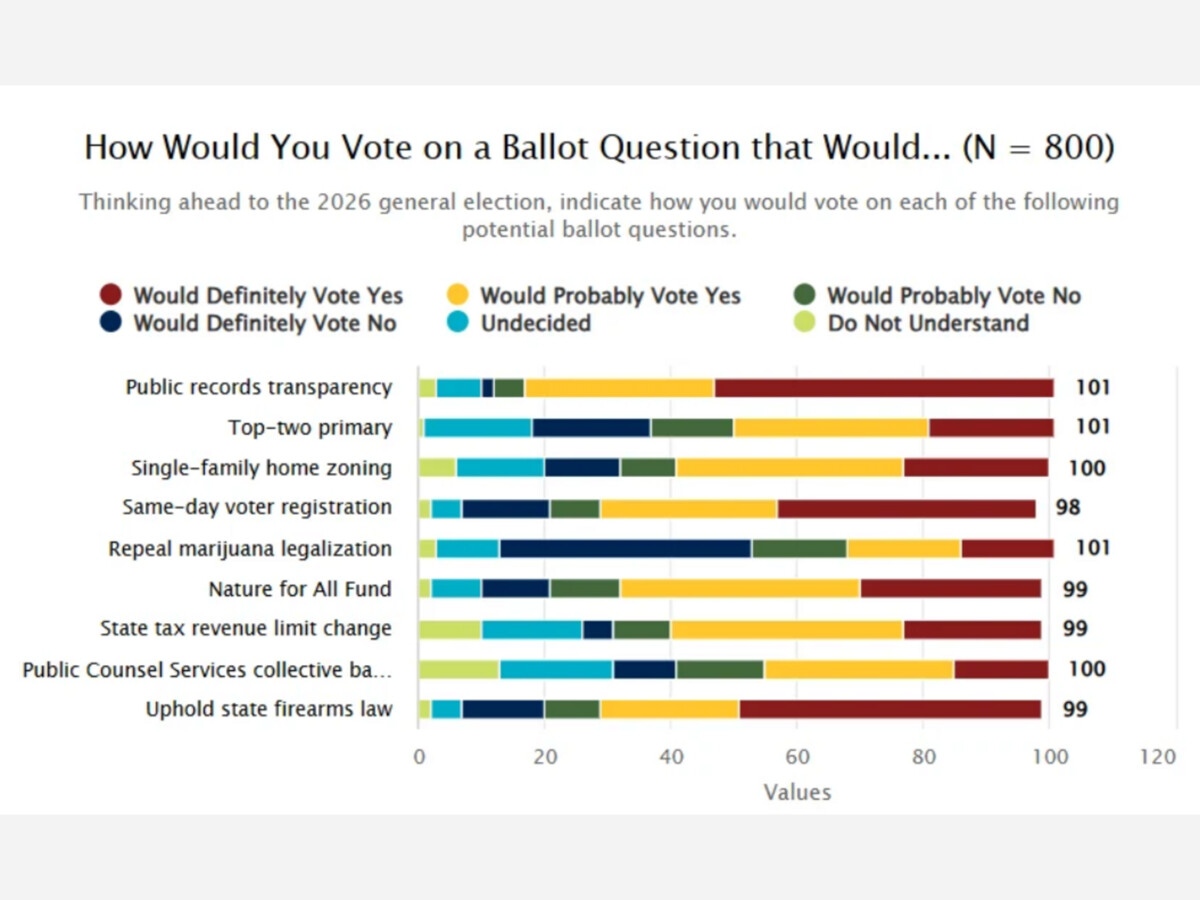
A UMass/WCVB poll shows how likely a pool of 800 registered voters in Massachusetts are to vote for the nine statewide ballot questions. (Screenshot.)
Ella Adams | SHNS
Voters are supporting a ballot question dictating more widespread public records access and opposing one that would repeal legal recreational marijuana, according to new poll results.
Massachusetts voters will see nine questions on their November ballots, after lawmakers chose not to take action on any of them and the state's highest court ruled two out of the running. The Legislature's Joint Committee on Initiative Petitions review proposed ballot measures and brought forward no recommendations.
Of 800 registered voters surveyed between Aug. 5 and Aug. 12 in the UMass/WCVB poll , 55% opposed or were likely to oppose the marijuana proposal and 33% said they're in support, which poll Director Tatishe Nteta called "unsurprising."
It's been a decade since voters legalized the possession, use, distribution and cultivation of marijuana in Massachusetts, Nteta said, noting that "a majority of voters (54%) view legalization in a positive light, with only 2 in 10 (22%) saying that legalization has been negative for the state."
"With the campaign for the ballot question still in its nascent stages and 1 in 10 voters remaining undecided, there remains time for the tables to turn and support for repeal to grow," Nteta continued. "But, with Trump voters (48%) and Republicans (45%) the only groups approaching majority support for the ballot question, convincing Massachusetts voters to reverse course on marijuana legalization appears to be a formidable challenge.”
Most of the nine ballot questions are faring well amongst voters; 70% expressed support or likely support for the question that would uphold the state's firearms law, 59% did so for residential zoning reform, 59% for a change to the state tax revenue limit, 67% for the creation of a state conservation fund, and 69% for Election Day voter registration.
The question that would subject the Legislature and governor's office to the state's public records laws was the most popular ballot question among voters. Polling showed 84% of voters said they'd definitely or probably vote for the measure, with just 7% opposing or likely to oppose it.
“At a time when it’s difficult to find anything Democrats and Republicans agree on, transparency in state government comes pretty darn close,” poll co-director Raymond La Raja said. "Voters want the governor and legislature subject to similar public-records laws that cover state agencies and local governments.”
A wide coalition across Massachusetts is still aggravated about how the voter-approved law to audit the Legislature has been carried out, after 72% of voters approved the question in 2024 and lawmakers railed against it.
Beacon Hill seems to be going in its own direction when it comes to the transparency-related question on public records.
After months of lawsuits and back-and-forths on the topic, the House in June passed a bill (H 5469) to narrow the scope of the voter-approved legislative audit and to create a formal process to govern public access to legislative records. The Senate in July passed its bill (S 3244) proposing a framework for public access to legislative records. Reps. Alice Peisch, Andy Vargas and David Muradian and Sens. Cindy Creem, Cindy Friedman and Kelly Dooner have been tasked with negotiations to come up with a compromise at some point either before or after the Nov. 3 election.
Lawmakers this year have also repeatedly expressed public frustration with the initiative petition process and the volume of proposals in play. A bill in conference addressing ballot question financing disclosure could feature a House proposal to create a special legislative commission to review the entire initiative petition process as laid out in the state Constitution.
Voters seem "unsettled," pollsters wrote, about the question that would implement an all-party primary elections system. Of those polled, 51% said they would probably or definitely support the question.
Just 45% also said they'd definitely or probably support a question that would enable Committee for Public Counsel Services employees to collectively bargain. That question had the largest percentage of undecided voters of the poll at 18%, while 13% said they did not understand it.
The poll's margin of error was 4.4%
Ella Adams is a reporter for the State House News Service and State Affairs Massachusetts.


Mist, with a high of 65 and low of 47 degrees. Overcast for the morning, patchy rain nearby for the afternoon, fog during the evening, mist overnight.