

Image
Allison Kuznitz |SHNS
The commonwealth's prized life sciences industry shed more than 3,600 jobs in 2025, marking the first year-over-year decline in more than two decades and pointing to ongoing strain for biopharma companies amid federal headwinds and declining early-stage investments, according to a new trade group report.
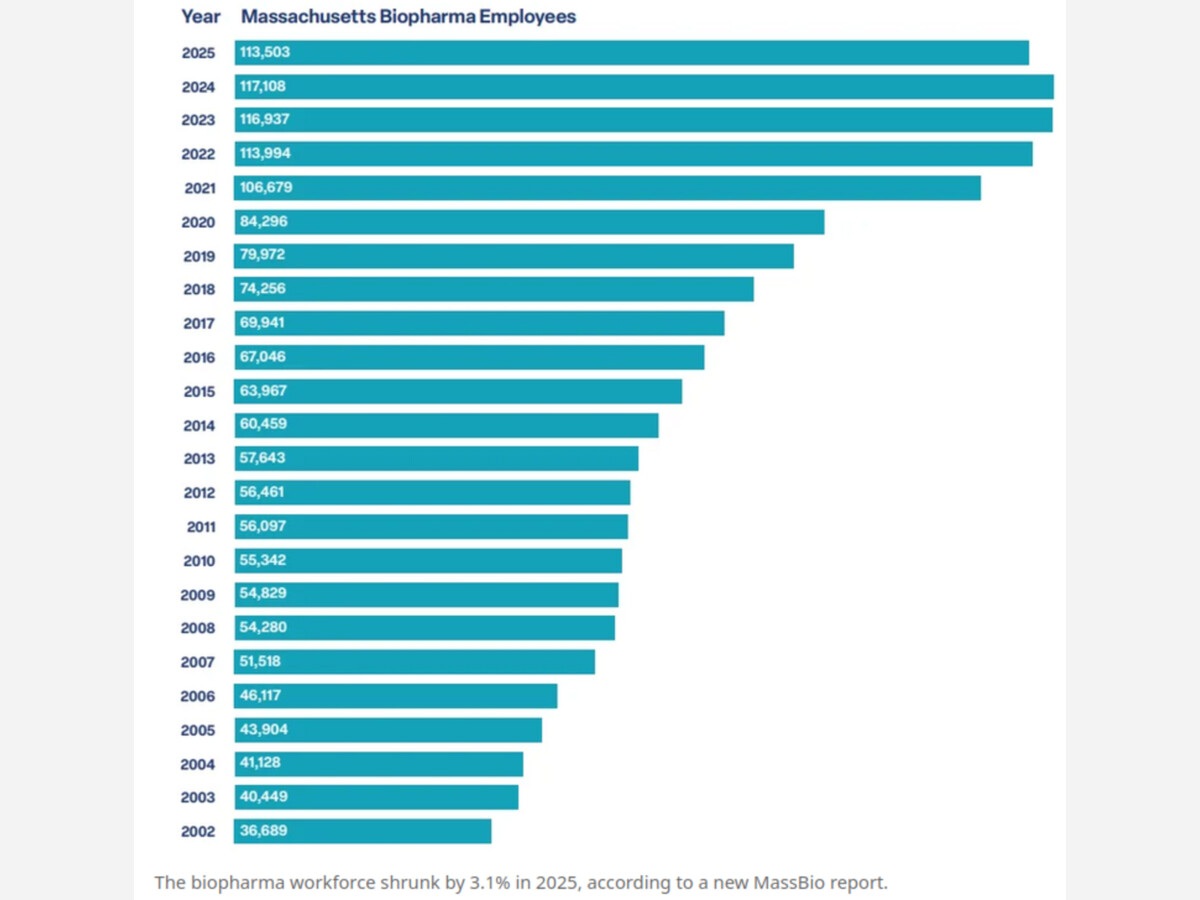
The biopharma workforce counted 113,503 employees in 2025, compared to 117,108 employees in 2024 — marking a 3.1% contraction, the Massachusetts Biotechnology Council said in its annual industry snapshot released Tuesday. Between 2023 and 2024, the industry's workforce grew by just 0.1% while also losing more than 1,000 biopharma research and development jobs.
MassBio said 2025 marks the first time that the overall biopharma workforce has shrunk since Gov. Deval Patrick signed the landmark life sciences initiative in 2008 that invested $1 billion over a 10-year period and solidified the commonwealth's global competitive edge in developing lifesaving therapies and drugs.
Beacon Hill leaders continue to treat biopharma as a crucial driver of Massachusetts's overall economic well-being, with a 2024 law authorizing another $500 million in capital investments over the next decade and boosting the annual life sciences tax incentive program. Economic development legislation that's under negotiation this session looks to invest in the development of AI technologies within the life sciences space and reshape the tax incentive program.
"Biotech supports tens of thousands of good-paying jobs, strengthens communities across the state, and attracts investment and talent from around the world," House Ways and Means Chairman Aaron Michlewitz said in a statement included in the report. "As we navigate a challenging environment, the Legislature remains committed to protecting the ecosystem that has made Massachusetts a leader and ensuring that innovation, economic growth, and opportunity continue to thrive here for generations to come."
Massachusetts last year lost 2,563 research and development jobs, a 3.9% decrease and the "steepest drop among the major R&D hubs" across the U.S., according to the MassBio report. Still, the commonwealth represents more than one-fifth of the country's entire biopharma R&D workforce.
Biopharma workforce
The biopharma workforce shrunk by 3.1% in 2025, according to a new MassBio report.
The report points to some bright spots on the employment front, including the addition of 238 manufacturing jobs in 2025 after two years of losses. The state's biomanufacturing workforce now totals 10,311 employees, a figure dwarfed by California's 41,902 employees. Competitor states with lower costs of living added significantly more biomanufacturing jobs last year, including Indiana (804), North Carolina (883) and Florida (426).
Some of the commonwealth's largest biopharma employers have grown their local head counts in 2026, including Sanofi making 385 new hires. Pharmaceutical giant Lilly more than doubled its workforce, moving from 540 employees in 2025 to 1,423 in 2026.
Meanwhile, vaccine manufacturer Moderna shed nearly 1,400 jobs, which MassBio attributed to "post-COVID normalization." Moderna and Merck last week announced successful trial results for a personalized cancer vaccine to treat melanoma, with Moderna CEO Stéphane Bancel calling it a "pivotal moment for the field of cancer research."
Massachusetts-headquartered biopharma companies raised $3.45 billion in venture capital in the first half of 2026, compared to last year's midway haul of $2.75 billion. During the pandemic, venture capital funding hit nearly $8.5 billion in the first half of 2021, before falling to $5.1 billion in the first half of 2022.
While MassBio says venture funding "rebounded" in the first half of 2026, the report notes the money was "concentrated in fewer, bigger bets." The top 10 deals accounted for nearly 47% of all venture dollars flowing to Massachusetts companies.
Initial funding for biopharma startups declined, laying a shaky foundation for the future health of the industry. The average seed round was $4.65 million in the first half of 2026, compared to $7.65 million in the first half of 2025. The average Series A round, which comes after the seed funding stage, was $79.6 million in the first half of 2026 — compared to $61.7 million at this point last year.
"My biggest concern, and our biggest opportunity, remains the earliest startups with the riskiest science, and keeping these companies and the brilliant minds behind them here in Massachusetts," MassBio CEO Kendalle Burlin O'Connell wrote in the report.
"We collectively, from government to the investor community to large pharma to MassBio, must do more of what we used to do: take the chances that could change the game for an entire therapeutic area or patient population," she continued. "Deliver the seed dollars, the wrap-around services, the policy embrace, and the physical infrastructure necessary for them to get from the lab to the clinic, from a promising idea to real data."
Massachusetts-headquartered biopharma companies completed eight initial public offerings in the first half of 2026, compared to two in 2025 and six in 2024. The report says that any "pullback in seed and Series A rounds will determine the size of the (IPO) class at the end of this decade."
The commonwealth, which is home to 63.2 million square feet of lab and manufacturing space, posted a vacancy rate of 31% in mid-2026. That's up from about 28% a year earlier, the report said.
Massachusetts has roughly 2,400 trials in "active development," with 54% of therapeutic-area trials focused on oncology. The commonwealth is ahead of California when it comes to oncology trials but losing to China, which the report says "leads outright on oncology."
Drug pipelines from Massachusetts-headquartered companies constitute 17% of the U.S. pipeline and 6.2% of the global pipeline. Burlin O'Connell said that every trial and drug candidate in the pipeline "traces back to a bet somebody made five, eight, ten years ago."
"What we choose to fund today is what shows up in a report like this one at the end of the decade," she said.
Alison Kuznitz is a reporter for State House News Service and State Affairs Pro Massachusetts

Sunny, with a high of 58 and low of 41 degrees. Sunny in the morning, clear in the afternoon and evening,