

Image
To the Editor:
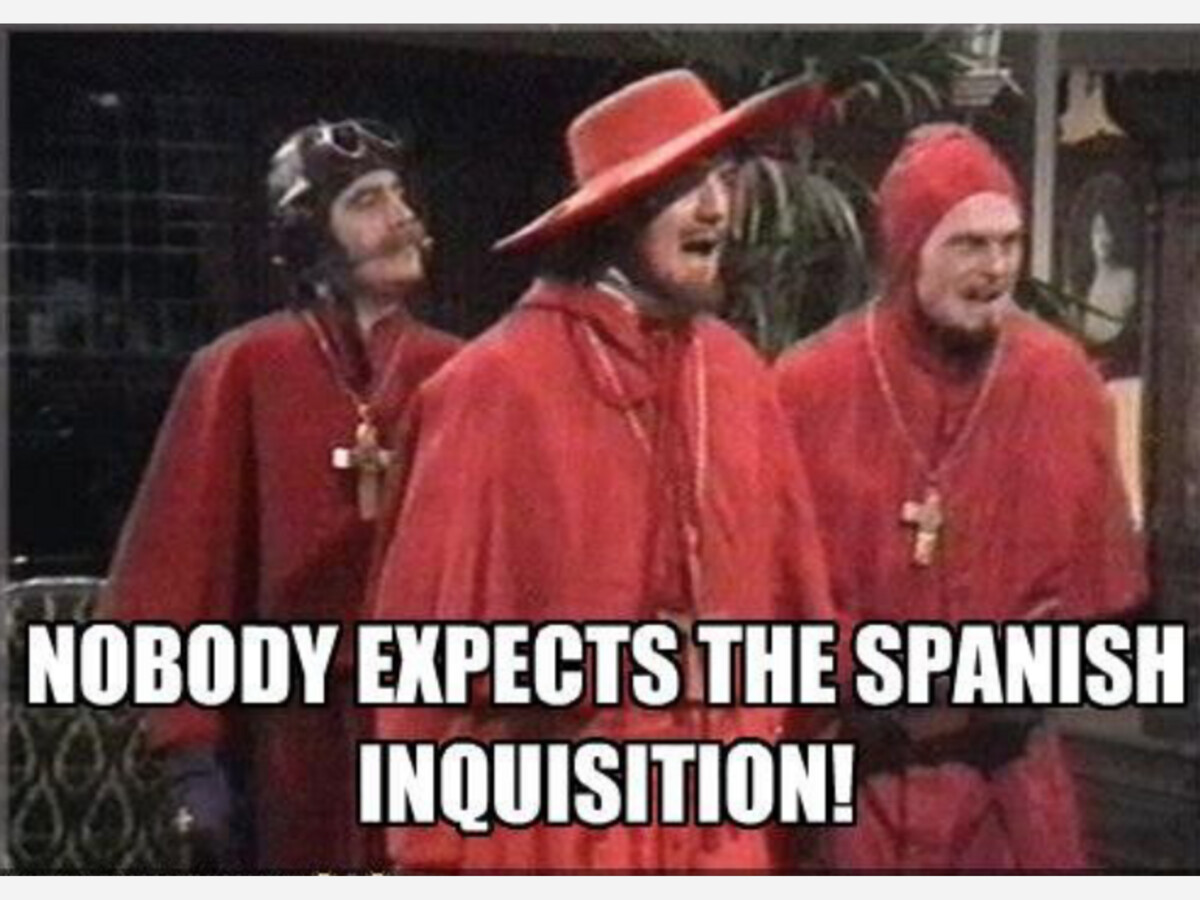
When I started reading James C. Johnston, Jr’s letter about book banning I wasn’t expecting the Spanish Inquisition. But then again as the old Monty Python gag goes, “Nobody expects the Spanish Inquisition!”
In his letter Mr. Johnston seems intent to lay the blame for any imagined present day “book banning” on the Catholic Church. I notice that he did not provide a single example of this supposed urgent crisis but rather attempts to make hay of the kerfuffle of the Galileo Affair of 1616. My goodness that’s even before the Pilgrims landed in Massachusetts and started banning Catholics!
For a historian Mr. Johnston seems a little mixed up on the whole Galileo issue. He seems to think that Galileo was trying to convince everyone that the world was round and not flat.
Of course that was settled science even then and had been for hundreds of years.
What the Galileo Affair was actually about was whether the earth went round the sun or vice-a-versa. Galileo, it turns out, had the right answer but it went against the prevailing wisdom of the day.
It’s important to note that this would have been the prevailing wisdom not just of the Catholic Church, but of the Protestants, the Muslims, the Chinese, and all established academia of the day.
It should be forgivable if the people of those times with the means available to them did not have all of the information they would’ve needed to correctly understand the workings of the solar system.
Even Albert Einstein had the wrong conception of the universe. He insisted that the universe was eternal, unmoving, and static.
It was the Belgian Catholic priest and physicist, George Lemaitre, who showed Einstein that this was wrong and that the universe was expanding -- today we call that the Big Bang theory.
It is a tiresome old trope that the Catholic Church is anti-science and against reason.
For many centuries the Church was the main support of the development of scientific inquiry. Cathedrals themselves often functioned as solar observatories. The Vatican Observatory today is still an active research institution.
Universities grew out of the monastic schools of Europe and expanded under the Church’s patronage. The “Natural Philosophy” taught and developed at these schools was the precursor of what became the scientific method. Church scholars, like the Franciscan friar Roger Bacon and Bishop Robert Grosseteste, were major contributors in the development and application of mathematics, observation, empirical testing, and experimentation.
It was the Church which preserved (by translation) the great science of the Greco-Arabic world, not to mention so much of ancient literature and history.
The scholastic method exemplified by the great Doctor of the Church Saint Thomas Aquinas treated nature as orderly and intelligible -- consistent with a Creator whose works could be investigated rationally.
And it was, after all, the churchman Copernicus who first posited that the earth moves around the sun. Years before Galileo, he published “De Revolutionibus” under Church patronage and he dedicated the work to Pope Paul III. Apparently he knew how to finesse the politics of his day better than Galileo did later on.
In 1992, speaking before the Pontifical Academy of Sciences, Pope Saint John Paul II made the following observations:
Theologians of Galileo’s time erred because they, “unduly transposed a question of factual observation into the realm of faith.” Theologians must stay informed about scientific progress so they do not bind doctrine to passing cosmologies. Faith and science are different realms with different methods but ultimately they cannot contradict one another. The Holy Spirit is meant to teach us, “how to go to heaven, not how the heavens go.”
Pope Saint John Paul II also noted that the Galileo Affair had become “a sort of myth in which the image fabricated out of the events was quite far removed from reality… A tragic mutual incomprehension has been interpreted as the reflection of a fundamental opposition between science and faith… this sad misunderstanding now belongs to the past.”
David Brennan
Franklin, MA


Sunny, with a high of 71 and low of 51 degrees. Sunny in the morning, clear for the afternoon and evening,