

Image
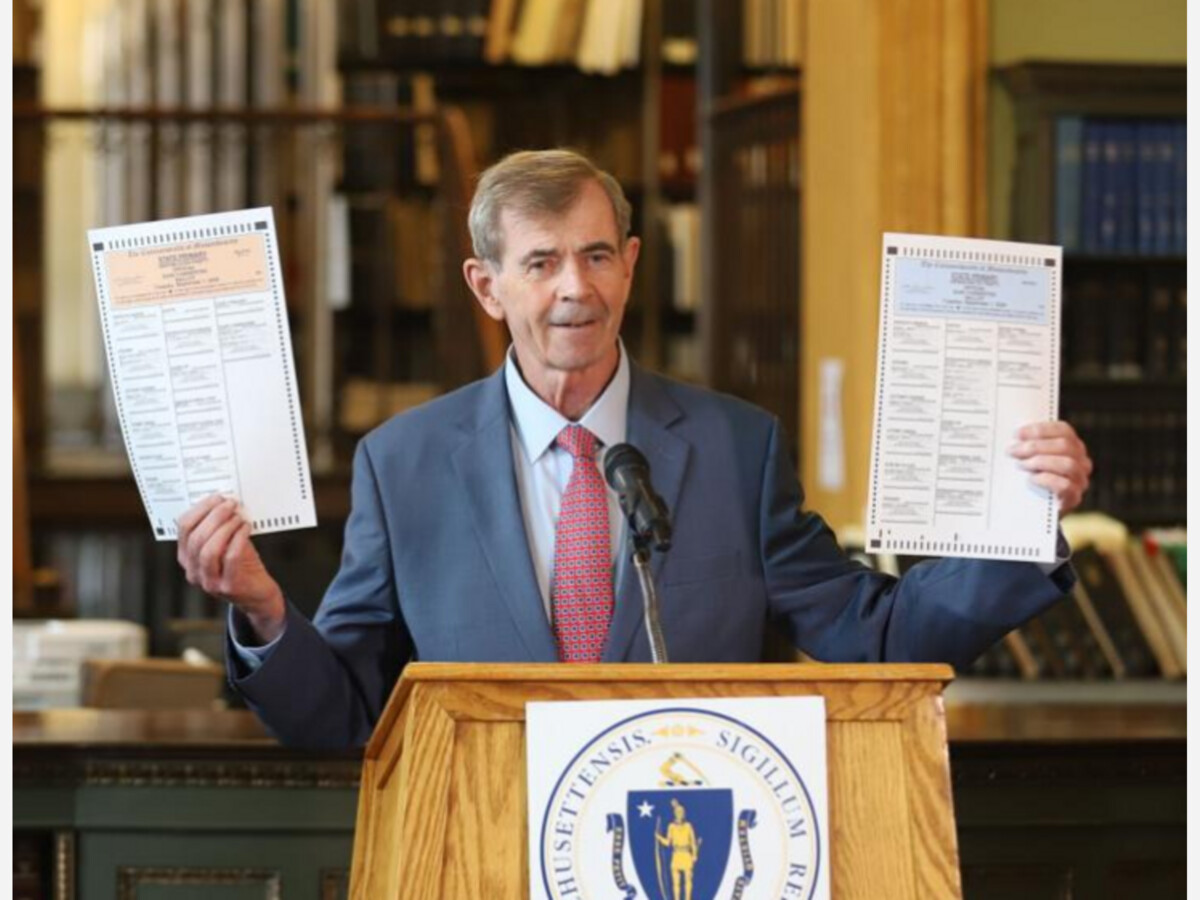
Secretary of State William Galvin holds up ballots during a press conference held at the State House on Thursday, Aug. 27, 2026.
Katie Castellani /SHNS
Secretary of State William Galvin is remaining neutral on the ballot question proposing a system of all-party primary elections, but he had questions about the proposal Thursday and said it is crucial to understand how it could affect voters.
"What does it do to the rights of voters? That really should be the question," Galvin said during a press conference held at the State Library on Thursday. "In other words, if this does enhance the rights of voters, well, that's a good reason for it. But is it going to be more complicated? Is it going to restrict groups that might have been able to run before as third parties? Those are all questions."
Currently, candidates affiliated with third parties can appear on the ballot if they get a certain percentage of votes, Galvin said, adding that all-party primaries could limit those third party contenders' access to the ballot.
"The question presented by the ballot question, which is complex because it's multiple questions all wrapped into one, is do you want to see the party - the two-party system? Ironically, to some extent, the ballot question will be much harder, I think, in my opinion, on the third parties because they will have less access," Galvin said.
"If this proposal were adopted, my opinion is it's going to wipe out third parties completely," he said of the proposal that will appear on November's ballot as Question 3. "But the question is: Is it a system that's going to make it more attractive?"
The idea has caught on in other states, where supporters argue it "is supposedly going to make it less ideological in the primaries, make it more mainstream, and enhance voters' rights," Galvin said.
"On that score, I think it's had mixed results," the secretary said.
Galvin said data released Wednesday shows Democratic Party enrollment has fallen to below 25% of all registered voters and Republican Party enrollment has dropped to between 7% and 8%. Asked by a reporter whether statistics showing that voters are opting out of party affiliations indicate an openness to the ballot question, Galvin said, "I'm not sure you can draw that conclusion. I think what you can say, and I think you said it, is that increasingly people don't feel they want to be members of parties."
"That suggests an openness," he added. "On the other hand, I think they, for the most part, they like the party structures."
Several groups including Massachusetts AFL-CIO, 1199 SEIU, Local 509 SEIU, Progressive Mass, MassDems and AFT Massachusetts have coalesced to lodge a "No on 3" opposition campaign to the proposal. Among the groups' arguments is that the question "shuts out independents and small parties," wouldn't boost participation is a "national experiment" that has been "rejected by voters across the ideological spectrum."
On the other hand, supporters say the all-party primary system could increase participation, reduce gaps in voter turnout and raise election competition. Supporters also say that under an all-party primary system, money in campaigns would become less influential and it would uplift minor parties and independents.
A recent UMass/WCVB poll, which surveyed 800 voters, found 51% of respondents said they would probably or definitely support the all-party primary ballot question. It's a result pollsters said shows voters seem "unsettled" about the proposal.
Katie Castellani is a reporter for State House News Service and State Affairs Pro.



Sunny, with a high of 71 and low of 51 degrees. Sunny during the morning, clear during the afternoon and evening,