

Image
Colin A. Young |SHNS
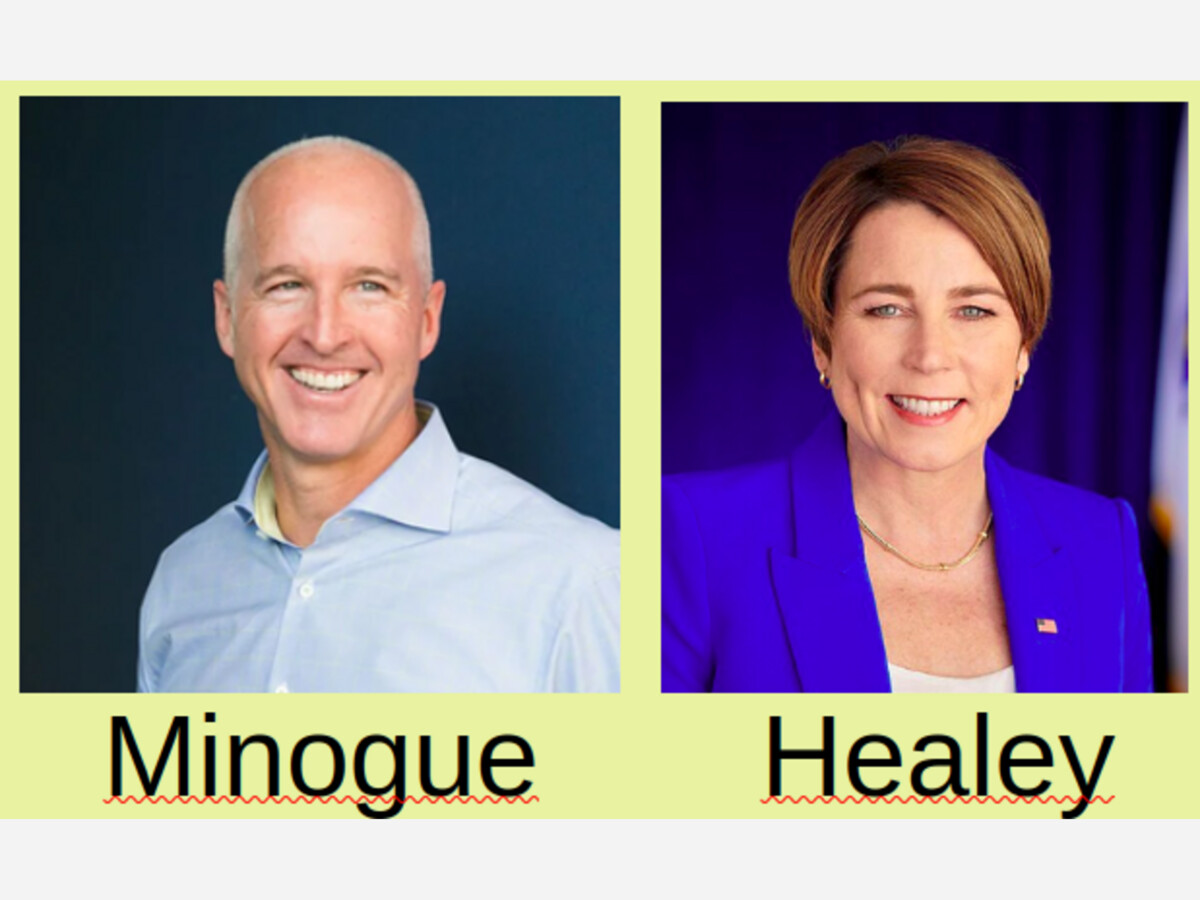
Healey versus Minogue is now official, and there may be more common ground between the candidates than at first blush.
Hamilton medical device executive Mike Minogue easily won the Republican nomination Tuesday and the general election contest against Gov. Maura Healey got underway in earnest that night. Each candidate gave a bite-sized summary of their main argument to voters:
"We know that Massachusetts can do better. We know it. Most important, most important, we have the courage to fight for it, and that's why I'm running for governor," Minogue said. He vowed to be "a new kind of governor -- a governor who is not the political establishment, a governor who is not part of the one-party system, a governor who is an outsider and coming in to shake it up, a governor that will stand up and speak the truth and fight for you, and I am beholden to no special group. I go into this role knowing I will work for you."
"In this election, we're going to send a message that if you support Donald Trump, if you funded him, if you endorse the bad things he's done to our state, then you cannot be governor of Massachusetts," Healey said. "This election is about whose side you're on. Mike Minogue stands with Donald Trump. I stand with you."
Healey and Minogue each spoke for about 15 minutes after accepting their nominations, and the vocabulary that they used showed they are both speaking to the same anxieties among voters while offering vastly different solutions.
Take affordability, the umbrella issue of the 2026 elections. Both candidates know Bay Staters are frustrated by how expensive everything here has become -- Minogue says government is the reason you couldn't afford ribeye steaks this summer; Healey says government is the way to get back to grilling.
Healey, having ticked through her administration's actions or proposals to cut permit times, cap copays and address energy costs: "To folks out there, I want you to know that I see you, and I understand you, and I'm working every day to make life better for you. I want you to know that."
Minogue: "The problem is that our state government is smothering the American dream. Because Massachusetts is working for some, but not all, and we're going to change that."
At the other end of Minogue's "AAOK" catchphrase is public safety (AAOK stands for "accountability, affordability, opportunity and keep communities safe"). That was another common thread between the Democrat and Republican, but it was also clear Tuesday night that they have different ideas about who or what Massachusetts needs to be protected from.
Minogue spent less time talking about public safety and immigration enforcement than Healey did, but he did get a cheer out of his primary night crowd when he reminded them, "you've said you want a commonwealth that isn't a sanctuary state." On his campaign website, he says, "The fundamental role of the governor is to uphold the law and keep our communities safe. MA will not be a sanctuary state. Criminal, violent, gang-member or drug dealer illegal immigrants will be deported from our state and country. Illegal immigrants will not have free Right to Shelter, Medicaid, or benefits. We can have both common sense and compassion."
Healey made clear that immigration enforcement -- particularly as conducted by the Trump administration -- is precisely the threat that she wants to protect Massachusetts from.
"A governor's job is to keep people safe, and right now that means protecting them from ICE. I will. My opponents won't," she said.
Minogue and Healey even used the same rhetorical device that the predominant emotion they and their supporters hold "alone is not enough" and that it must be turned into "action." Thing is, they acknowledged that their bases are expressing essentially opposite emotions.
"Anger alone is not enough. We have to turn that frustration into righteous action," Minogue said.
Healey, meanwhile, tapped into the Barack Obama well: "We know that hope alone is not enough. Doing things that make a positive difference in people's lives, taking action is what we need."
With lots of attention paid to the anti-incumbent sentiment fomenting nationally, Healey may have taken a measure of comfort from the result of the Democratic primary for U.S. Senate. Markey, 80, easily defeated 47-year-old U.S. Rep. Seth Moulton and upended the trend of younger candidates convincing voters that older Democrats should be shown the exits. Unlike other incumbents who have fallen this cycle, Markey was the progressive candidate in the race and Moulton's more moderate message didn't resonate across the state.
That trend played out to an extent in other races -- Sen. Michael Rush, who lost to progressive challenger Persis Yu, and Senate President Pro Tempore William Brownsberger, who is separated from progressive newcomer Daniel Lander by a handful of votes headed into a recount, can attest.
U.S. Reps. Richard Neal of Springfield and Stephen Lynch of South Boston wound up winning, but each sweated it out late into Tuesday night as they held off younger candidates challenging them from the left.
Chuck Todd, the former "Meet The Press" host and political analyst who now has "The Chuck ToddCast" podcast, said Tuesday night that one of his Bay State takeaways was that "you start to see the moderate Democrat who is going to struggle in these primaries." Todd wondered about the ramifications of the Bay State ballot question this fall that would eliminate party primaries and instead pit all candidates together with the top two finishers advancing.
"Hey, because what do Moulton, Neal and Lynch all have in common? Right, they're just not where the base of the party is these days," Todd said on a livestream he did in partnership with Decision Desk HQ. "Does that, how much would that change if they do change this system in November?"
Given the chronic lack of competitive races under the current system and rapid shifts away from major party enrollment, it is unlikely that an all-party primary format would reliably result in Democrat vs. Republican matchups in the general election. But, Todd wondered Tuesday night, "if you took away the labels, is there two factions in the state that are equally competitive or not?"
"I feel like these days it's progressive and super progressive. You know, I really do," Steve Bilafer, a onetime aide to former Attorney General Thomas Reilly and longtime Bay State political operative, responded. He added, "But yeah, you might see more of a different type of of Democratic elections, you know, when they're running against each other in the final. We'll have to see."
Before the final vote counts were in from Tuesday's primaries, chatter started about the crowded field of Democrats who could get involved in a game of musical chairs around U.S. Senate elections in 2030 (when U.S. Sen. Elizabeth Warren's term is up) and 2032 (when Markey's term, which he said would be his last, ends).
"That's a good question. You know, some of the moves and things that have been happening this year give you the indication that some people are at least getting their ducks in a row for a potential run," Bilafer said when Todd asked if he thinks Warren will run again in 2030. "I think that primary would look like maybe Marty Walsh; Andrea Campbell, the attorney general."
As of Friday, there were 60 days until Election Day -- and 1,523 days until Election Day 2030.


Overcast, with a high of 56 and low of 37 degrees. Patchy rain nearby in the morning, overcast in the afternoon, clear for the evening, overcast overnight.