44° and Overcast



Image
REPRINTED FROM ISO NEWSWIRE, WITH PERMISSION
It’s Friday morning and Steve Desroches, Barrett Mully, and Dave Turner can’t stop thinking about Saturday. That isn’t because they’re longing for the workweek to be over. Instead, they’re focused today on setting up the power grid for success tomorrow.
Representing three departments across ISO New England, they work collaboratively to support the Day-Ahead Market — part of a suite of competitive wholesale markets that help ensure reliable electricity for the region.
The Day-Ahead Market allows participants to lock in prices the day before delivery and hedge against real-time price volatility. It’s where most of the region’s wholesale electric energy is bought and sold, with $9.8 billion in settlements in 2025.
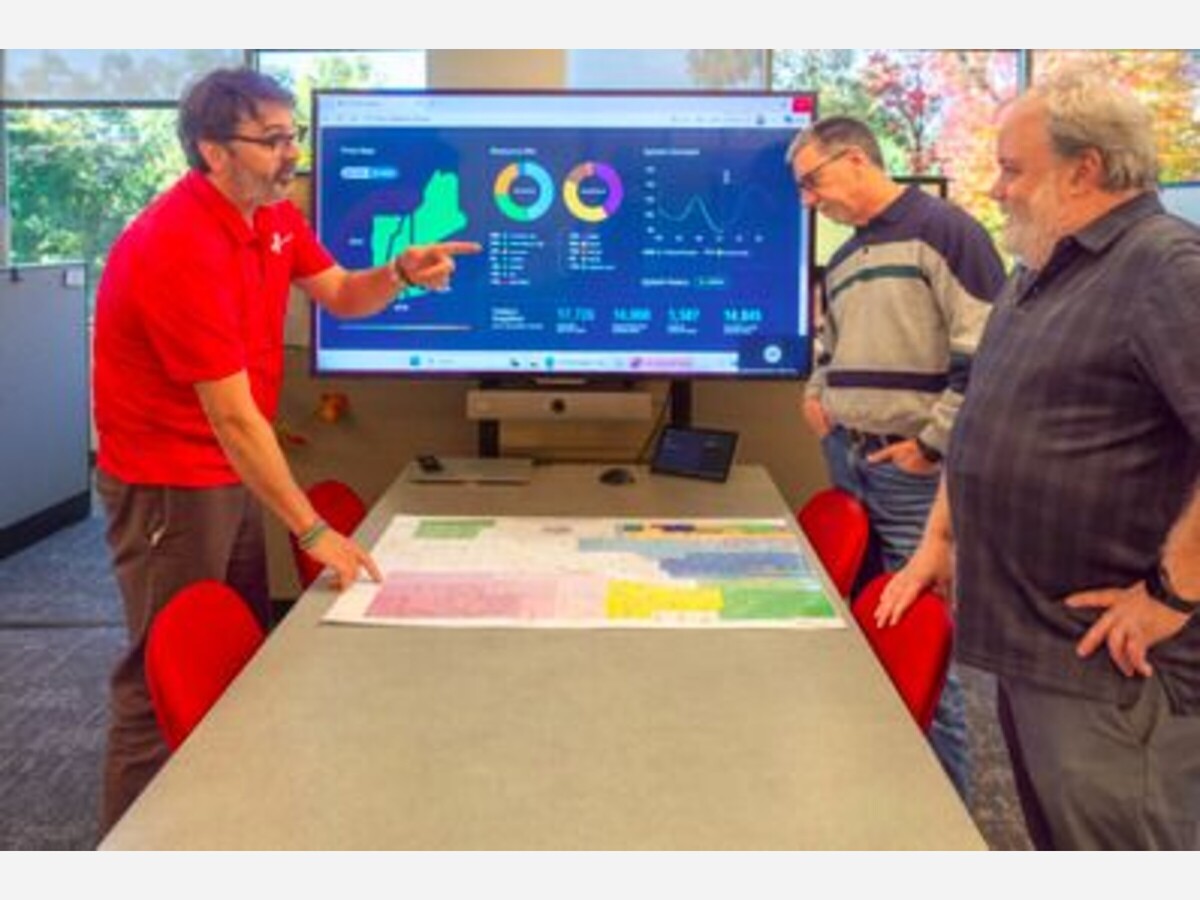
Desroches, Mully, and Turner join a handful of colleagues in the “Bullpen,” a corner of the ISO’s office in Holyoke, Massachusetts. To get there, employees pass under an archway of leafy vines. Inside, the walls are covered with group photos and power grid diagrams. There are cubicles to either side, but in between there’s room for a conference table and a large screen displaying a complex spreadsheet.
Staff gather in the Bullpen every morning at 8:45 to consider three key questions about the next day. How much electricity are consumers likely to use? How will it reach them? How will the Day-Ahead Market provide it?
On this day, Desroches, Mully, and Turner are responsible for verifying and sharing the myriad details needed to answer those questions.
Preparations start well before the three representatives come together.
First, the ISO needs to estimate how demand for electricity will rise and fall. It also needs an understanding of how resources on the grid can meet that demand across every hour of the day in several distinct areas of New England. This is the job of the demand and resource forecaster. Today, that’s Steve Desroches.
He arrives in the ISO New England control room at 5 a.m. The nerve center of the power grid, the control room is about the size of a basketball court. Lining three of its walls are hundreds of square feet of screens displaying information about grid conditions. In the middle are eight large workstations. Six are for system operators, who manage the grid in real time. Two are for members of the forecast team, who help keep their colleagues prepared by looking ahead anywhere from a few hours to a few days.
The main factor influencing electricity demand is the weather. To guide their predictions, ISO-NE forecasters use a suite of weather and demand models. By comparing predictions to actual outcomes, the forecast team continuously refines its models. Each model has its own strengths and weaknesses, Desroches explains. One might excel at predicting peak demand while being less accurate at other times. Another model might get the non-peak hours right. The performance of the models is constantly changing as new data is added. It’s up to each forecaster to choose and blend the models, using their knowledge and experience to arrive at the most likely scenario.
“We’re like chefs who all make the same thing,” says Desroches, whose job title is lead forecaster. “Our ingredients are a little different, but they taste the same to most people.”
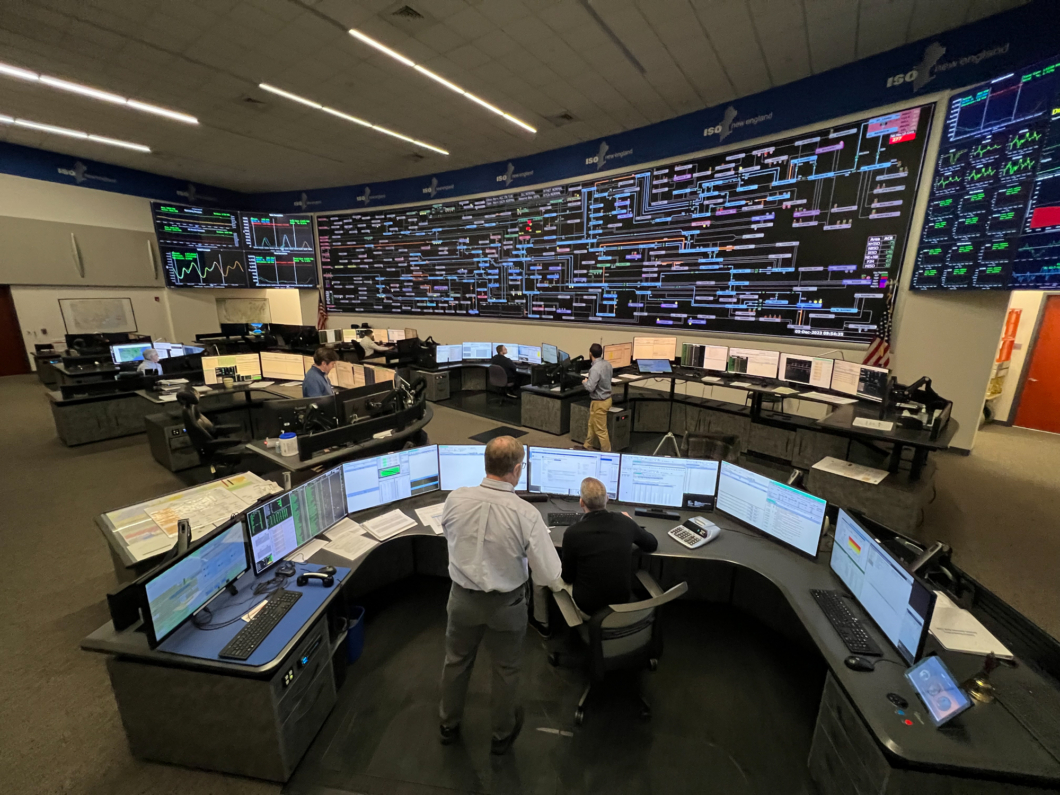 ISO New England’s control room is the nerve center of the regional power grid.
A Holyoke native and a mechanical engineer by training, Desroches started his career servicing and later supervising construction of power plants around the Northeast. Then he spent two decades as an ISO-NE system operator. He says his experience has served him well since switching to the forecast desk about two years ago.
The ISO’s forecasters don’t just forecast the weather. They also have to consider the characteristics of grid resources. For instance, each oil- or gas-fired power plant has unique requirements for how quickly it can start up or change output, as well as maximum uptime and minimum downtime. Batteries and pumped storage can discharge for a limited time and must have opportunities to charge back up.
Weather makes a difference for electricity supply as well as demand. Wind turbine output depends on wind speed. Solar panel output depends on the amount of sunlight, which is affected by the constantly changing height and density of clouds or sometimes even wildfire smoke. These are just a few of the factors Desroches and his colleagues must consider to create an accurate forecast.
On this morning, Desroches’ results suggest demand will peak tomorrow evening at about 14,000 megawatts (MW) — typical for an autumn Saturday. But before finalizing his forecast, Desroches needs to compare notes with colleagues, and so he heads to the Bullpen.
The Bullpen is home to the Transmission Outage Coordination department, and today’s 8:45 meeting is hosted by Barrett Mully, senior intermediate outage coordinator.
His role is to prepare and then walk his colleagues through a lengthy spreadsheet cataloging equipment that will be out of service for maintenance, testing, or other reasons. These are the capacitors, circuit breakers, conductors, static synchronous condensers, and other devices that make it possible for electricity to travel long distances.
Some devices may be on the list for a day or two, while others are part of larger projects and may stay off line for months. To avoid impacts to consumers, the Outage Coordination team works with transmission owners to assess and schedule maintenance outages as much as two years in advance.
Once ISO-NE staff understand which transmission elements will be disconnected from the grid, they get to work figuring out how to safely detour electricity over other parts of the system that remain in operation. Every solution has to avoid overloads, maintain consistent voltage, and be resilient enough to survive additional outages that might happen unexpectedly.
With equipment going in and out of service, each day’s transmission roadmap looks a little bit different. To use the technical term, its “topology” is constantly shifting.
Depending on the topology, certain areas within New England may have less access to transmission than others. These “pockets” require electricity produced nearby rather than far away. While tomorrow’s forecasted peak is well below the total capacity of all the resources on the grid, staff can’t assume all of that capacity reaches everywhere.
“That’s great if you can get 14,000 MW, but are you secure for all these areas?” Mully says. “In theory, you could have all your generation in one place. But if you’re not secure in a pocket, you’ve got to start up some generation there.”
 Transmission equipment is constantly going in and out of service, meaning the route that electricity takes to reach consumers is slightly different each day.
Mully followed his own circuitous path to ISO New England. He was an engineer on oceangoing vessels, a nuclear power plant operator, and an entrepreneur before joining the ISO in 2022. He says that experience taught him prioritization, problem solving, and critical thinking skills, as well as how to leverage his team members’ unique abilities to accomplish complex tasks.
It takes about 20 minutes for Mully to guide his colleagues through the spreadsheet, answer their questions, and ask his own. By the end of the morning meeting, each of them has a better understanding of how the grid will work tomorrow. Soon it will be time for parties outside the ISO — the buyers and sellers of wholesale electricity — to play their part.
ISO New England has been administering the Day-Ahead Market since 2003. Dave Turner, principal market operations analyst, has been working on it since the beginning. An engineering major who later switched to economics, he was hired shortly after the ISO’s creation nearly three decades ago.
Every morning, Turner or another member of his team builds a “case,” establishing parameters for the market based on the system topology and the demand and resource forecast. While the processes and tools have evolved over the years, he says, the fundamentals have stayed the same.
“We’re trying to look ahead to tomorrow and be as realistic as possible,” he says.
After the 8:45 meeting, Turner heads back to his cubicle to finish building the case. The Scottish mountain range decorating his computer screens is quickly covered over by spreadsheets and one-line diagrams of electrical substations around the region. As he’s been doing all morning, he methodically verifies data and collects documentation. A few cubicles away, there’s a second analyst reviewing his work. Both analysts follow a checklist that fits on four pages only because the font is tiny.
“We’re trying to look ahead to tomorrow and be as realistic as possible.”
DAVE TURNER
principal market operations analyst
“Even though it’s the same steps, every day is a little different,” Turner says. “That’s what I like about it.”
At the same time the case is being constructed, market participants are submitting electronic offers to sell and bids to buy energy. There are about 14,000 supply offers and 10,000 demand bids every day.
The deadline for offers and bids is 10:30 a.m., after which all the pieces are in place. Now it’s up to the ISO’s sophisticated market-clearing software to determine which offers will satisfy the case. The software follows a process called economic dispatch, selecting the lowest-priced offers first and working its way up until the offers match the bids as well as meeting required reserves.
By 1:30, the results are published to the Pricing Reports section of the ISO’s website. Hourly prices are established for 1,209 pricing nodes, reflecting the cost of producing and supplying power in different places across region.
From the perspective of the Day-Ahead Market, at least, tomorrow is taken care of. But the ISO’s work isn’t done.
Control room operators now have a game plan, though they’ll inevitably have to adapt it as grid conditions unfold in real time. Any divergences from the Day-Ahead Market will be settled in the Real-Time Market.
Desroches will update his forecast twice more throughout the day. Mully has future outages to plan for. Turner has market outcomes to analyze.
And there’s always the next day to consider. A fresh forecaster, outage coordinator, and market analyst are already thinking about it. In the Bullpen, there are always more players warming up.



Sunny, with a high of 62 and low of 44 degrees. Sunny for the morning, clear during the afternoon and evening, overcast overnight.