63° and Sunny
Image
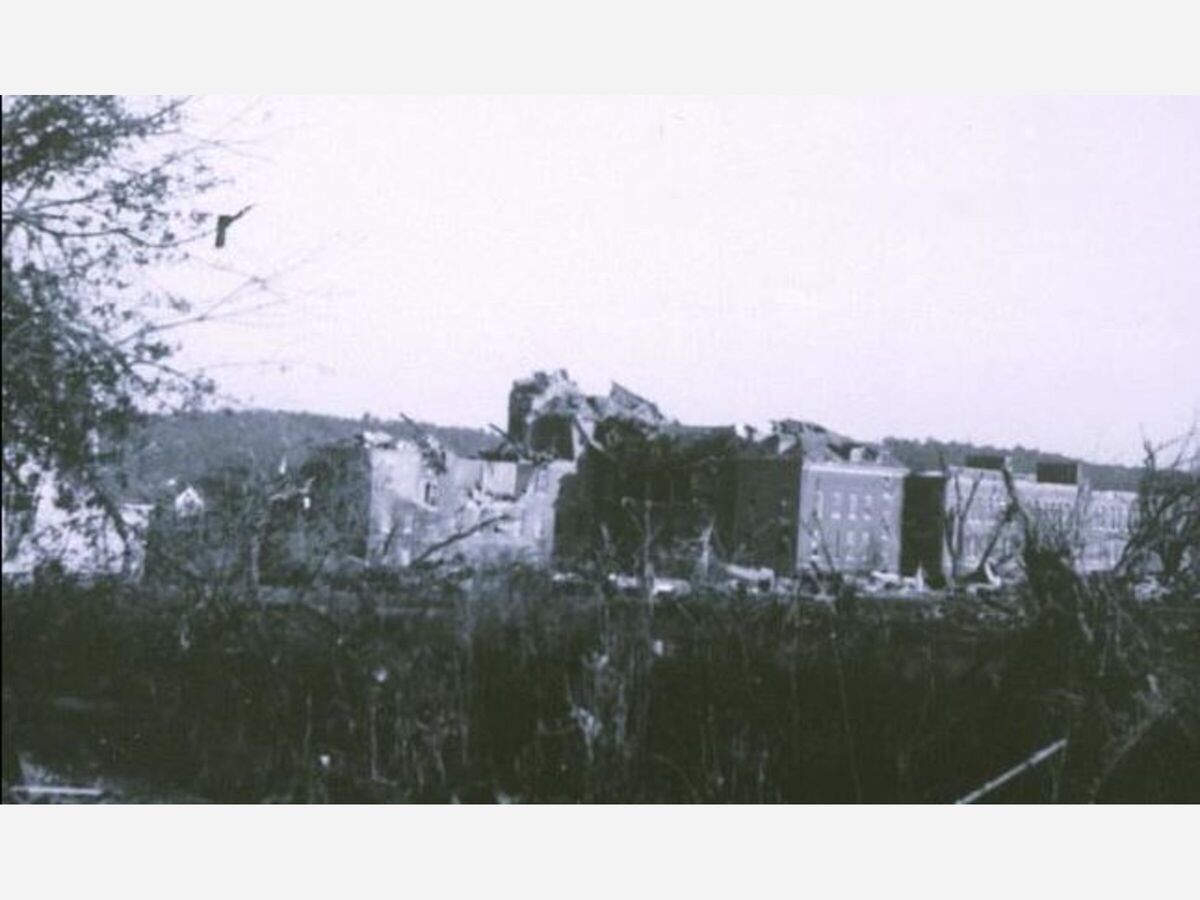



Above, damage to Assumption College in Worcester from the 1953 twister. The building is now used by Quinsigamond Community College. (NWS photograph)
Knowledge of the famous, very deadly June 9, 1953 Worcester Tornado is, generally quite widespread, so much so that the name, Tornadoes, was attached to the minor league baseball team that called that city home from 2005 to 2012.
What does that have to do with Franklin? Well, the tornado certainly devastated Worcester, nearly destroying the campus of Assumption College and killing a total of 94 people, injuring more than a thousand, damaging 4000 structures, and leaving 10,000 homeless.
But the tornado was on the ground for nearly 50 miles in the Bay State and Franklin was also in its sights. [The whole event is known as the Flint–Worcester tornado outbreak sequence and was rated, long after the fact, as an F5 in Michigan and an F4 when it got to Worcester.]
According to contemporary accounts the first place the tornado touched down in Franklin was in the vicinity of King and Union Streets “just south of the Parmenter Farm.” It then headed toward Uncas Pond and the vicinity of the Franklin Rod & Gun Club, on its way destroying the home of Mr. and Mrs. Wilfred Gosselin and then encountering the home of Mae Leeman on South Street.
A 31-year-old mother of two, Leeman, the wife of a Franklin patrolman, recounted standing in the middle of the road covering her children with a coat to protect them as the funnel cloud tore the neighborhood to pieces, uprooting and tossing large pine trees as it came. Half of the roof of her home lay scattered and there were holes in what was left and not a pane of glass remained in the windows.
She said when the storm began it was just rain and then thunder. Soon, hailstones the size of eggs began to fall. “I ran to the phone to call my husband,” who was on duty at the station, she recalled.
“Before I even picked up the receive there was an awful crash, I was stunned for a while and when I looked up, one side of the roof was gone...and I could see it raining in,” she explained. That’s when she fled outdoors, dodging flying lumber, shingles, and glass – as well as falling trees – and trying to shield her two small children.
Parts of the Gosselin and Leeman homes were later found scattered across a large area.
Elsewhere in Franklin, a calf was injured – the only loss among the many farm animals in Franklin at the time. And one of the Leeman’s two dogs was never found, presumably swept a great distance away by the twister. Many roads in town were blocked by debris and several large, historic trees met their end that day.
A reporter flying over the damaged area the next day noted that the path of destruction appeared to be about 200 yards wide but wasn’t continuous. The storm would scour a path of destruction and then appear to jump across a considerable distance without doing damage before touching down again.
In Wrentham, where the storm hit more populated areas, damaged was estimated at several hundred thousand dollars – many millions on today’s values – and nine people were injured. Buildings near the center of town were badly damaged and some, near Wampum Corner, were completely destroyed.
A Sentinel writer managed to find a touch of humor in the situation of a Mr. Harris A. Garland, who was in the process of moving into his new home in the Wampum Corner area of Wrentham at the time the tornado struck. The writer noted that instead of moving into his home, it was his home that moved (and was much the worse for the process).



Patchy rain nearby, with a high of 74 and low of 56 degrees. Sunny in the morning, patchy rain nearby in the afternoon, clear overnight.