Image
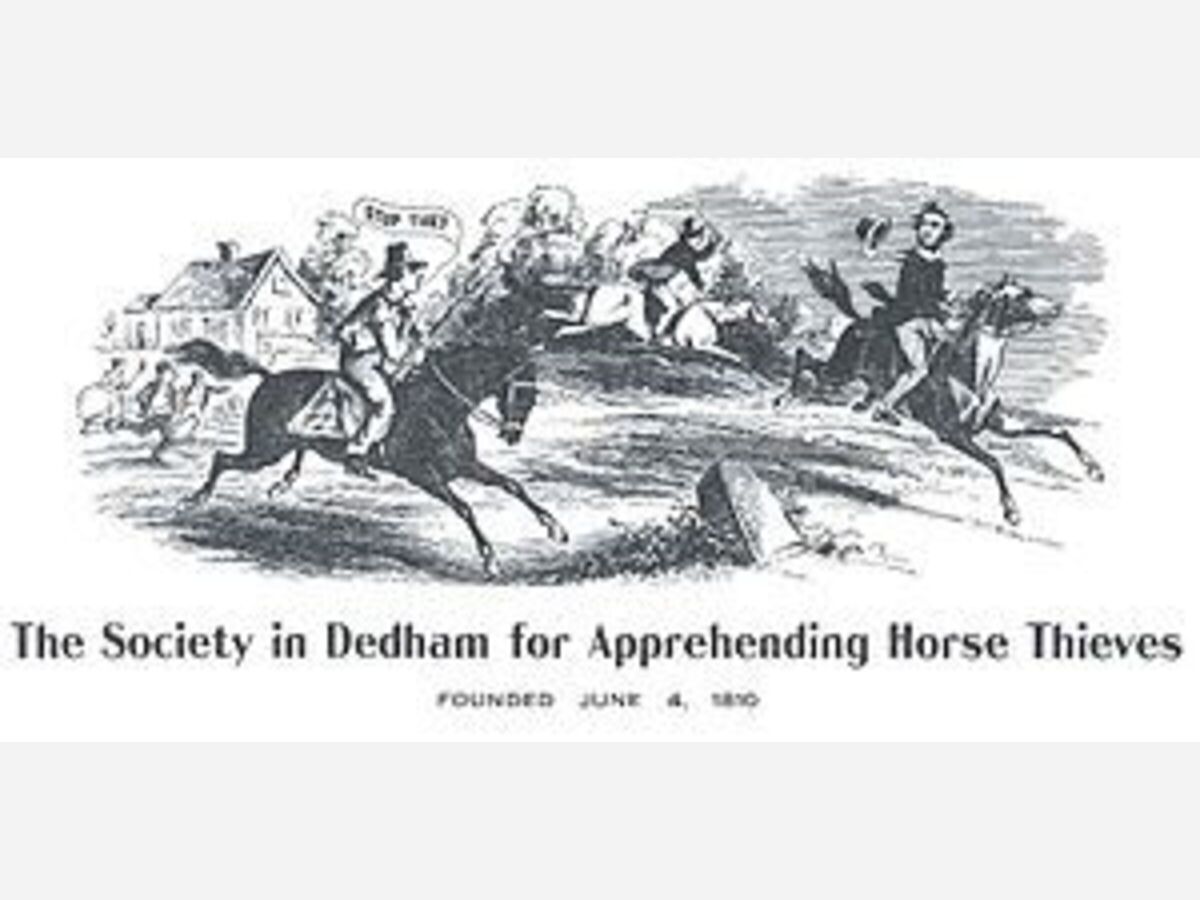



Actually, the organizations full, original name seems to have been much longer: The Society for Detecting Horse Thieves, and Recovering Stolen Horses belonging to Wrentham, Franklin, Medway, Medfield, Walpole, Foxborough, Mansfield and Attleborough. And it was formed way back in April of 1796!
That long and peculiar name thoroughly baffled Jordan D. Fiore when writing a history of our ‘mother town’, Wrentham, in the 1970s. Was it a social club just for local grandees, he wondered? That it might literally have been exactly what its name states seemed farfetched.
As it turns out organizations with similar names and a similar purpose cropped up all over the new nation, the earliest seemingly in Northampton, Massachusetts in 1782. Whether it was the spirit of democracy that bred lawlessness, the absence of the King’s law or some other cause, there seems to have been a crime wave in the first century of the nation’s existence and, in the absence of an organized constabulary, such self-help organizations sprang to life.
Two Virginians at about the same date, both with the surname Lynch, and both in the business of enforcing the law through extrajudicial groups are credited as the origin for the term ‘lynching’ – though neither actually executed anyone. That activity and association came later.
In New England, the end result of the activities of these societies seems to have been the return of stolen property, prosecution of individuals through the courts, and probably a lot of social stigmatization of wrongdoers.
Horses were the main focus – a form of capital that was mobile and readily saleable. But in the Worcester area, it was fruit growers that banded together to protect crops and mobilize against thefts of apples and grapes.
In later years, the Franklin-area Society for Detecting Horse Thieves broadened its geographic focus and shortened its name to the Norfolk and Bristol Horse Thief Detecting Society. An extant 1870s membership roster includes many familiar Franklin family names such as Pond, Ray, Russ, and Rusegue.
“Our” society must have faded from the scene not much later. No sign of it appears in the Sentinel newspapers. But Dedham, the mother town of our
mother town preserved and still keeps alive its Society in Dedham for Apprehending Horse Thieves and claims to have hunted for a stolen horse (without success) as late as 1909, and flirted with the idea of extending its brief to the motorcar. But by that date, the whole thing seems to have oscillated between fruitless Keystone Kops efforts and a mock seriousness that has, over time, attracted more than 10,000 members, including governors, presidents, and celebrities. Since members must be voted in, there is even a certain exclusivity.
And, in Dedham at least, we are sure horses are, consequently, much safer from horse thieves than in other parts of the land.

Sunny, with a high of 62 and low of 41 degrees. Sunny during the morning, overcast for the afternoon, clear in the evening,






![Franklin, Medway Announce Memorial Day Plans [Updated]](https://franklinobserver.town.news/sites/default/files/styles/manual_crop_400/public/9677/2026-05/memorial_day_observances.jpg?itok=B3DfGp8i)