Image
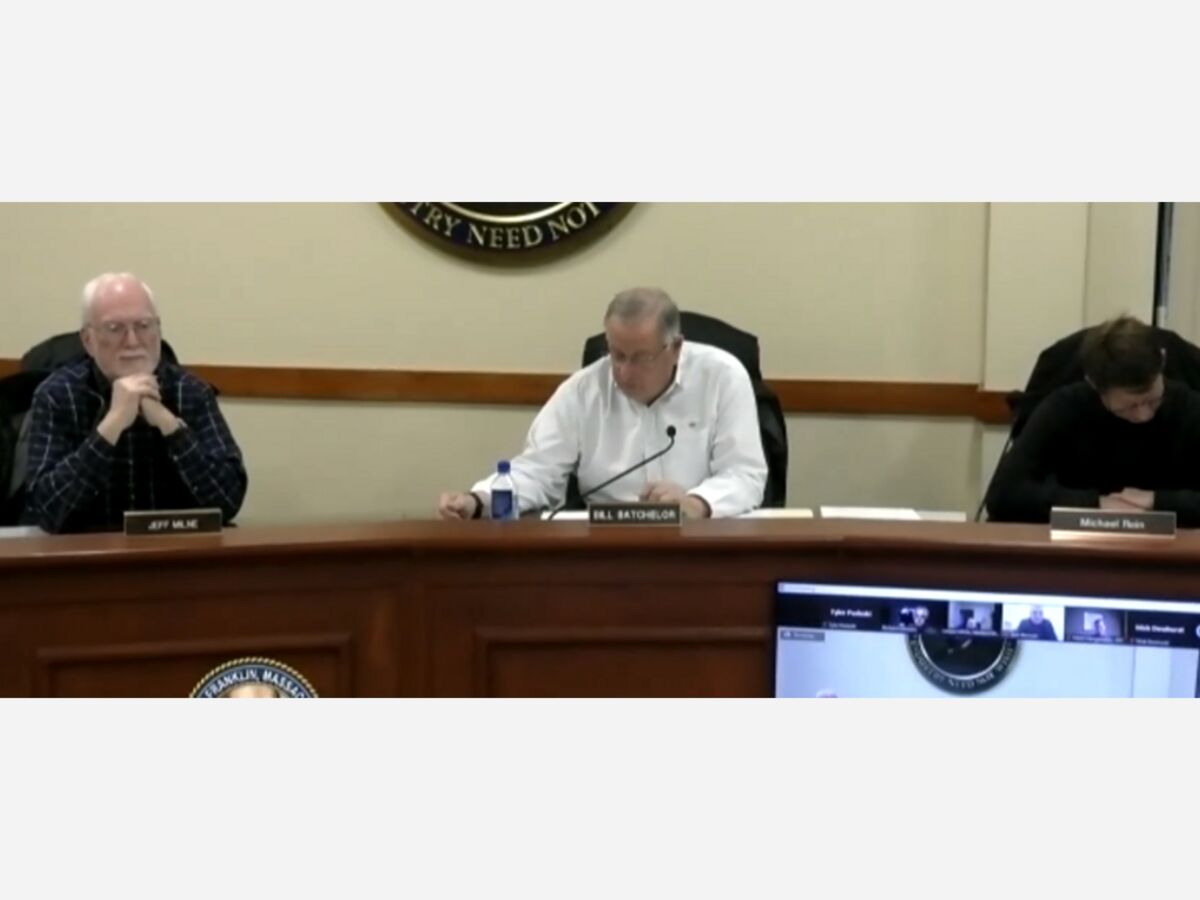



The Franklini Conservation Commission met on Thursdsay, April 14, 2022, virtually and in person. Chairman William Batchelor called the meeting to order and noted the absence of Commissioner Jeff Livingstone and Commissioner Andrew Mazzuchelli.
The first public hearing was for 585 King Street, an initial notice of intent (NOI). Josh Berman joined the meeting representing Marcus Partners. The site is a proposed large warehouse adjacent to the I-495 interchange. “We have a wetland crossing that we will be going over and then planned replication areas,” he said. The project has been before the planning board a number of times previously.
The project, according to Mark Manganello of LEC Environmental Consultants Inc., speaking for Marcus Partners, involves construction of a warehouse building, paved parking areas and access driveway stormwater management system, utilities and associated land clearing and grading.
He said, the Wetland crossing will result in both temporary and permanent disturbance to wetlands. “The project's been designed to avoid and minimize wetland impacts to the greatest extent practical, and to minimize for unavoidable wetland impacts with a wetland mitigation plan that involves wetland replication, bank restoration and buffer zone restoration,” he said.
Manganello then provided a detailed description of the projects and how the various environmental impacts are being handled.
When he completed his presentation, Chair Batchelor first asked Town Director of Planning, Bryan Taberner (who is currently also serving as Conservation Agent) if he had any comments. He noted mostly the thoroughness of the presentation. Batchelor then asked whether Wetland Scientist Lenore White of Wetland Strategies, Inc., who is working for the town to evaluate the project, would have any comments. She did.
Consultant Raises Specter of "No"
“Mark Mangenello has rightfully pointed out that this is what would be considered a `limited project,’ insofar as there appears that there's no other access into the site that would not involve wetland alteration,” White said. “So, it would qualify as a limited project as far as that goes, but I do want to point out that limited projects are discretionary, there's nothing in the limited project provisions that says the Commission should approve, it says may approve,” she continued. Further stressing the point, White stated that the regulations don't automatically allow an approval. But rather they give the commission that discretion as to whether or not they want to approve the project.
White then asked Manganello why the project needed an Environmental Impact Review?
Manganello explained that it was because of new “environmental justice” requirements.
According to the Massachusetts Environmental Projection Agency website “justice” demands an entirely new level of environmental scrutiny for projects. Justice itself does not seem to be defined but the web site states:
Effective January 1, 2022, all new MEPA projects located in “Designated Geographic Areas” (defined in 301 CMR 11.02) around EJ populations are required to submit an EIR as set forth in 301 CMR 11.06(7)(b). A “Designated Geographic Area” is defined as the area within one mile of the project or EJ population; or, for a project that meets or exceeds MEPA review thresholds at 301 CMR 11.03(8)(a) and (b) or that generates 150 or more New adt of diesel vehicle traffic over a duration of one year or more, excluding public transit trips, the area within five miles of the project or EJ population.
For these projects, the EIR must contain, in addition to the elements specified under “EIR Filing Requirements,” the following items specified in 301 CMR 11.07(6)(n), based on the methodology set forth in the MEPA Interim Protocol for Analysis of Project Impacts on Environmental Justice Populations:
For any project seeking to qualify in its entirety as an “Ecological Restoration Project” under the Wetlands Protection Act and implementing regulations at 310 CMR 10.00, the analysis required in Part II-IV of the MEPA Interim Protocol for Analysis of Project Impacts on Environmental Justice Populations can be provided in a checklist format as described in the Protocol.
Projects required to submit an EIR under 301 CMR 11.06(7)(b) may request that the Secretary allow a Single EIR under 301 CMR 11.06(8) or a Rollover EIR under 301 CMR 11.06(13); however, they are not eligible to seek a Full Waiver from the requirement to file an EIR.
Still awake?
White also noted that Manganello had referenced the need for review by the Army Corps of Engineers (presumably because the resource area connects to areas under Corps jurisdiction). Manganello said that review has not yet been conducted.
White said she would begin her evaluation but thought it likely that the EIR or Army Corps review would likely alter the existing plans, so she asked to be informed when those steps are complete.
Based mostly on that discussion, the Commission agreed not to make any decisions or take further testimony and then voted to continue the matter to a future date.
The next hearing was also for an initial NOI for 839 Upper Union Street. Here, it was determined that the state assigned DEP number for the project had only just arrived and other documentation had not arrived a week prior to the hearing, per Commission rules, making it hard for Commissioners to evaluate the project. Because of those factors, the Commission voted to reschedule the hearing for a later date.
The next task for the Commission was a continued NOI for 84 Populatic Street. The applicant was not present and more significantly, the DEP number had only just arrived, again contrary to Commission process, so the Commissioners voted to continue the matter until April 28.
Franklin Heights, parcel B, was the next matter of discussion. Taberner said that there was no one representing the applicant present at the meeting. He said White had gone on site with regarding to her concern that “flagging” of the site had not been done properly and in the process had also found another wetland area not previously delineated. Taberner suggested continuing the matter to the next meeting, which the Commission duly voted.
The remainder of the meeting dealt with Minor Buffer Zone Activities and Permit Modifications/Extensions: and approval of minutes of the March meeting. Taberner also informed the Commissioners that a new Conservation Agent is expected to start on April 25.


Light snow, with a high of 33 and low of 20 degrees. Light snow during the morning, clear during the afternoon and evening, light freezing rain overnight.