53° and Overcast



Image

Sam Drysdale | SHNS
As Massachusetts prepares to mark America’s 250th anniversary, the state of firsts faces a familiar question: Is it still leading, or living on its legacy?
The state that gave America its first public school, its first subway and a blueprint for near-universal health insurance is still fond of calling itself a "state of firsts." The slogan appears in tourism campaigns, economic development pitches and speeches from elected officials.
But 250 years after the shot heard ‘round the world, the more difficult question is whether Massachusetts is still leading — or increasingly relying on a reputation built by earlier generations.
In education, transportation and healthcare, Massachusetts remains a national model in many, but not all, respects. Each success story now carries unresolved challenges: stubborn student achievement gaps, aging and sometimes failing public infrastructure and healthcare cost increases that continue to outpace wages, economic growth and inflation.
Some critics — including Republicans trying to weaken a Democratic supermajority here — describe a state in decline, with leaders who are unwilling to fully take on its weaknesses.
Asked about the legacy of sectors they left their fingerprints on, some of the Democratic policymakers and bureaucrats who helped build and sustain Massachusetts' modern institutions use a different description: stagnation, but with opportunity.
"Massachusetts is the state of firsts because Massachusetts has a lot of firsts," said John McDonough, a former state representative from Boston and one of the architects of the state's landmark 2006 universal healthcare law.
The list is long.
Long before the Revolution, colonial Massachusetts required towns to provide education. Boston Latin School, founded in 1635, is widely considered the oldest public school in America.
Horace Mann created the nation's first state board of education in the 1830s and helped establish the model of tax-supported public schools that spread nationwide. Massachusetts passed the country's first compulsory school attendance law in 1852 and became an early pioneer in voluntary school integration in the 1960s.
Healthcare innovation stretches back nearly as far.
During a 1721 smallpox epidemic, Cotton Mather helped organize one of the first large-scale inoculation campaigns in the English-speaking world after learning about the practice from an enslaved man.
Boston established an early public board of health in 1799, with Paul Revere serving as its first president, and Massachusetts created the nation's first state board of health in 1869. Massachusetts General Hospital hosted the first public demonstration of surgical anesthesia in 1846, while Boston hospitals later helped pioneer organ transplantation and magnetic resonance imaging.
In transportation, Massachusetts was building ambitious infrastructure before the nation fully industrialized.
The Middlesex Canal connected Boston to inland markets in the early 1800s, railroads accelerated the state's industrial growth, and in 1897 Boston opened North America's first subway tunnel. In 1964, lawmakers created the Massachusetts Bay Transportation Authority (MBTA), the nation's first integrated regional transit system.
The state's fingerprints are all over American public life and the underlying sectors that support people. The question is whether those fingerprints are fading and whether new ones are being attached to modern progress.
For much of the last three decades, Massachusetts has answered that question with test scores.
The 1993 Education Reform Act transformed a good but uneven school system into one that became the envy of the nation. The law paired significant new funding with statewide academic standards, accountability measures and the Massachusetts Comprehensive Assessment System (MCAS) exam.
Paul Reville, an architect of the reforms who later served as education secretary, said Massachusetts earned its reputation.
"Recently, first has meant our academic performance relative to other states," Reville said. "We're proud of our first-place status."

Former Secretary of Education Paul Reville poses for a photograph in front of the State House in front of the statue of Horace Mann, a Massachusetts education secretary from 1837 to 1848 who is called the "father of American public education."
This year, Massachusetts students once again topped the nation in Advanced Placement exams.
But Reville quickly added a caveat.
"One doesn't have to look very far in the present time to know that we have a long way to go to get to what we were really trying to achieve," he said.
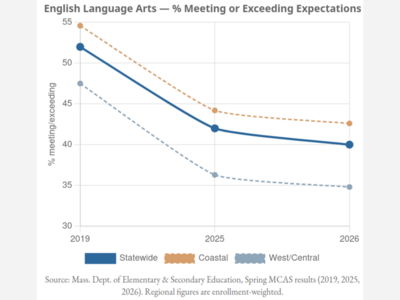
Massachusetts still ranks near the top nationally on many metrics, but achievement gaps tied to income, race, disability and language status remain, and other states are closing in on the Bay State's lead.
"I think that in Massachusetts there has been some level of complacency, particularly with respect to innovation, given our long history of first-place finishes," Reville said.
The debate over accountability reflects that tension. Voters in 2024 eliminated MCAS as a graduation requirement, dismantling a defining feature of the 1993 law. Massachusetts is still searching for what accountability looks like in the post-MCAS era.
Meanwhile, lawmakers have spent the last several years implementing a multibillion-dollar overhaul of school funding aimed at directing more resources to high-needs districts. And there's simmering discontent over whether the combination of state funds and local property taxes are producing enough revenue to pay for the type of public education that students need.
The state's achievement gaps remain among the nation's most persistent. While white and affluent students generally top national performance metrics, Black fourth graders in Missouri outperformed Black fourth graders in Massachusetts in reading in the most recent national assessments, a statistic frequently cited by education researchers as evidence that overall excellence can mask deep inequities.
"We're a long way off on equity still," Reville said.
Students in Massachusetts, as well as the rest of the country, are struggling to learn the basics of reading and writing, and school budget cuts are sweeping the state as inflation outpaces what critics call an out-of-date public education funding formula.
Reville now believes the original reform movement underestimated the forces outside school walls.
Students spend only a fraction of their lives in classrooms, he said. Housing stability, nutrition, healthcare, early childhood development and opportunities outside school matter just as much. The next generation of innovation may require a cradle-to-career system that integrates schools with broader social supports.
That would be a different kind of first.
Transportation may offer the clearest example of how Massachusetts' history can be both an asset and a challenge, with a legacy of innovation that also leaves the state maintaining some of the nation's oldest infrastructure.
Visitors descending into Park Street Station still encounter infrastructure that ties back to the nation's first subway system. The tunnel opened in 1897. More than a century later, parts remain in daily operation.

Streetcars diverted around the under-construction Park Street station in November 1896. The station was finished the following year, the first subway station in North America. [City of Boston Archives, Transit Department photograph collection]
The MBTA spent much of the early 2020s in crisis. Federal investigators found serious safety deficiencies on the subways. Trains were forced to run at reduced speeds because it wasn't safe to move faster on deteriorating tracks. Delays, derailments, fires and service disruptions became national news.
Former state transportation secretary Fred Salvucci traces many of those problems to decades of underinvestment.
"When you underfund an agency like the MBTA for decades, which is what happened, you dramatically undermine the state of the infrastructure by failure to maintain it," he said.
Yet Salvucci also points to moments when Massachusetts led the nation. During the highway revolts of the 1960s and 1970s, citizen activists blocked proposed expressways through Boston neighborhoods. The money instead funded major transit expansions.
"The benefit of getting a serious investment in the Red Line and Orange Line ... was very significant, and more thorough and systematic than occurred anywhere else in the United States," Salvucci said, noting that while other regions also halted highway projects, few redirected the money into transit on the same scale.
"Simply not doing bad things is good, but doing good things instead is even better."

Park Street Station under construction in Boston in 1914. [City of Boston Archives Public Works Department photograph collection]
He said MBTA engineers also pioneered subway construction techniques later adopted around the world.
"The MBTA doesn't, rarely if ever, get credit for being innovative, but there was tremendous innovation," he said.
Former transportation secretary Jim Aloisi sees a similar legacy in the Big Dig, the massive public construction project that was famous for cost overruns but led to underground highway tunnels in downtown Boston and a connection to Logan Airport.
"The much-maligned Big Dig actually helped unlock the bottlenecks, provide people with better mobility, and at the same time was very reparative," he said. It reconnected neighborhoods divided by elevated highways and "re-knitted the city."
Whether Massachusetts could undertake another project of that scale remains uncertain.
"We were lucky then with the stars in the right alignment," Aloisi said. "We also had a mentality that didn't stand in the way of understanding that spending money on projects like that is not wasting money, it's investing in yourself and investing in the future."
Today, the MBTA is attempting another turnaround.

Gov. Maura Healey (right) greets MBTA General Manager Phil Eng after exiting a Green Line train at North Station on Feb. 12, 2024.
General Manager Phil Eng said the agency has made dramatic progress.
"From where we were just three years ago to where we are today is night and day," Eng said.
Salvucci credits Eng and Gov. Maura Healey's administration with addressing years of neglect, but he rejects describing much of the current work as new investment.
"A lot of what Eng has been doing, they're calling it investment. That's sloppy language. It's not investment, it's deferred maintenance," Salvucci said. "It's stuff that should have happened 15 years ago that's happening today at much greater cost."
Eng agrees the agency is catching up, but argues that recent developments are "investment."
"We are making up for lost time," he said.
"The work we're doing is the precursor to continued, not only more robust service, but expansion," he said. "We're building the foundation for what everyone else wants us to keep looking at and building towards."
The challenge now is whether Massachusetts can move beyond repairing the systems it inherited and begin building the next generation of transportation infrastructure.
Perhaps nowhere has Massachusetts exerted greater influence on modern American policy than healthcare.
The state's 2006 healthcare reform law — often called Romneycare — made health insurance mandatory, created an insurance marketplace for consumers, led to near-universal coverage and became the model for the Affordable Care Act. But the achievement emerged from a much longer history of public health innovation and political experimentation.
For decades before the law's passage, Massachusetts debated universal coverage proposals, expanded Medicaid and experimented with healthcare regulation and deregulation. The 2006 law was the culmination of generations of policymaking rather than a sudden breakthrough.
Its durability may be its greatest accomplishment.

Governors laugh in the front row of an event celebrating the 20th anniversary of Romneycare on April 13, 2026 at Faneuil Hall. From left: Gov. Maura Healey, former Gov. Deval Patrick, former Gov. Mitt Romney, former Gov. Bill Weld, and former Gov. Michael Dukakis.
"What stands out is Massachusetts' willingness to be an innovator in expanding coverage and sticking with it," McDonough said.
"Other states have tried. They go through episodes. They come up with fancy, dancy programs with funny names. But when it gets tough around the money, then they lose their nerve, and they back off," he said.
"Massachusetts has been solidly committed to going as far as possible toward universal coverage and sticking with it."
Twenty years later, Massachusetts still has one of the highest insured rates in the nation. It has come with a hefty price tag — about $22.4 billion for the state's Medicaid program this fiscal year, which accounts for about 37% of the overall state budget.
House Speaker Ron Mariano, one of the lawmakers who helped craft the 2006 law and remains in office two decades later, recalled his work on the bill as the most difficult of his career.
"Everyone was viewing this as a major effort that could potentially be a game changer for how we do healthcare. That became apparent. Everyone was watching us back then," he said ahead of a recent 20th-anniversary celebration of the law.

This photo from the 2006 health care access bill signing sits in Speaker Ron Mariano's office, with a personal message from Gov. Mitt Romney.
Yet coverage and affordability have become two different conversations.
Healthcare spending has exceeded the state's cost-growth benchmark for four consecutive years. Total spending reached $83.3 billion in 2024, the most recent data available, driven by prescription drugs, hospital outpatient services and rising insurance costs.
McDonough sees continuity between today's debates and those of previous generations.
"The color of the blood that courses through the veins of the U.S. and Massachusetts healthcare system is not red, it's green," he said. "It's always about money."
"We are in a continuum along the perpetual crisis," McDonough added. "The state of crisis around healthcare costs is just the way things are."
Massachusetts tried to tackle that problem in 2012 with one of the nation's first comprehensive cost-containment laws. The measure created the Health Policy Commission, established a healthcare spending benchmark tied to economic growth and was widely viewed as the next chapter after Romneycare.
If the state had solved coverage, supporters hoped, it could solve costs.
The law increased transparency and gave policymakers new tools to monitor spending, but the results have been mixed. The benchmark remains in place, yet healthcare spending repeatedly exceeds it, reigniting debates over whether Massachusetts is willing to confront powerful interests in the healthcare industry.
"We do seem to lack in Massachusetts sufficient political will to do what would be necessary to control healthcare spending and healthcare costs," McDonough said.
That would require regulating some of the state's most influential institutions, including hospitals, physician networks, insurers, pharmaceutical companies and medical device manufacturers.
As Massachusetts approaches America's 250th birthday, its legacy is secure. Few states can claim a longer record of shaping the institutions that define American life, and Massachusetts is still living within systems it helped invent.
The question confronting the state's semiquincentennial is whether the next generation will be remembered primarily for simply preserving those achievements, or for creating the new ones that people will be writing about in 2176.
Sam Drysdale is a reporter for State House News Service and State Affairs Pro Massachusetts.



Overcast, with a high of 61 and low of 47 degrees. Patchy rain nearby during the morning, overcast in the afternoon, clear during the evening, overcast overnight.