36° and Clear



Image
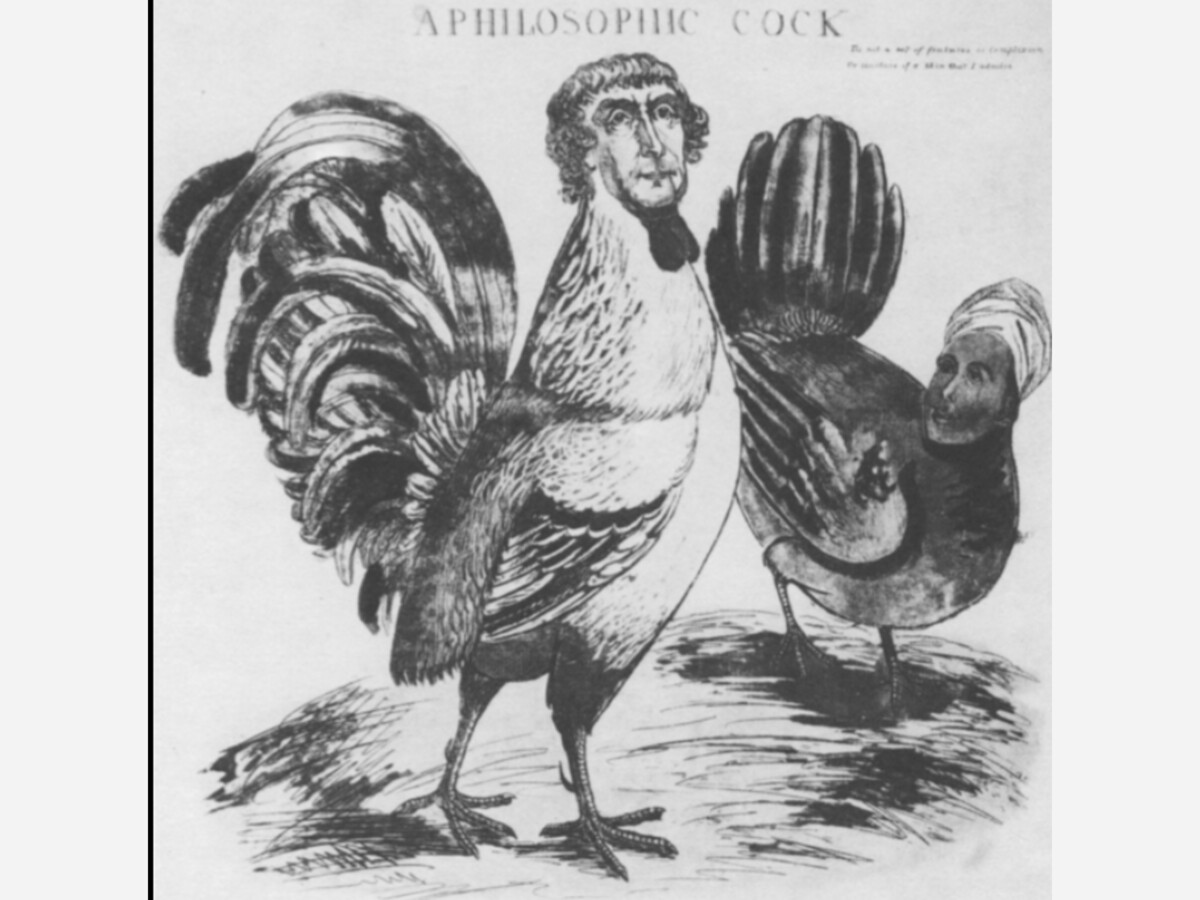
Above, an 1804 cartoon depicting Jefferson as a rooster and his enslaved paramour, Sally Hemings, as a hen. The writer notes that Jefferson made no effort to suppress such attacks on him.
[Editor's Note: Parts of this letter appeared in the Observer a few years ago, amended this time by the writer, with emphasis on Freedom of the Press.]
To: The Editor
Re: Freedom of the Press: “Thus Spoke Thomas Jefferson About a Free Press”
From : James C. Johnston Jr.
When Thomas Jefferson was still the United States’ Minister to France on January 16, 1787, he wrote to his old friend Edward Carrington, who was serving as a member of Congress in Philadelphia, the following lines, “Were it left to me to decide whether we should have a government without newspapers, or newspapers without a government, I should not hesitate a moment to prefer the latter.”
Jefferson was an advocate for a free press and was living in pre-revolutionary France where freedom of the press was still something to be fondly wished for. People were still sent to jail in many if not most countries for the crime of sedition that is for printing articles in the public press which were not liked by the “powers that be”. In most western nations, as for the rest of the world, a free press was largely unknown. And two hundred and fifty years ago very few people who were not of the emerging middle class or the aristocracy could read the printed word anyway.
The idea of living in a country with a free press and no government was an extreme concept at best, but Jefferson was sincere in this belief. Thomas Jefferson held to this belief for all of his life even when he himself became the object of vicious attacks when he ran for the office of President of the United States in 1800 and in 1804. There were attacks made upon him and his personal life that would shock most modern readers of scathing editorials today. An unfortunate fact of these attacks was that they were based in reality!
The fact that Jefferson lived and had sexual congress with his slave woman, Sally Hemings, who was actually his deceased wife’s half-sister fathered by her own biological father who owned Sally as his personal property and fathered children by her, was widely published in the Federalist press. The fact that Hemings was his late wife’s half-sister was also widely published. In spite of that, and hundreds of other stories circulated about Jefferson, Jefferson always remained a champion of the free press. Even when he was vice-president serving under his once and would-be friend and political foe, John Adams, Jefferson actively opposed the infamous Alien and Sedition Acts which made it a crime to criticize the Government in the press, as well as, the President, and other government officials.
As a full disclosure, I really must declare that Mr. Adams and I are in fact distant cousins. I can also say that I have never met Mr. Adams, nor does our being related influence my historic evaluation of him. Seriously, he and Abigail seldomly drop in for tea these days!
During Jefferson’s eight year tenure as President of the United States, he and his policies such as The Embargo Act were subjects of vicious editorials, out-right attacks, and very unflattering political cartoons. Jefferson, who could be a very skilled and vicious political in-fighter himself, allowed the Alien and Sedition Acts to die and remained a great defender of the free press. At the end of the day, freedom of the individual in every respect was at the base of Jefferson’s personal philosophy and political belief system.
This seems to be at war with the great fact of Jefferson’s life that he was the owner of hundreds of other human beings as slaves in his lifetime. Jefferson hated slavery but bowed to the economic necessity of his situation. This may have made him a moral coward, but in 1807, in the seventh year of his presidency, Jefferson supported the ending of the international slave trade. He wanted to free his slaves at his death, but his debts were so great, that this could not be done.
In the context of his time, Jefferson was a decent man, yet there was also a nasty bit of hypocrisy at war with his legacy of greatness as an advocate of political and personal freedom and human rights. Jefferson was a very complex man. The important thing to remember is that Jefferson would fight for my right to call him a hypocrite in the public press.
Slavery was The United States’ Original Sin! The ownership of human beings predicated on the most pernicious sort of racism is to me the very essence of racial fascism. Slavery was a fact of life in this nation from 1619, when the first slave ship docked at Jamestown, Virginia, and the first cargo of Africans kidnapped from their own nations were transported to the Americas against their will. Slavery lasted until its abolition by the Thirteenth Amendment in 1865. That means that for more than half of our recorded history we have been a nation of slave-holders.
Nationally, slavery was ended 151 years ago, but just in the last year –and-a-half, persons of color and women have been excluded from promotion to the highest ranks of the United States armed forces, and our President has let it be known that he does not want to share a public platform with high ranking officers of color or women. How far have we advanced from the days when Jefferson wrote attacks against slavery while owning hundreds of human beings in bondage?
At 82 years of age, I find this hypocrisy painful to live with. Just what do we mean when we say that all men [and women] are created equal anyway? When I can see the living genius of people of color on the public stage of American life, I find it difficult to understand the racism that persists to this very day. When I was very young, back in the days of Martin Luther King when I was involved in the Civil Rights Movement, I was sure that I saw a new age of enlightenment dawning in America. I think that I was right about that in most of the nation, and yet residual racism seems to have been growing stronger during the last decade in some parts of this country.
Times are tough for most of us no doubt. Oil and gas prices are surging through the roof. Groceries are very expensive. The price of all goods transported across the nation by trucks is rising. Housing is growing very scarce as well as prohibitively expensive. Lumber from Canada, which is subject to new tariffs imposed by our government and therefore paid by United States citizens, make new housing costs higher than ever. Inflation is making all the goods we buy far more expensive, and the Middle Class is facing financial difficulties they had not envisioned. Education beyond high school has become priced beyond the ability of the Great American Middle Class to pay, and the super-wealthy seem to be living in another country from the rest of us. As an historian, I look at this state of affairs and cringe just a little bit, because I know that we are on the edge of a dilemma that people do not wish to articulate nor know how to deal with.
Our democratic institutions seem to be melting away as masked law enforcement agents, in civilian automobiles and wearing civilian clothes, randomly attack people of color or of Hispanic and non-Caucasian background with impunity. They kill with impunity, take people away into custody with impunity, and make them disappear also with impunity. There seem to be no consequences for these I.C.E. Agents who randomly shoot and beat-up people. Yet, this is our America in 2026, the very year of the celebration of our 250th year of independence from royal and non-representative political oppression. Sometimes these days I don’t feel all that free.
One of the guarantees that we have traditionally enjoyed since the days when Andrew Hamilton defended Peter Zenger in a royal court is a free press as a final a check on the abuse of power. Today, in spite of the ruling of the courts, we have a president who still restricts the free press from access to what is going on in the executive branch of his government. Going back more than two centuries to Thomas Jefferson, no man was so savaged by the press while in office than Jefferson, yet he defended the press against legislation designed to kill the press’ freedom to cover the government and its actions. Jefferson, like all of us, had his faults, but his basic instincts were definitely in favor of democracy. A free press is essential for democracy if we want to keep the republic as Ben Franklin warned us in 1787 that we must work to keep.
We are living in dangerous times. There is a privileged class of billionaires, who own a huge chunk of America as their private real-estate, who declare that we have never been better off. From their perspective, maybe this is true for them, but somehow when I deal with the economic realities of my own life in October of 2026, I don’t feel that way. No doubt we all have a lot to think about as the first Tuesday after the first Monday in November, our traditional national day of voting, looms up ahead of us, and we will we vote to see what kind of future we will have. Between now and that seminal day we have more than a little to think about. Jefferson’s words about a free society and a free press haunt me, and I will think about what he had to say to us on that all-important subject as I cast my vote for the future of the great democracy in which we still live protected against ignorance by its free press.



Sunny, with a high of 60 and low of 36 degrees. Partly Cloudy in the morning, overcast in the afternoon, clear during the evening,