25° and Clear



Image
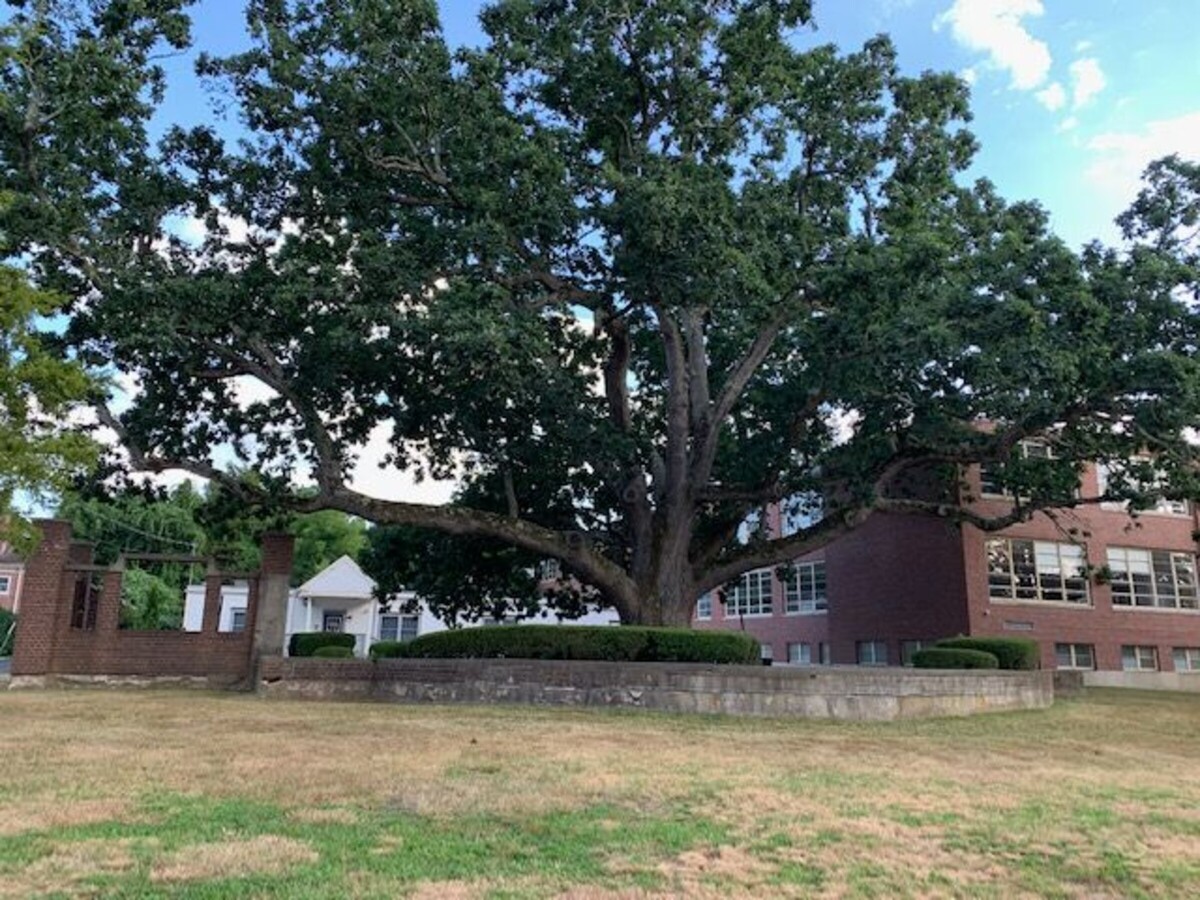
On May 5, the first tree in Franklin ever to be judged of such significant size and historic importance that it deserves to be in the state's Legacy Tree program, was officially added to that roster. The local star is the familiar white oak on the corner of Pleasant and Main streets, adjacent to the St. Mary's School Building.
According to state arborists, its dimensions alone qualify it to rank among the great trees of the state. This specimen has a span of a full 94 feet and a height of 57. Its circumference is some 235 inches. While arborists can't readily determine the age of a tree, it was already a large and mature tree that gave its name to the Hayward Mansion more than a century ag0-- Oaklee. It is also entirely possible that it was shading the town's original meeting house (where the Catholic Church is today) when the town was established in 1778.
In the marginal notes of the 'Legacy" listing, the state arborists wrote, "stunning."
The Legacy Tree Program does not afford any special or legal protection under the Commonwealth's Shade Tree Law, M.G.L. Chapter 87, but it does provide bragging rights and aligns with the great interest being shown by policy makers in the health and number of trees in the Commonwealth.
Indeed, on Friday, Boston Mayor Wu kicked of an urban forestry initiative designed to increase the number of shade trees in the city.
Similarly, tree canopies shading Massachusetts cities and towns could grow dramatically, particularly in environmental justice communities where there's currently scant coverage, under a legislative proposal to launch a municipal reforestation program.
Neighborhoods with less than 20 percent tree canopy cover -- defined as "the surface area of the land covered by the combined leaves, branches, and trunks of all standing trees in a given area when viewed from above" -- are deemed top priority locations in bills filed by Reps. Steve Owens and Jennifer Armini and Sen. Cindy Creem (H 869 / S 452).
David Meshoulam, co-founder and executive director of Speak for the Trees Boston nonprofit, said the urban tree canopy declines every year across the country due to development, the threat of pests, climate change and decades of underinvestment. Massachusetts was among 23 states that experienced a "statistically significant" decline in urban tree canopy from 2009 to 2014, he said.
"Communities are losing trees faster than they can replace them," Meshoulam said. "We can and must do better to ensure that tree deserts across the state have the resources they need to expand and grow their tree canopy to meet the needs of the residents."


Overcast , with a high of 34 and low of 23 degrees. Overcast in the morning, mist in the afternoon and evening, clear overnight.