25° and Clear



Image
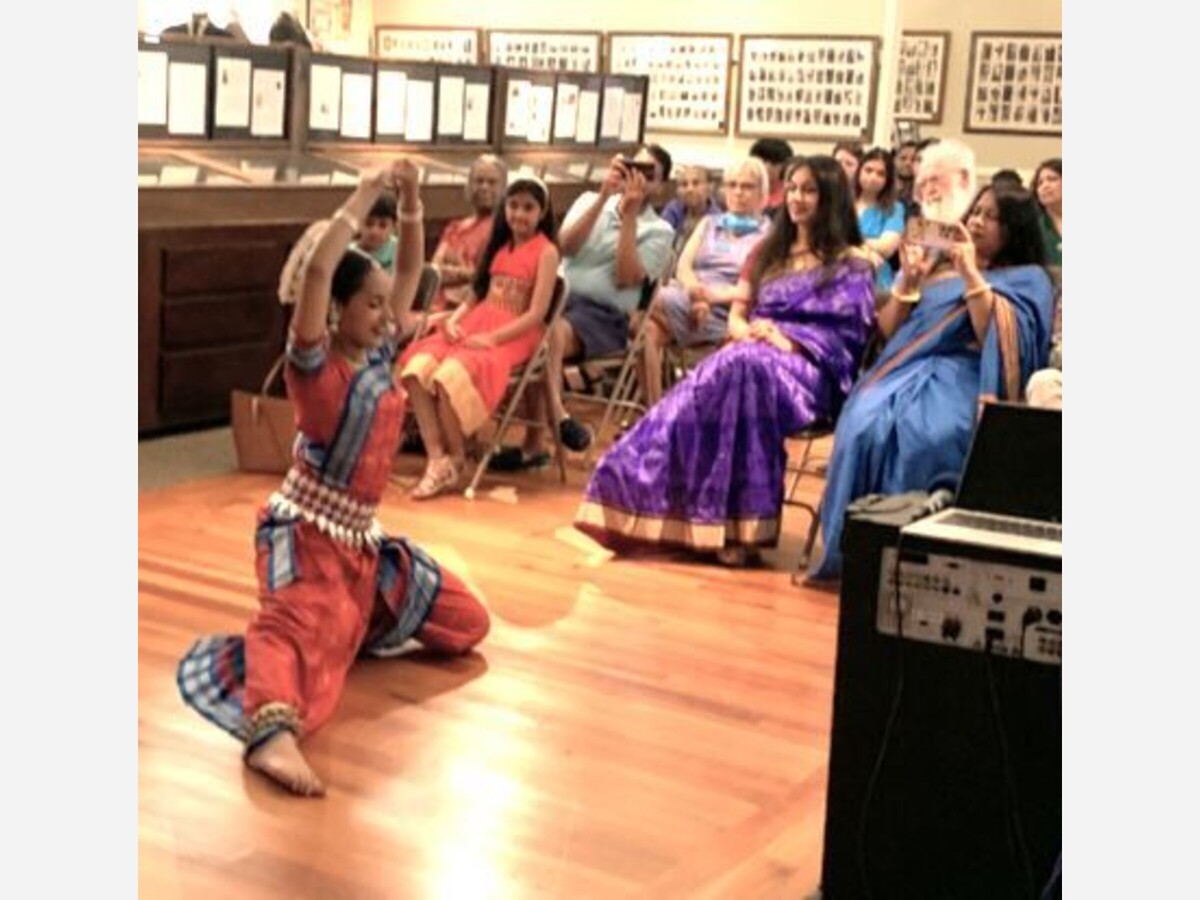
Above, Maya Swain demonstrating Odissi classical dance at the Franklin Historical Museum on Saturday.
An event honoring the Independence Day Holiday of the Republic of India transformed the Franklin Historical Museum on Saturday.
India is the seventh-largest country in the world by area; since 2023, the most populous country, and ever since 1947, when it achieved its independence, the world's most populous democracy.
Following the playing of both the US and India national anthems (the later more like America the Beautiful than the Star-Spangled Banner in that it extols the wonders and beauties of the nation), Krishna Swain, a Bellingham High Senior, provided a concise historic overview of India and its connections with the rest of the world.
For example, the Indus Valley Civilization, one of the earliest in the world, appears to have been highly stable and highly egalitarian, with almost no indication of a wealthy class or ruling class. Also, unlike many other cultures, few weapons have been found in archaeological sites. And its writing system remains undeciphered.
Swain noted the early presence of Christian proselytizers in India. Long before Christianity reached the British Isles, there were Christian churches in India. And India was an early innovator in mathematics, providing the concept of zero and the numbering system misattributed by Europeans to the Arabs, from whom they learned it.
In the more recent past India (and Britain's American colonies) both chafed at limits on the development of local industry due to restrictions that favored British-made products.
Swain went on to discuss musical traditions, including the modern era synthesis of old and new musical instruments and even the invention of wholly new instruments, on one of which he played a “Bollywood” hit song – with his father Sanjeeb providing rhythm accompaniment.
The dance topic was introduced by Shipra Avantica Mehrotra, a renowned performer and leading educator of Odissi classical dance in the United States. The New York Times described her performance at the 2010 Erasing Borders dance festival as “wholly poetic” and “the truest revelation of dance itself.” She is also the founder and artistic director of Avantica Academy of Odissi Dance in Norfolk, MA.
Mehrotra gave a short talk about the origin, philosophy, and symbolic meaning in classical Indian dance. With help from her student, Maya Swain, 13, she was able to show how different dance positions are performed, how they are often reflective of sculpture and bas relief found on Indian temples, and the meaning of the performance.
When she completed her talk, Maya Swain embarked on an extremely athletic and graceful performance of Odissi dance lasting 10-15 minutes and showcasing her own burgeoning virtuosity. She earned a loud and enthusiastic ovation from her audience.
At that point, the event “took a break” on the front steps where the Swains served prepared Indian food and offered visitors a chance to take pictures with a backdrop of a famous Sun Temple in Eastern India.
When the afternoon resumed, Julie Swain provided an introduction and overview of Yoga, Meditation and Ayurveda, the first two having group participation to provide a flavor of what lies beyond, when one makes h a bigger commitment of time. She went on to explain Ayurveda, the ancient system of philosophy and science pertaining to the maintenance of health and well-being. She provided samples of typical herbs and plants used in Ayurveda such as turmeric and moringa, sometimes called the Tree of Life.
The final segment of the program was an interactive discussion with Julie, Krishna, and Sanjeeb Swain, and Shipra Avantica Mehrotra fielding questions and sharing views. Among the topics touched on:
When the event closed a little before 5 pm, there was enthusiasm to “continue the discussion” perhaps with more or different events in the future.
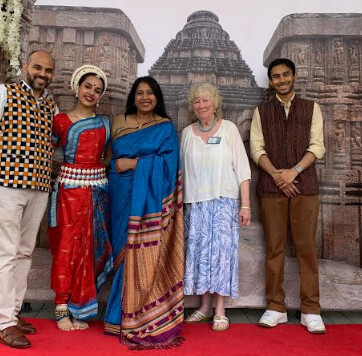
Above Sanjeeb,Maya, and Julie Swain, Jan Prentice of the Franklin Historical Commission, and Krishna Swain.


Overcast , with a high of 34 and low of 23 degrees. Overcast in the morning, mist in the afternoon and evening, clear overnight.