25° and Clear



Image
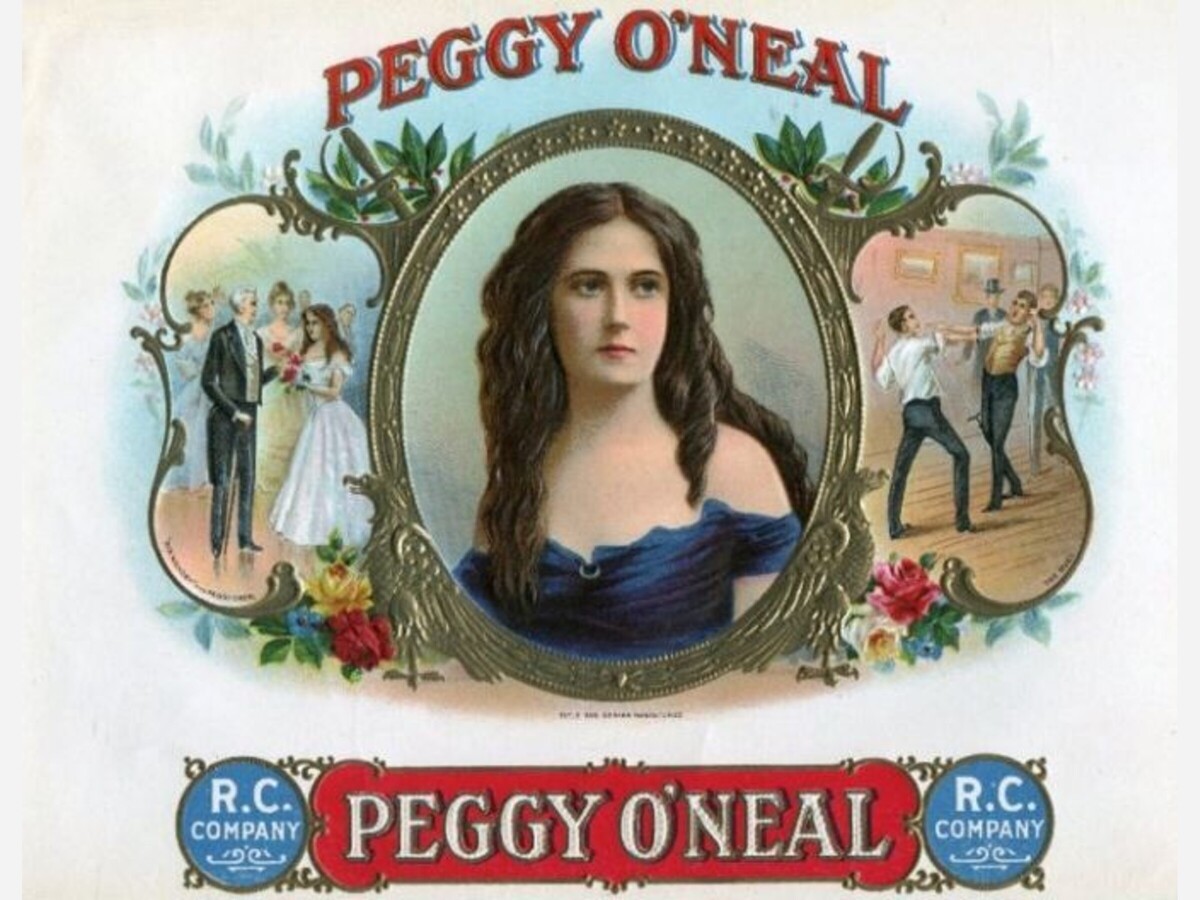
Above, a cigar box illustration shows President Jackson introduced to Peggy O'Neal (later Peggy Eaton) (left) and two lovers fighting a duel over her (right), an incident that is among the more colorful in Jacksonian America.
By James C. Johnston Jr.
Sometimes the impact of just one letter is so great that it seems to merit an article all of its own. Here is a letter called a folded stamp-less cover, posted and post-marked in Bedford, Massachusetts, that ties into the life and times of the energetic and self-made-aristocrat seventh president of the United States, Andrew Jackson. Jackson was also a person who liked to project the image of being the living embodiment of the “Common Man”.
Andrew Jackson, who was: President of the United States, former Congressman, and U. S. Senator, and General of Volunteers, Conqueror of Florida, and the Victor of the Battle of New Orleans who overwhelmingly defeated the Duke of Wellington’s Brother-in-Law, Sir Edward Packingham, outside of the aforesaid New Orleans in a very lopsided victory on January 8, 1815 weeks after the Treaty of Ghent had been signed. But Jackson saw himself as the champion of the common man [White Man that is], and he successfully became President of The United States on his second try in 1828 when he defeated incumbent John Quincy Adams of Massachusetts. Regarding the not-so-new element of political sectionalism, Jackson was born in Virginia, but he identified himself as a “Tennessee Man,” thus a “Westerner”. Jackson, therefore, had the distinction of being the first “Westerner” to be elected President of the United States.
When Jackson was elected President in 1828, the victory was bitter sweet. During the hard fought campaign, Jackson’s beloved wife, Rachel, had been attacked in the Anti-Jackson Press as a woman of low reputation, because at the time of their marriage, she unknowingly and technically was still married to her very physically abusive first husband, a Captain Lewis Robards. The year was 1789, and Andrew Jackson was still in his late twenties.
When Jackson first moved to Tennessee, he met his landlady’s lovely daughter, Rachel Robards, who happened to be staying with her mother to avoid her abusive husband who had recently beaten her rather severely. Jackson fell hopelessly in love with her. And on discovering that Rachel was in a horribly abusive relationship, Jackson encouraged Rachel to escape Robards, secure a divorce, and marry him.
Captain Robards fooled his estranged wife into thinking that he had divorced her. Rachel, thinking that she was legally free to wed, then went through a marriage ceremony with Jackson. After a while Robards revealed to the community, in public print, that his wife, whom he had not divorced after all, was indeed living in sin with Jackson as a bigamist!
Rachel then got a legal divorce, and she and Jackson married again, but the damage to her reputation was done, and for the rest of her life she was scorned, rejected, and hounded by “good society’’ even in the public press until her death in 1828 when she was in her sixties. The Presidential election of 1828, which saw Jackson victorious over his opponent John Quincey Adams, had been exceptionally vicious. The sexagenarian Rachael was accused of all sorts of sordid crimes. As a result, she died of depression and heart failure. I would like to add at this point that John Quincey Adams himself was a gentleman who never once engaged in gossip about Mrs. Jackson. I am afraid that the rest of Jackson’s enemies were not of this ilk.
During their childless marriage, Rachel Jackson had been endlessly tormented by her detractors, but the most recent public assaults, during the 1828 Election, had been far too much for her. During their long marriage, Jackson had fought duels over the assaults on Rachel’s honor in which he both killed and wounded those who insulted her. Jackson was fierce in his attitude and reaction to his enemies.
During his tenure as President of the United States from 1829 to 1837, Jackson threatened to: hang his Vice President, John C. Calhoun, for trying to take South Carolina out of the Union, shoot Senator Henry Clay on general principles of his opposition to Jackson, march troops into South Carolina and hang everyone supporting “Nullification” of that state’s membership in the Federal Union, and he had a special mission to destroy The National Bank and its President, Nicholas Biddle of Philadelphia for both opposing him politically and as a symbol of the privileged and elite society.
Jackson’s hatred of Biddle was based on Biddle’s upper class Philadelphia background and political support of Jackson’s political enemies. When it was time for the renewal of the charter of the National Bank, Jackson called it, “A bank monopoly,” and vetoed the bill which Congress passed to re-charter it. Jackson then removed all Federal Deposits of cash from Biddle’s Bank and put the funds into banks which were owned by political friends. These favored banks were called “Pet Banks” for that very reason.
In the town of Bedford, Massachusetts, a petition was circulated calling for the reinstatement of the National Bank’s Charter. This was very big news at the time which excited some correspondence among the citizenry of the nation who followed politics very closely. In my collecting of ‘other people’s mail’ as an adjunct to my stamp collecting, I came across the following folded stampless letter written by David Mann from Bedford, Mass. It reads,
Samuel M. Barclay Esq. Mrs. Scovel called a few days ago and requested me to remind you of your promise to ascertain whether the lots on which she resides have been patterned and if you obtained a copy of the patent.
I see the governor has come out against the bank [National Bank]. What course does the state administration intend to pursue, and are they going to unite in favor of Van Buren:-What is the prospect of obtaining loans to carry on the improvements- Will the Legislature adopt the Treasury Plan of sending an agent to Europe to obtain loans-Would it not be better to send one to Washington City to get the “Greatest and Best” [Jackson] to change his course and secure the country-What has become of The Bedford Petitions for the bank-
I will be pleased to hear from you and if your engagements permit-give me all the news political or otherwise-
Your friend, David Mann
This letter is just loaded with history, and it shows just how clearly members of the public saw and understood contemporary events in all their subtlety.
Now Jackson had gone to great lengths to portray himself as “Friend to the Common Man”. It is true that Jackson was the orphaned son of Scots-Irish immigrant stock who had been abused by a British officer, during the American Revolution, who had slashed Jackson’s face with a sword because the thirteen-year-old refused to clean the officer’s boots.
After that, killing Englishmen became a sort of hobby with Jackson. He hanged a couple of Englishmen as spies when he was taking over Florida from the Spanish in 1818. Jackson also hanged a substantial number of Native Americans, including the Sachem of the Seminoles, who had attacked slave plantations in Georgia and South Carolina. Jackson had killed several thousand British troops at New Orleans which gave him a smug feeling of being well.
Killing people who he considered his enemies was something Jackson did not shrink from. When he was in his late sixties, a man tried to shoot him on the steps of the Capitol. When the two pistols Jackson’s assailant misfired, Jackson beat the man into a state of insensibility with his very heavy walking stick. Along with shooting the odd-insulting party in a duel, Jackson was known to be rather sharp with those who challenged him’
When the women of “Washington Society” refused to accept the wife of his Secretary of the Treasury Mrs. Peggy Eaton into their ranks, Jackson called those same leading members of “Washington Society Women” into his office and informed them that Mrs. Eaton was to be invited to all of their social functions. They, in turn, pointedly reminded the president that Mrs. Eaton had been a mere waitress at Gatsby’s Tavern and was therefore hardly worthy of inclusion in their august company. Jackson then told them that unless they complied with his wishes, he would kick all of their husbands out of their jobs and that they would, “…find yourselves out in the streets of Washington!”
When the society women failed to follow Jackson’s instructions, he fired his cabinet and a raft of federal officials and drove these lofty ladies and their husbands back to their own states. The Whitehouse had been over-run by 10,000 of the “Common People” on March 4, 1829 when Jackson was first inaugurated president. The interior of the “Presidential Palace” was trashed beyond belief. Jackson himself was saved from being crushed by his adoring mob by being lowered out of a window in a very large basket and then spirited away to Gatsby’s! The “Common Man” theme was a little dangerous at times.
In addition to punishing Biddle, the National Bank, snobby women in government circles and their husbands, would-be secessionists in general, and anyone seen as a political enemy, Jackson also saw danger from the “Wild-Cat Banks” which seem to have sprung up everywhere. Some would argue that this was the natural consequence of destroying The National Bank as a great stabilizing force in the economic life of the nation.
These “Weld-Cat” banks were all issuing paper banknotes in vast amounts far in excess of their actual stocks of bullion, or specie coins of gold and silver. The Bank of England and other great European government and banking entities had been issuing paper notes for a very long time in 1837. They were very conservatively supervised and controlled for the most part. The French went through a bad patch during the French Revolution when the government went crazy issuing banknotes with the words, “Forgers will be punished with death.” There was also a clear implications that “Citizens” who would not accept the paper money at full face value were counter-revolutionaries who could be denounced for lacking “Loyalty” and face Madam Le Guillotine who was after all “The Great Arbiter of Equality.”
But in the United States of 1837, it was obvious that these millions and millions of dollars of pretty banknotes had no real value {Bit Coins?}, and Jackson caused the “Specie Circular” to be issued. This order simply stated that all money owed to the Federal Government must be paid in “Specie” which is gold or silver coinage. Paper note would not be accepted. The effect of this order was to demonetize paper money overnight. Runs on the banks for gold and silver began immediately as people tried to cash in their banknotes for hard cash. Hundreds of bank failures occurred immediately with thousands to follow.
The Great Panic, Crash, and Depression of 1837 followed, and the blame fell on poor Martin Van Buren who succeeded Jackson on March 4, 1837. There is a lot of history in letters and postcards. Go unto your attics sometime and discover a fantastic, or unexpectedly romantic past.
James C. Johnston Jr. is a former Franklin selectman, Franklin High School history teacher, and author of "The African Son," a novel , as well as "The Yankee Fleet" and "Odyssey in the Wilderness," (a history of Franklin, Massachusetts). Article copyright James C. Johnston, Jr. 2023, used with permission.


Overcast , with a high of 34 and low of 23 degrees. Overcast in the morning, mist in the afternoon and evening, clear overnight.