48° and Clear



Image
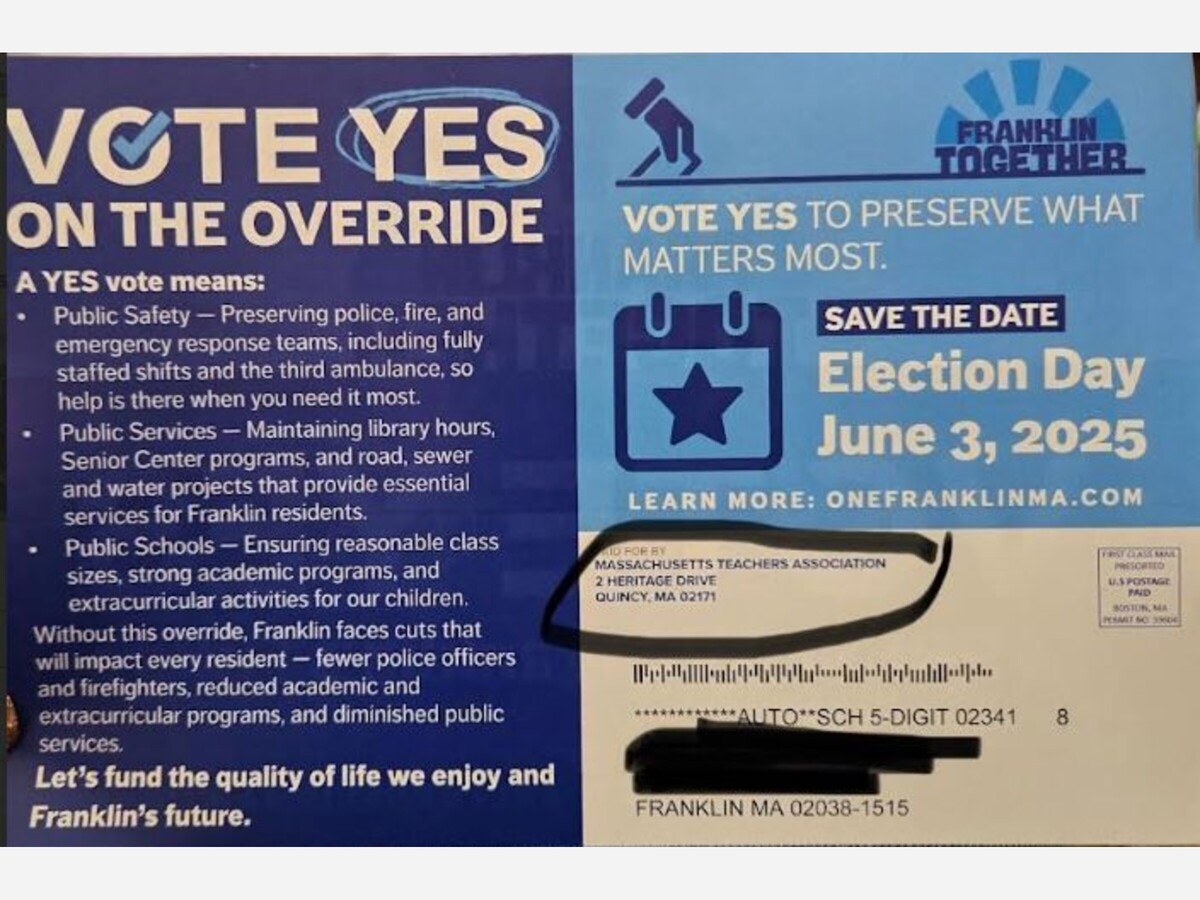
To the Editor:
Something doesn’t add up.
Recently, Franklin residents received a professionally designed mailer urging them to vote “Yes” on the upcoming Proposition 2½ override. What many may not realize is that this mailer was not funded by the Town, nor solely by a local group — it was paid for by the Massachusetts Teachers Association (MTA), one of the most powerful statewide unions.
Mailers of this size and quality aren’t cheap. Each piece typically costs between $0.56 and $0.75 to print and mail. With over 24,500 registered voters in Franklin, that would total $15,000 or more — a significant investment to influence what is supposed to be a local election.
But it wasn’t just one mailer per household.
In my own home, we received two copies of the same mailer. Some residents reported receiving as many as four copies at their address.
When you factor in the duplicates, the actual cost to the MTA may be even higher than originally estimated.
And that raises an even more important question:
How would a statewide union like the MTA know such detailed information about Franklin’s specific public safety needs, library hours, and override challenges — unless they coordinated directly with the “One Franklin” ballot committee?
Here’s why that matters:
Under Massachusetts campaign finance law, outside groups like the MTA are allowed to support or oppose a ballot question.
However, they must do so independently — meaning without coordinating with the local ballot committee.
If an outside group coordinates with a ballot committee — such as by using the committee’s logo, colors, branding, or specific messaging — then the law treats the spending as an in-kind contribution.
That contribution must be properly reported by both the outside group and the ballot committee.
In this case, the mailer prominently featured the “One Franklin” branding and website, mirroring the ballot committee’s messaging. If the MTA coordinated with “One Franklin” in designing or approving this mailer, it should be reported as an in-kind contribution.
Failure to do so would be a violation of Massachusetts campaign finance law.
And there’s a deeper problem:
The MTA isn’t footing the bill for the tax increase — Franklin’s residents are.
This isn’t simply local residents advocating for a higher tax on themselves.
It’s a powerful statewide teachers’ union promoting an override that will directly increase the tax burden on Franklin homeowners and businesses — while many of those pushing for it will not pay a dime of the increased taxes themselves.
Town Ballot committees are meant to be truly local efforts, reflecting the will of the residents who will live with the consequences.
When outside unions fund town-wide campaigns using local committee branding, it undermines transparency, fairness, and the principle of local control.
Franklin voters deserve to know the truth:
Is this really a grassroots local movement — or a state-driven campaign to raise our taxes?
For the integrity of our local elections, for transparency, and for the sake of every Franklin taxpayer, these questions must be asked — and answered.
Dashe Videira
Franklin Resident



Patchy rain nearby, with a high of 72 and low of 42 degrees. Patchy rain nearby for the morning, clear overnight.