


Image
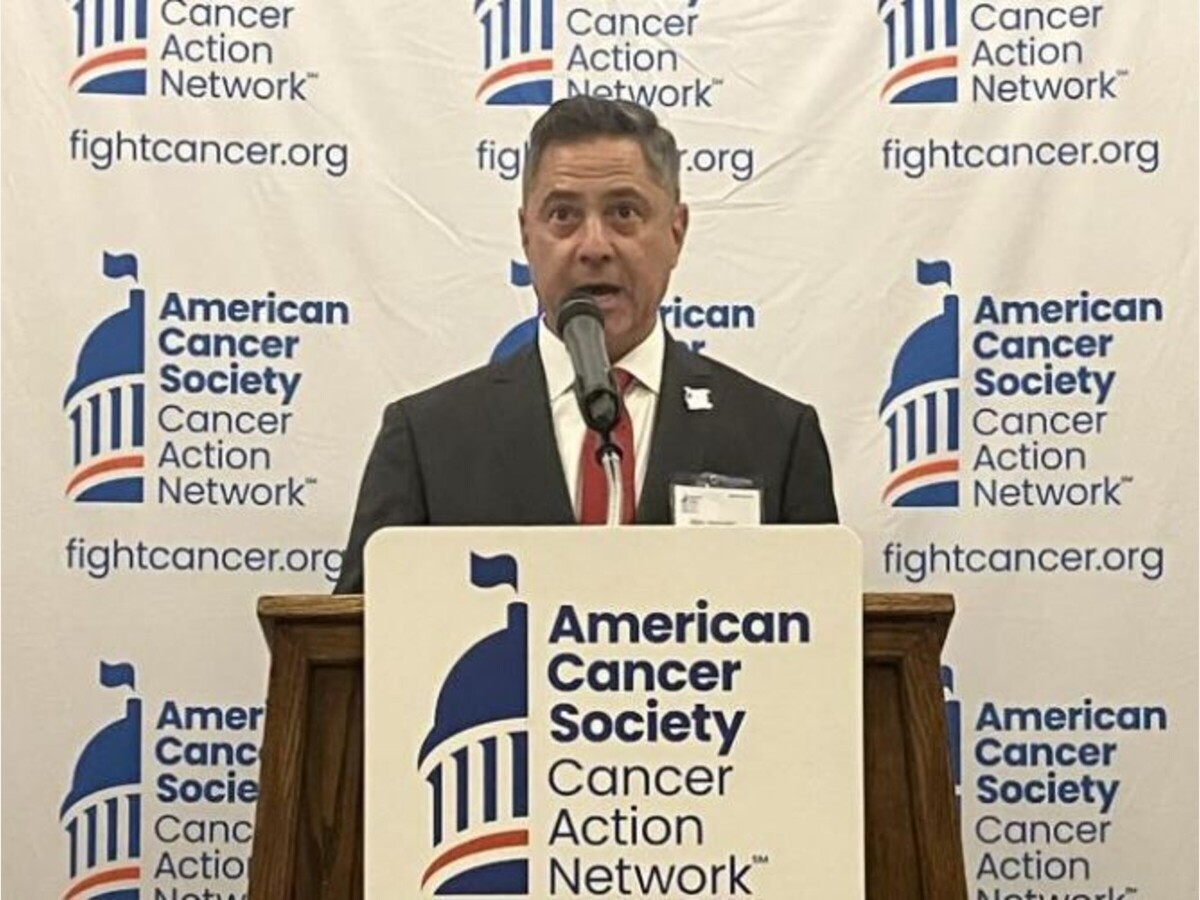
Marc Hymovitz, government relations director at the American Cancer Society Cancer Action Network, speaks at an advocacy event about biomarker testing legislation on Tuesday, June 10, 2025.
After gaining momentum last session, cancer care advocates returned to Beacon Hill Tuesday to promote bills expanding access to biomarker testing, which can help oncology providers determine targeted treatments for patients.
Commercial health insurers, as well as the Group Insurance Commission and MassHealth, would be required to cover comprehensive biomarker testing when "supported by medical and scientific evidence" under proposals from Rep. Meghan Kilcoyne and Sen. Jake Oliveira (H 1227 / S 809).
The testing analyzes patients' genes and proteins to identify more precise and effective treatment options, and supporters say it can help some patients avoid broader regimens like chemotherapy and radiation.
The bill cleared the Financial Services Committee and Health Care Financing Committee last session, before it stalled in the House Ways and Means Committee.
"We're confident this session, that given the progress we made last session, we can move this forward," Marc Hymovitz, government relations director at the American Cancer Society Cancer Action Network (ACS CAN) , told the News Service ahead of an advocacy event. "Today is part of that, just having our volunteers from across Massachusetts coming up to talk to their legislators, to tell legislators how important this bill is to them as constituents."
The bills have again garnered pushback from the Massachusetts Association of Health Plans (MAHP), which opposes costly mandates but is open to a possible legislative compromise.
Among fully insured health plans, the coverage requirement would increase premiums on average by 45 cents to $1.32 per member per month "or between 0.072% to 0.211% of premium, over a projection period of five years," according to an April 2024 report from the Center for Health Information and Analysis. That could translate into premium costs of $35 million annually, or more than $168 million over a five-year period.
MAHP CEO Lora Pellegrini said the association supports biomarker testing "when it is clinically appropriate and supported by rigorous evidence." But MAHP has "significant concerns" with the proposed bills, she said.
"While biomarker testing holds promise for improving diagnosis and treatment in certain cases, these bills may not represent the most effective or efficient approach to promote the ongoing inclusion of clinically beneficial biomarker testing as part of insurance coverage," Pellegrini said in a statement to the News Service Tuesday. "MAHP has initiated discussions with the bill sponsors and the American Cancer Society and remains committed to working collaboratively toward a compromise that ensures clinical and cost effectiveness."
The refiled bills had a hearing before the Finance Services Committee on April 29. Under House rules reforms, House members have until June 28 to take action on Kilcoyne's bill or seek an extension.
Hymovitz said expanding access to biomarker testing across insurance types would help alleviate health disparities, including among marginalized communities and patients living in rural parts of the state.
"A lot of the issue that we're seeing is the science is ahead of the policy. Biomarker testing and precision medicine treatments are relatively new in medical science, but the policy hasn't caught up," Hymovitz said. "Insurers are covering some biomarker testing. They're just not fully meeting what national medical guidelines say they should be covering, and we're trying to speed that up by getting this legislation passed."
Twenty-one states have laws boosting access to biomarker testing, which is also being used to treat arthritis, autoimmune conditions, rare diseases and preeclampsia, according to ASC CAN.
"Many states around us have also passed similar legislation, including Rhode Island, Connecticut, New York. These are our economic competitors right around us -- also high-outcome states when it comes to health care," Oliveira told the News Service. "So I think the momentum is building this session to move it across the finish line."
Kilcoyne described biomarker testing as an antidote to a "scorched-earth policy," in which oncology providers with limited information turn to more invasive and potentially ineffective treatments that can lead to longer hospital stays. She also acknowledged policymakers will face questions about imposing new insurance coverage requirements amid soaring health care costs.
"The fact of the matter is, is what we know that this technology can do -- is that it can make sure people are spending less time in the hospital, it can make sure that people are not getting unnecessary treatments, and that they are getting the least invasive procedures possible," Kilcoyne said. "Which we all know sitting here today is going to save us money and the commonwealth money, as well. So this has dollar-saving implications, but more importantly, life-saving implications."



Sunny, with a high of 43 and low of 25 degrees. Sunny during the morning, overcast during the afternoon and evening, clear overnight.