25° and Clear



Image
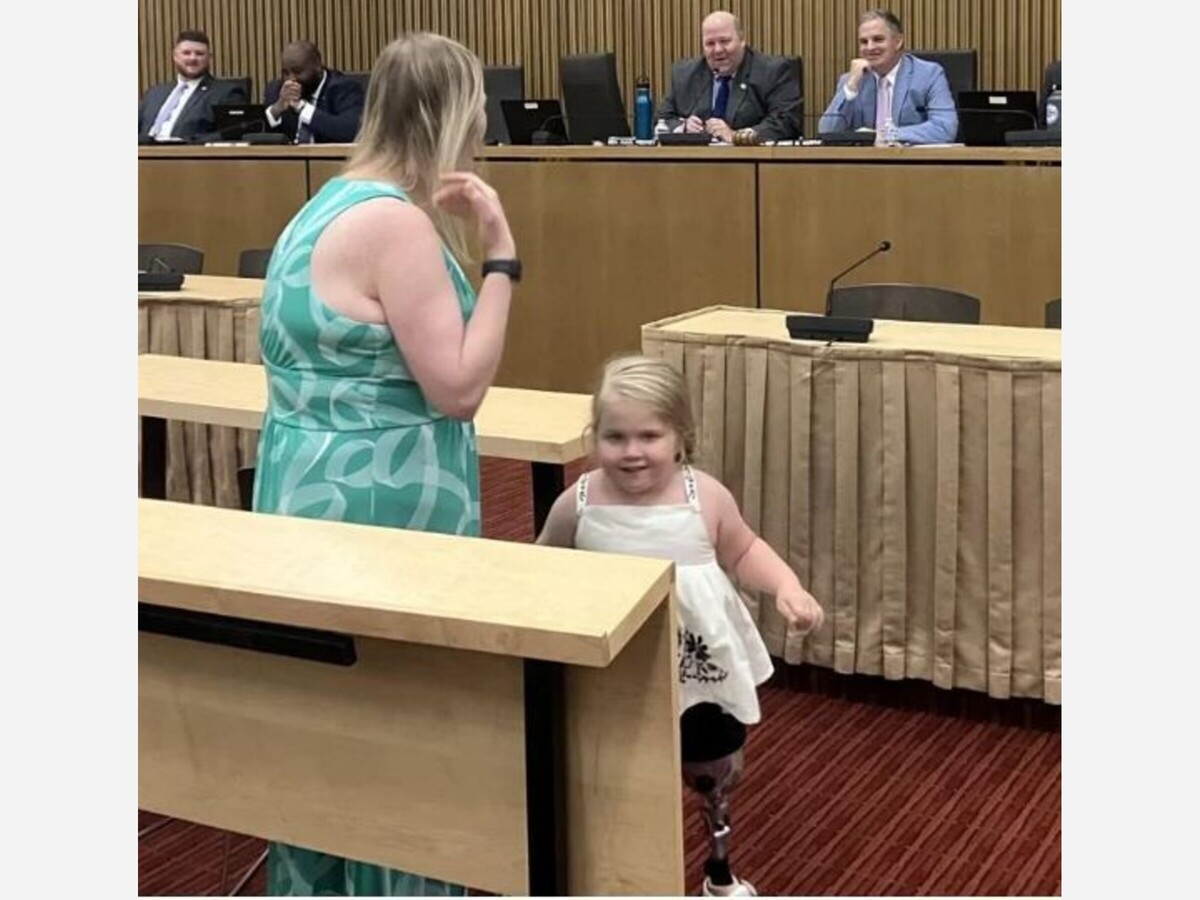
Five-year-old Genevieve enjoys the spotlight during a Financial Services Committee hearing after her mother, Kara McEachern, testified in Gardner Auditorium on Tuesday, June 24, 2025.
Five-year-old Genevieve twirled excitedly around Gardner Auditorium on her prosthetic leg Tuesday after her mother testified in support of a trio of bills that would expand insurance for additional orthotic and prosthetic devices, which individuals with limb loss and limb difference say are critical for participating in sports and other physical activities.
Kara McEachern, the girl's mother, explained that most insurance plans do not cover secondary or activity-specific prostheses, including running blades or water legs.
"Families are left to pay out of pocket or seek grants," McEachern said during a Financial Services Committee hearing. "Genevieve wants to run with her friends, splash at water parks and learn to ice skate like her big sister. But her current prosthesis doesn't bend at the ankle, it's not waterproof, and a secondary device for physical activity is considered optional and uncovered."
"This is where policy must catch up with reality," the girl's mother told lawmakers.
After finding out Genevieve just turned five on Monday, committee co-chair Sen. Paul Feeney led lawmakers and hearing attendees in singing "Happy Birthday To You."
"We're glad you came in," co-chair Rep. James Murphy told Genevieve, who continued to bounce around. "If you want to do an internship this summer, you can work for us anytime you want."
McEachern said she supports the slate of bills from Rep. Carlos González, Sen. Jake Oliveira and Sen. John Velis (H 1178 / S 811 / S 836), which are endorsed by the So Every BODY Can Move campaign. They would require the Group Insurance Commission, MassHealth and commercial health insurers to cover prosthetic and orthotic devices designed for physical activity and exercise. Some 84,000 Bay Staters are living with limb loss and limb difference, according to a summary for Velis's proposal.
Similar legislation cleared the Financial Services Committee and Health Care Financing Committee last session but then stalled in the House Ways and Means Committee.
A coalition of organizations representing insurers, employers and small businesses ahead of Tuesday's hearing urged the committee to "pause further consideration of new benefit mandates until the state takes meaningful steps to rein in the true cost drivers of our health care system: unchecked provider price growth and rising pharmaceutical costs." Leaders of the Employer Coalition on Health, National Association of Benefits and Insurance Professionals, Massachusetts Association of Health Plans, Retailers Association of Massachusetts and National Federation of Independent Business signed onto the letter to Feeney and Murphy.
The hearing agenda also included proposals to expand coverage for facial and scalp prostheses for individuals with alopecia, and to require dental care coverage for head and neck cancer survivors, among other insurance provisions.
"Massachusetts employers, particularly small and mid-sized businesses, are facing an affordability crisis when it comes to offering health insurance," the letter said. "Mandated benefits drive up premium costs in the fully insured market, which already bears a disproportionate share of the health care cost burden. These costs can also translate into higher cost for taxpayers, when employers are forced to drop coverage and individuals become uninsured or enroll in Medicaid."
The Legislature last session passed seven new mandates, which will translate into $750 million in new spending over five years, according to the business groups.
"And yet, 18 more mandates are being considered today, with 188 new mandated benefits filed this session, without a comprehensive fiscal impact analysis or clinical review," Tuesday's letter said. "We also urge caution on proposals embedded within these bills that would erode health plans' ability to manage care through cost-sharing, utilization management, or benefit design. These tools are among the few available to ensure that care is appropriate, evidence-based, and affordable."
Without insurance coverage, individuals with limb loss and limb difference may be unable to pay steep out-of-pocket costs, and end up living sedentary lifestyles that can lead to expensive health complications, according to So Every BODY Can Move. The campaign is looking to expand coverage for medically necessary prosthetic and orthotic care in 28 states ahead of the 2028 Los Angeles Paralympics.
Posie Mansfield of Essex, who described skiing as her "whole life," turned to adaptive sports after she had an above-the-knee amputation. For more than a dozen years, she skied on one leg, but the wear and tear on her knee forced her to undergo a knee replacement this past April.
"If I'd had a sport prosthetic back when I first started skiing, I may not have even needed the knee replacement," Mansfield, 76, said. "The irony is the insurance company paid for the internal prosthesis, the knee replacement, but they wouldn't pay for a sports external prosthesis. That's the irony, and that's the problem."
Mansfield, asked by Feeney about the total cost of the knee replacement surgery, estimated "it's in the hundreds of thousands."
"And a sports knee costs a few thousand," Mansfield added, referring to a prosthesis.
"There's the answer, right?" Feeney replied. "So not only is it the morally right thing to do to actually cover people that want to maintain a healthy lifestyle and activity -- but economically, it seems like the right thing to do based on your testimony, as well."



Overcast , with a high of 34 and low of 23 degrees. Overcast in the morning, mist in the afternoon and evening, clear overnight.