


Image
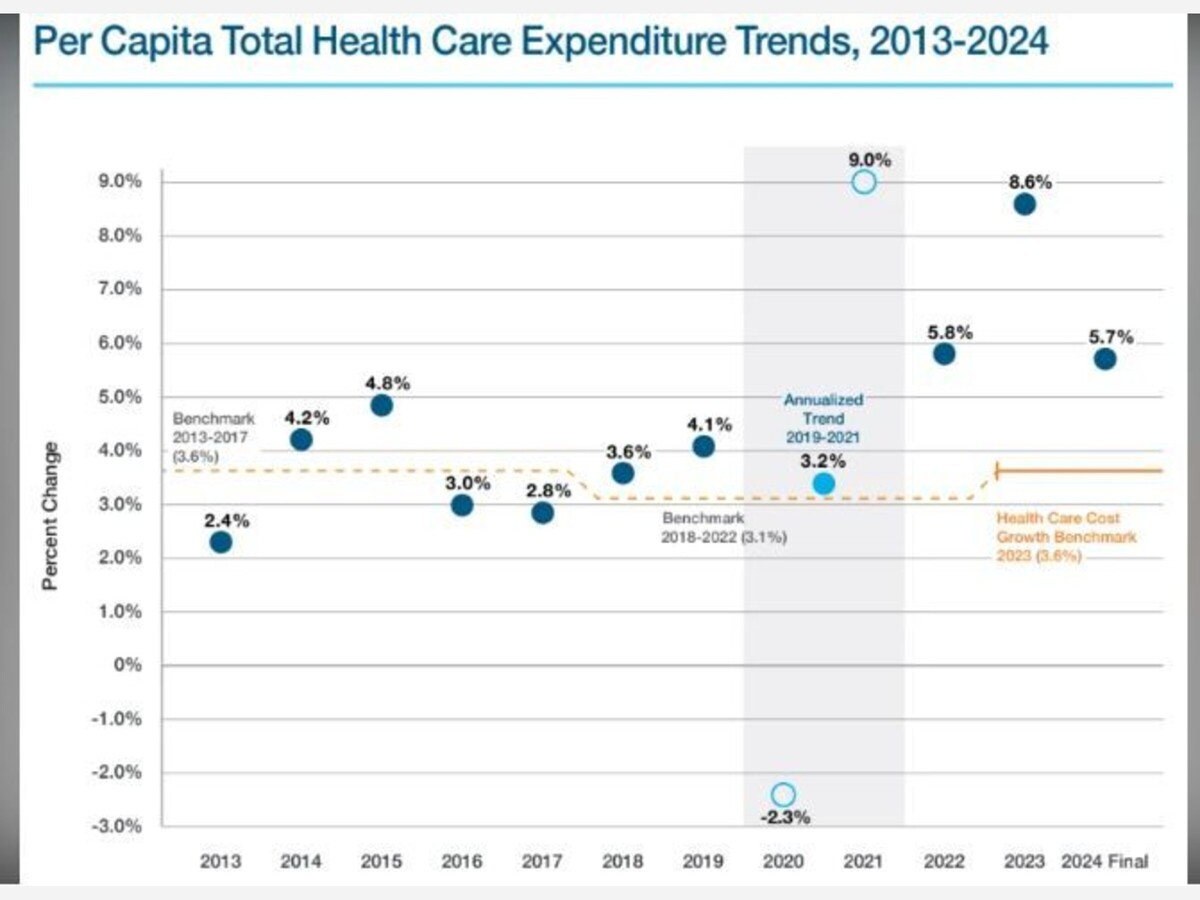
Total health care spending in 2024 blew past state government's cost containment benchmark in Massachusetts for a fourth consecutive year, according to a new report that highlighted rising drug prices and higher premiums for workers at smaller companies.
Total spending was $83.3 billion in 2024, a per capita increase of 5.7% over the prior year, according to a Center for Health Information and Analysis report released Thursday. That is 2 percentage points above the state's cost growth benchmark, which regulators have repeatedly set at 3.6% despite surging spending.
Total health care spending rose 8.6% between 2022 and 2023, according to CHIA.
"The Annual Report presents a sober assessment of the strain our health care system is under—and underscores the need to relieve pressures on residents, employers, payers, and providers," CHIA Acting Executive Director Andrew Jackmauh said.
The cost growth benchmark was created under a 2012 law and critics say it has failed at its intended effect: keeping health care spending increases at affordable levels.
The Massachusetts Health and Hospital Association last year argued the benchmark "outlived its ability to align with the state’s overall economic growth, especially in recent years" and described the 3.6% target as "a vestige of what the state imagined as an achievable goal under normal economic circumstances more than a decade ago."
The new report largely captures data from 2024, when the sprawling MassHealth redetermination effort caused 350,000 members to lose coverage. Many of those people turned to the Massachusetts Health Connector, which at the time had launched a pilot program to expand access to heavily subsidized coverage. The Steward Health Care bankruptcy crisis during that year also strained resources and access to care, the report notes.
Prescription drug spending totaled $12.3 billion in 2024 and accounted for about 23% of total health care spending growth net of drug rebates, according to the report. Spending on hospital outpatient services totaled $15.3 billion, fueling about 22% of overall spending growth net of drug rebates.
MassHealth represented about 28% of total health care expenditures, the report said.
Lora Pellegrini, CEO of the Massachusetts Association of Health Plans, said more than 40 state reports have indicated premiums will keep rising without interventions to resolve underlying cost drivers.
"Addressing this challenge requires accountability across the health care system," Pellegrini said. "Hospitals, providers, and the pharmaceutical industry must be held accountable alongside payers for meeting the state's cost growth benchmark, and policymakers should recommit to ensuring all stakeholders share responsibility for improving quality, enhancing transparency, and containing costs."
The CHIA report notes that most health plans logged financial losses as "health care spending outpaced the premiums collected."
For residents with fully insured employer-sponsored coverage, premiums rose by 5% in 2024 — translating into $683 per member per month, CHIA said.
Smaller group employers grappled with steeper cost pressures. Monthly premiums among small employers were $685 per member, and $697 for mid-size employers, according to CHIA. Monthly per member cost-sharing was $117 for employees at small organizations and $92 at mid-size organizations.
Enrollment in high-deductible health plans decreased across all employers — except for mid-size organizations, CHIA said. The average annual deductible for small and mid-size groups was $2,120, compared to $1,059 for large and jumbo groups.
The report also examined hospital use and finances, with some data stretching into June 2025. The statewide median operating margin for acute hospitals was minus 2%.
"Hospitals and health systems relied on non-operating revenue for stability, with fewer than half of hospitals reporting positive operating margins," the report said.
The Health Safety Net ran a deficit of nearly $200 million in 2024, the MHA noted. Hospitals had to shoulder the cost for care among uninsured and underinsured patients, creating a strain on hospital finances, the MHA said.
"2024 embodied the unsustainable balance our healthcare sector now faces every day: the mission of delivering uninterrupted care through crisis and the challenge of absorbing ever-climbing input costs," said Daniel McHale, MHA's senior vice president of health care finance and policy. "That is why we are grateful for the state's focus on affordability and the root causes of healthcare costs – including administrative burdens and supplies."
Gov. Maura Healey's Health Care Affordability Working Group is expected to deliver recommendations this summer. Pellegrini, who's a member, said the group should pursue "stronger enforcement of the cost growth benchmark."
Alison Kuznitz is a reporter for State House News Service and State Affairs Pro Massachusetts



Overcast, with a high of 60 and low of 48 degrees. Overcast during the morning, moderate rain for the afternoon and evening, overcast overnight.