

Image
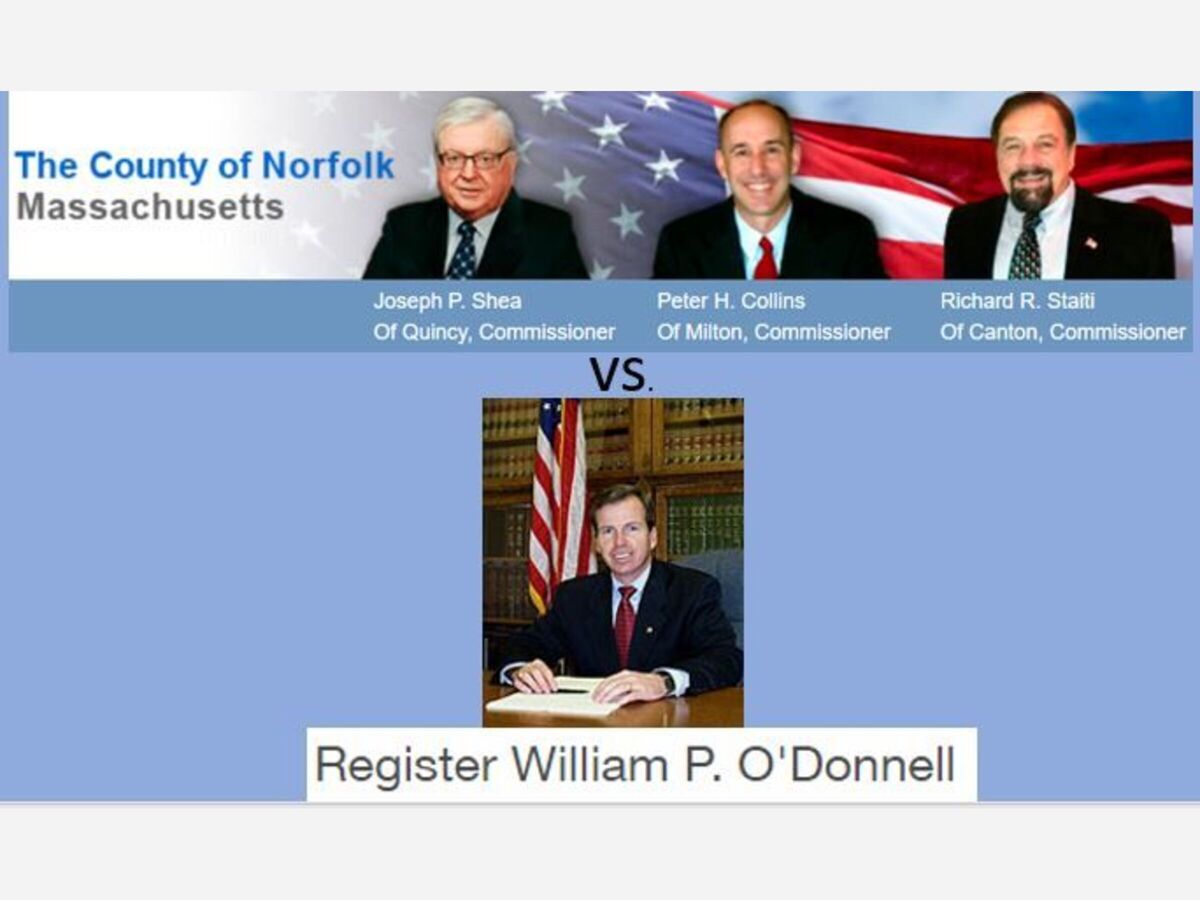
Late Friday, an email from the office of the assistant director of Norfolk County, put a cap, for now, to a series of missives and statements issued over prior weeks that showed the quiet of the county government backwater was purely an illusion, with personal ambition and differing views about governance simmering just below the surface.
Friday’s letter from the triumvirate of Norfolk County Commissioners – Joseph P. Shea (Quincy), Peter F. Collins (Milton) and Richard R. Staiti (Canton) – which only hinted the details of the controversy, read as follows:
Over the past few weeks, you have received multiple notices from the Norfolk County Registry of Deeds, William P. O’Donnell, regarding hiring of the Chief Information Officer [CIO] assigned to the Registry of Deeds.
Please know that the matter appears to have been resolved as the County Commissioners voted to place the candidate into a temporary full-time role, with benefits, effective August 9, 2021. Further, the Commissioners approved the placement of the retired chief information officer into a short-term personnel service contract to allow for a smooth transition over the next ten weeks.
Norfolk County, one of the state’s 14 counties, still handles a number of important government functions, though after a “reform” era in the 1970s, counties vary considerably in the duties they handle. In Norfolk County, one of the central institutions is the Registry of Deeds, which, according to its web site, “receives and records hundreds of thousands of documents each year, and is a basic resource for title examiners, mortgage lenders, municipalities, homeowners, and others with a need for secure, accurate, and accessible land record information."
According to its head since the early 2000s, Register William P. O'Donnell, the office generated some $81 million in 2020 from fees associated with those transactions. And that level of business, along with his concerns for efficiency, have prompted his insistence on hiring a CIO to replace an individual who is retiring. But the three county commissioners refused to approve the measure.
The timeline dates to a June 30 meeting when O’Donnell sought to confirm the appointment of Richard Hatch at a salary of $129,000 annually. But two of the three commissioners said no (Staiti voted in favor) because the body had voted for a hiring freeze earlier. Not one to take things sitting down, O’Donnell fired of letters and let everyone know that not having an on-premises, full-time CIO was incompatible with modernization efforts in his office and a move that invited increased danger of cyber-attacks. And, on July 14, he actually filed suit against the commissioners. A few days later he garnered a letter of support from The Real Estate Bar Association for Massachusetts, whose members depend heavily on the Registry.
“What got us to this point, in my view, was a poor decision. – the registry CIO position has been in existence for 20 years,” said O’Donnell earlier this month.
Two of the commissioners did not respond to a request for comment but a third, Staiti, did respond via email, noting that nothing could be said due to the ongoing litigation. From other sources, a possible point of contention has emerged in the form of a report assembled by a Framingham based management consulting firm that focuses on helping organizations reduce costs and become more efficient. The consulting firm was apparently hired by the Commissioners to examine some county operations.
“I never talked to him [the consultant] and I still have not seen the report,” said O’Donnell, who went on to acknowledge that some county registries don’t have a CIO, instead relying on the state to run their information technology systems. O’Donnell said his office is “pretty unique” and based on an IBM mainframe server. “It is an environment that takes a while to get accustomed to,” he said, noting that in his tenure only two people have held the position.
So, something of a standoff ensued. Even the possibility of funding an interim position fell flat because O’Donnell insisted the individual should receive full benefits.
Finally, on Friday the email arrived from Commissioners, noted above, arrived, heralding a `solution.'
However, the final paragraph of the letter seems to predict more fireworks ahead.
The Norfolk County Commissioners will reserve any further comment on this matter as litigation is pending. Until then, we will continue to manage the county in a sound and thoughtful manner and proceed with our plan to seek efficiencies, adopt best practices, and model our organization to deliver the best services possible to twenty-eight cities and towns of this great County.[Emphasis added by editor.]



Sunny, with a high of 43 and low of 25 degrees. Sunny for the morning, overcast in the afternoon and evening, clear overnight.