82° and Sunny



Image
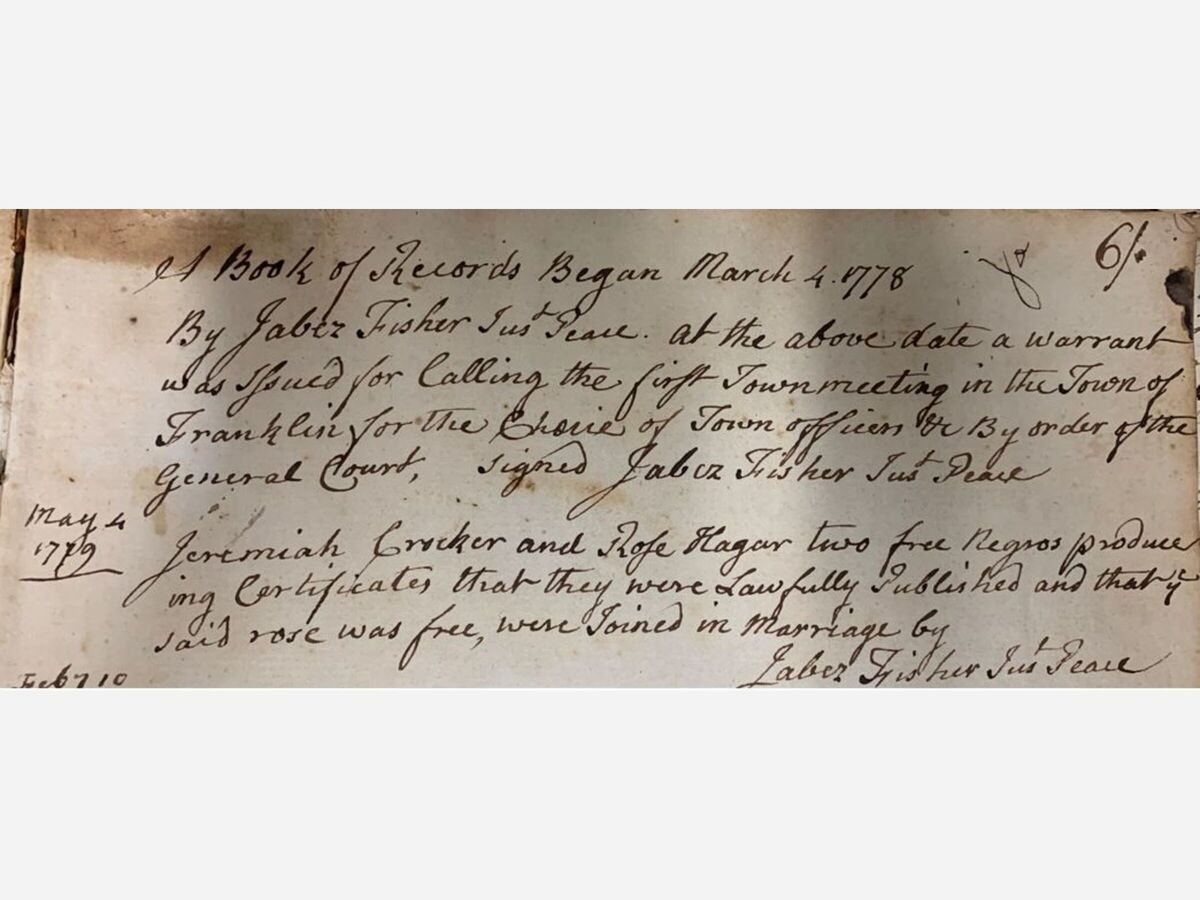
Just two days after Franklin was officially incorporated in Boston on March 2, 1778, its record keeping began locally:
A Book of Records Begun March 4 1778
By Jabez Fisher Justice of Peace at the above date a warrant was issued for Calling the first Town meeting in the town of Franklin for the Choice of Town officers by order of the General Court. Signed Jabez Fisher Justice of the Peace.
His next entry came two months later, and it was personally momentous for two Franklinites.
May 4, 1779. Jeremiah Crocker and Rose Hagar two free negros producing Certificates that they were Lawfully published and that said Rose was free, were joined in Marriage by Jabez Fisher Justice of the Peace.
Not much is known of Jeremiah’s earlier life, and even less about Rose. However, their later life, especially that of Jeremiah, is chronicled in at least two published sources. What is clear is that the couple left Franklin not long after their marriage.
According to Reference Librarian Vicki Earls, Jeremiah stated that he was born in Natick, Mass., was a slave to a family from Bellingham, Mass. and was living in Massachusetts at the start of the American Revolution. He was a soldier for most of the war, and enlisted from various towns, including Franklin, Mass. Whether he was free or enslaved while a soldier is something about which records are unclear.
According to his war pension application, he spent at least the last 40 or so years of his life in Henniker, N.H. and he is mentioned in the book "Strong and Brave Fellows: New Hampshire's Black Soldiers and Sailors of the American Revolution." One account suggests he may have been a servant to George Washington.
He also is described at length in A History of the Town of Henniker, Merrimack County, New Hampshire, by Leander W. Cogswell, published around 1880.
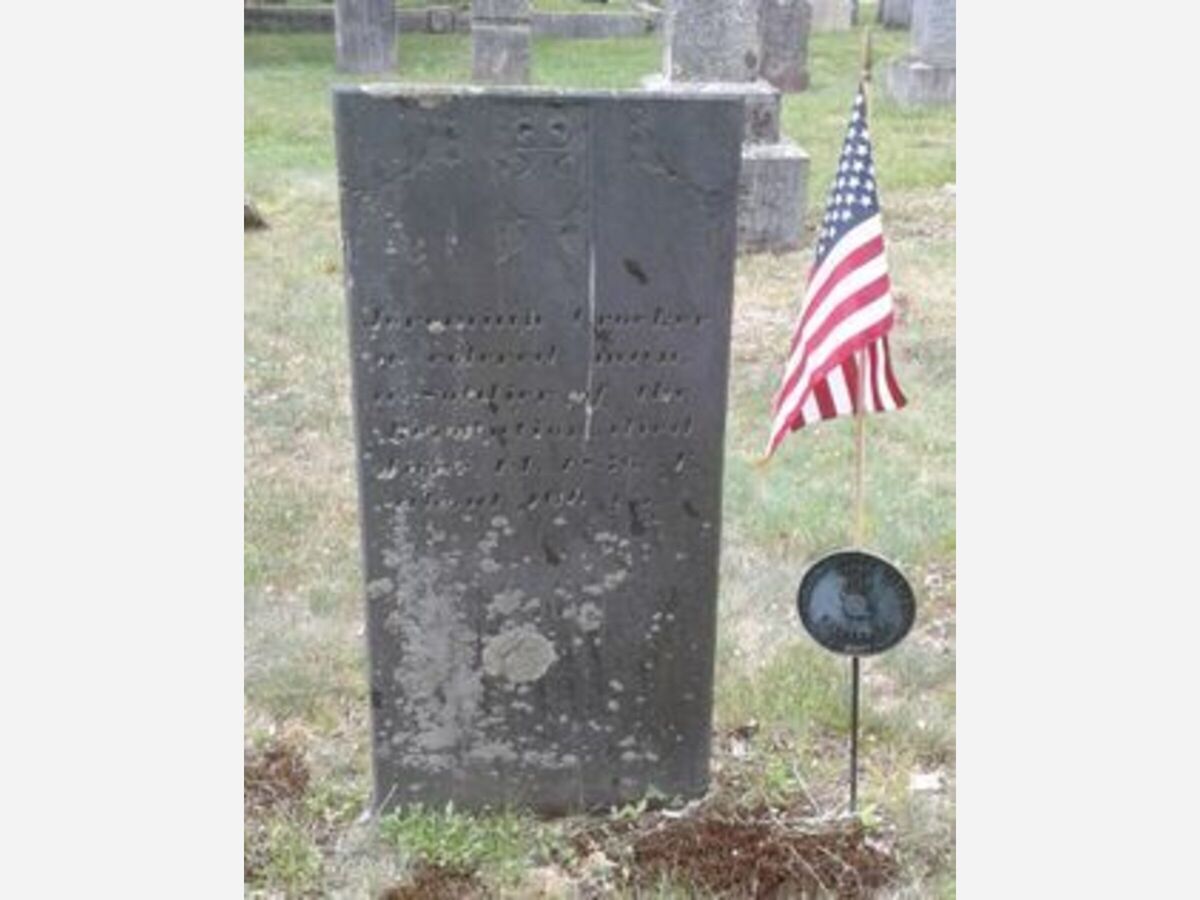
...It is believed that Maj. Jeremiah Crocker was the first [black] to bring his family here. Mr. Crocker...was a drummer for several years during the Revolution. He came to this town in 1780, with Thaddeus Gibson, in whose family he and his family resided quite a number of years. He was given the title of ‘Major” by his friends, for his services in the Revolutionary war. His family consisted of himself, his wife Rose, his two children Salmon and Irene, and his sister Irene. He lived with his family, for several years on the bank of the river northerly from the present stone house of Mrs. Tucker. He afterwards lived in a little house near the present residence of Fitz C. Courser. Having outlived his family, he went to reside in the family of John Stuart, who lived in a small house which once stood under the bank, opposite the entrance to the new cemetery, easterly from the village, where he passed the remainder of his days, and where he died June 14, 1836. His exact age was unknown, but from the most reliable data that could be obtained he was believed to have been a centenarian, and the fact was recorded on his tombstone. The good old man will still be remembered by many. He was genial and large-hearted, and was ever a welcome guest in whatever house he saw fit to enter. He used to relate a good many little anecdotes of his service life. Being extremely fond of music, and himself an excellent singer, he often dropped into a neighbor’s house of an evening, saying, “This is a bright, moonlight evening, and I thought I would just drop in and sing a few tunes with you;” and having had his little sing, he passed on to cheer the home of some other neighbor. He was a great lover of children, who looked upon the major’s visits as the brightest moment of their little lives, as they clambered upon his knees, and listened to his very pleasing stories. The major was fond of military display. Upon training and muster-days [e.g. the local militia] he always appeared with his uniform on, and considered it his duty to be near the soldiers to attend to their every want; and particularly did they think that from the hand of no one else but the major could they receive the refreshments served to them, whether liquor or water. He considered it a great privilege to do the same, and he bandied many a joke, and his countenance lit up with pleasure as he passed down the line, saying to one and another, “Great doin’s to-day sir.”
The high esteem in which the major was held was evinced by the very large concourse of people that assembled at his funeral.
The history of Henniker also noted that Jeremiah’s son Salmon married and raised children in that town. Jeremiah's headstone is prominent in the old cemetery near the center of Henniker and other plots nearby are presumed to be members of his family.



Patchy rain nearby, with a high of 93 and low of 63 degrees. Sunny in the morning, clear overnight.