36° and Overcast
Image



By James C. Johnston Jr.
1926 was a year of optimism for the Navy Department. Undaunted by the loss of the Shenandoah, two more great airships were commissioned by the “Senior Service”: U.S.S. Akron and U.S.S. Macon. Akron, Ohio was the home of the Wright Brothers where American dreams of heavier than air flight were born. The controversy over the positivity of lighter-than-air flight vs. heavier than air flight was on-going. I wonder if the ironic naming of the new airship for the hometown of the Wright Brothers was lost on most people? Perhaps not.
The stamp collecting world went mad of course with the prospect of a raft of new flight covers with interesting destinations to collect. Not a few of these philatelic treasures were to find their way into the albums of Franklin’s dedicated collectors who so admired these great silver ships which flew so majestically through the deep blue of the upper air.
The Macon was named in deference to the South. If nothing else, the United States Navy was extremely sensitive to the regional feelings of the various sections of the country. Los Angeles was in the West. Akron is firmly planted in the Mid-West, so a Southern city must now be favored by being attached to a new sky-giant. The fact that the Civil War was still a closer historic event to the citizens of the nation in the early 1920’s than is the Second World War is to us today was also a very real fact of life. Most of the Civil War had been fought in the South and therefore it had had a larger impact on that part of the country.
In point of fact, the Last National Encampment of the Veterans of the Union’s Grand Army of the Republic, was held at Indianapolis, Illinois from August 28 to September 1, 1949. It is also well to remember that this reunion was still 23 years away from the initiation of the building of these two new air-ships, and the Last Encampment of Army of the Confederacy was not to be held for another two years after that in Norfolk, Virginia on Memorial Day, May 30, 1951. And this was 25 years after the Macon’s birth! What is even more shocking is that for me both of these last Civil War reunions were once current events in my lifetime! I write this as I am looking at the two first day covers commemorating these two Civil War related events which were collected by me about the time of their issuance! Yipes!
The Navy experimented with the idea that its dirigible air-ships could serve as aircraft carriers. Some were rigged with trapeze contraptions for launching and retrievals if conventional air planes. In the end, it just using the dirdidgibles as aircraft carriers didn’t seem practical. Air craft carriers like the Yorktown and Lexington seemed a much better bet for carrying fighters, torpedo planes, and bombers. And there was another fact of life which wasn’t as well considered in the overall handling of air-ships, and that was the fact of the wind.
Dirigibles were just very large constructions of framework covered with a heavy foil wrapped over sewn canvas. They were just a sort of a variation of super-large box kites after all were they not? From the ground, these super-large sleek airships looked very solid in their silver metallic skins. But they were far more frail than that.
In 1931, the world’s tallest building; The Empire State Building was finished in record time under the supervision of its de-facto-clerk-of-the-works, former Governor of New York and Democratic Presidential Candidate in 1928 Alfred E. Smith. A mooring mast was placed on top of this titanic structure so that Zeppelins could dock and unload cargos. Actually that was an interesting idea, but as it turned out, not much real thought had gone onto the logistics of it, and then there was that wind factor thing to consider. In the end, King Kong got more use out the mooring mast than did any air-ship.
In 1931, after years of construction, The U.S.S. Akron proved to be an unlucky aircraft. In April 3, 1933, she went down in high winds off the New Jersey Coast with the loss of all but three of her 76 man crew. I am sure that more airmail covers exist memorializing her than she ever carried. The loss was mourned by an entire nation who also again recalled the 1925 wreck of the Shenandoah. In 1932, the Los Angeles was decommissioned before anything could happen to her.
Finally on April 21, 1933, the much anticipated launching of the U.S.S. Macon took place. Her life was short. For a year and a half, she flew across the nation carrying the mail and was the last symbol of the American experiment with dirigibles. The Graf Zeppelin, as the symbol of a revitalized Germany under the enlightened guidance of her economics wizard, one-time chancellor, foreign minister, and over-all genius Gustave Stressman, who unfortunately died unexpectedly in 1929, and the guiding light of The Zeppelin Company, Dr. Hugo Eckener. Eckener reached the height of fame with this incredible feat of aeronautical achievement, the Graf Zeppelin. Eckener guided the Graf Zeppelin in a whole series of monumental successes: her first flight to the United States in 1928, her flight around the world in 1929, her 1931 flight over the North Pole, her first 1932 flight to Brazil, her 1933 flight over Franklin, Massachusetts on her way to The Chicago World’s Fair, not to mention her Spanish flights, Egyptian Flights, and her successful catapult mail flight experiments. Covers from all of these flights were carried to Franklin in those heady days of the Graf Zeppelin’s great feats of aeronautic prowess to anxious stamp-collecting enthusiasts.
Then awful fateful day came in May of 1937 spelling out Das Ende of the relatively short heyday of Zeppelins. In May of 1937, the Hindenburg was the largest and most luxurious air-ship ever to be built. Dr. Hugo Eckener made this grand vision of what perfection could become when turned into a reality, and Germany’s Chancellor, Adolf Hitler, wanted this King of all airships to be named for him.
Except for America’s champions of champions, Jesse Owens and Ralph Metcalf and Adolph Keifer, the Germans of Hitler’s doped-up master race did fairly well in the 1936 Olympics, but Hitler wanted to also dominate the sky with a newer and greater airship which could be named for him. Eckener hated National Socialism, A/K/A the Nazi Party, Adolf Hitler, Anti-Semitism, and all that this fascist dictator stood for. Eckener flatly refused to name his new airship after Hitler. Instead, he named his new creation for Germany’s best loved father figure, President and Field Marshall the late Paul von Hindenburg who had died in 1934 removing the last challenge to Hitler’s total political domination of the German State.
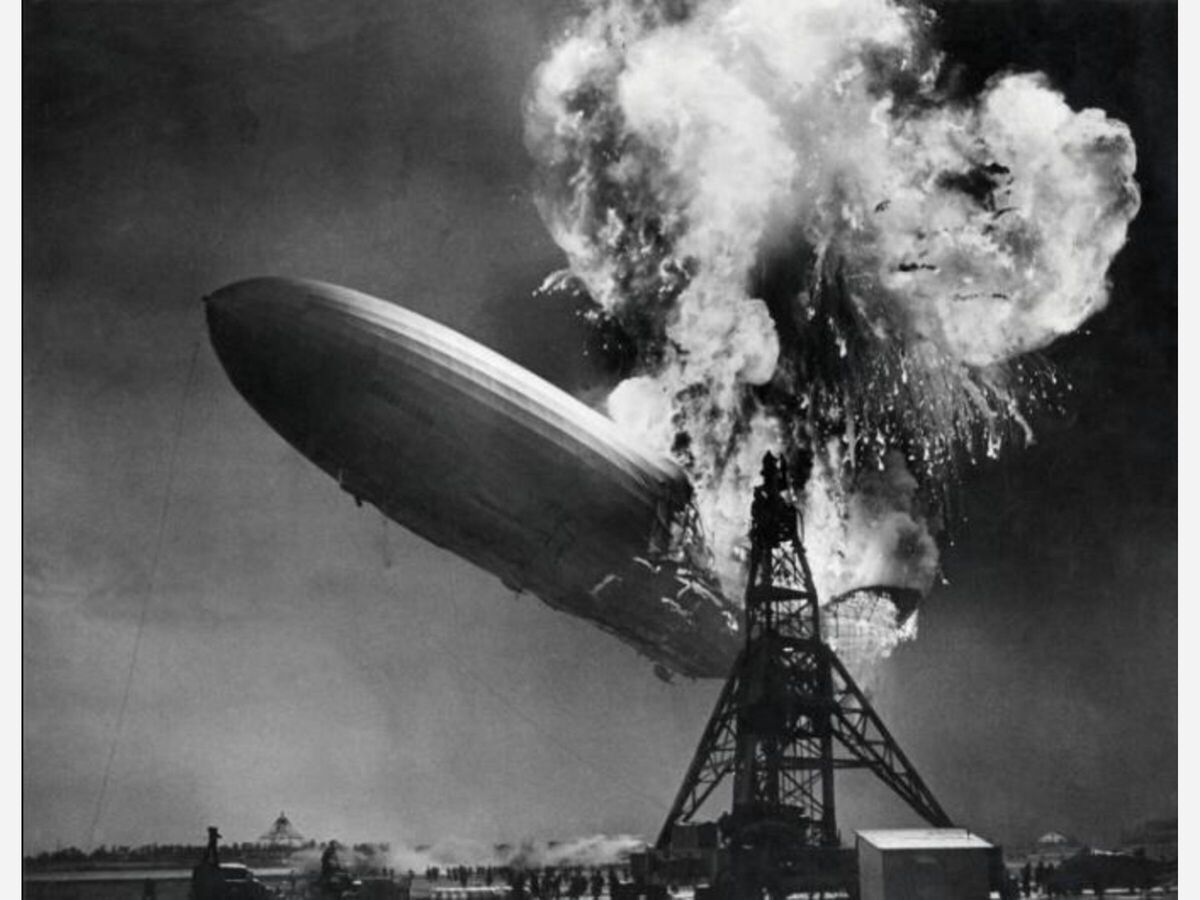
On May 6, 1937, after an almost perfect crossing of the Atlantic, an exterior tear in the skin of the great new airship had to be repaired in mid-air. After this delay, it was off to Lakehurst! The Hindenburg made an expert approach to the Lakehurst Mooring Mast. Captain Max Pruss was an accomplished officer and on top of his game. He had already made dinner plans in New York for that evening, and everything seemed to be going rather well when all of a sudden, the Zeppelin burst into flames.
Starting at the rear of the airship, flames swept to the front of the Hindenburg. Within seconds, the whole airship was a fiery inferno! There were 97 people aboard the airship: 61 crew and 36 passengers. Of these, 22 crew members and 13 passengers died. 39 crew members and 23 passengers survived. If anyone has ever seen the actual film footage of the Zeppelin bursting into flame in mere seconds, they would think it was amazing that anyone at all could have gotten out of Hindenburg and lived to tell of it. The Herb Morrison radio narration of the true horror and melt-down of the mighty Zeppelin is most likely one of the most listened to broadcasts to this very day. It is, in many ways, the ultimate historical recorded event of the late 1930’s. At this very minute, somebody in this world will most likely be playing it somewhere. Such was and is its impact. Morrison’s tearful expressing of his classic, “Oh the humanity!” still haunt’s the air as we approach the 85th
Anniversary of this horror filled event.
The charred covers, carried on the Hindenburg’s last flight, command enormous prices at auction of many thousands of dollars! As far as Hitler was concerned, this was Der Ende. Germany’s experimenting with Zeppelin flight. The era of great rigid airships was over. The embarrassment of the inferno at Lakehurst to the Reich was too great. The last and largest Zeppelin under construction was ordered taken apart. The Graf Zeppelin was ordered decommissioned and scrapped, and in 1940 the ZR-3, the Los Angelis was ordered dismantled. Indeed for the ridged airship, this was Der Ende.
No longer did great silver Zeppelins fly over the North Pole, or to South America, or Lakehurst, New Jersey, or anywhere else. Students in Franklin, Massachusetts would no longer be ordered outside to cast their eyes heavenward to behold the amazing Graf Zeppelin in flight over the town to Chicago or anywhere else.
Only in a stamp album on pages dedicated Zeppelin stamps will the great airships ever fly again. For the beautiful Art Deco stamps of Germany picturing the elongated tapering lines of great dirigibles, are evidence still of a great romantic idea of human flight. These silent witnesses to history are still avidly collected and there is still great interest in the philatelic social and postal history of the Zeppelin Era. We who remember that special time in aviation history insure that this short golden era of lighter-than-air flight will still be remembered for the remarkable time that it was.
James C. Johnston Jr. is a former Franklin selectman, Franklin High School history teacher, and author. Article copyright James C. Johnston, Jr. 2022, used with permission



Patchy rain nearby, with a high of 39 and low of 35 degrees. Patchy rain nearby in the morning, overcast in the afternoon, clear overnight.