82° and Sunny



Image
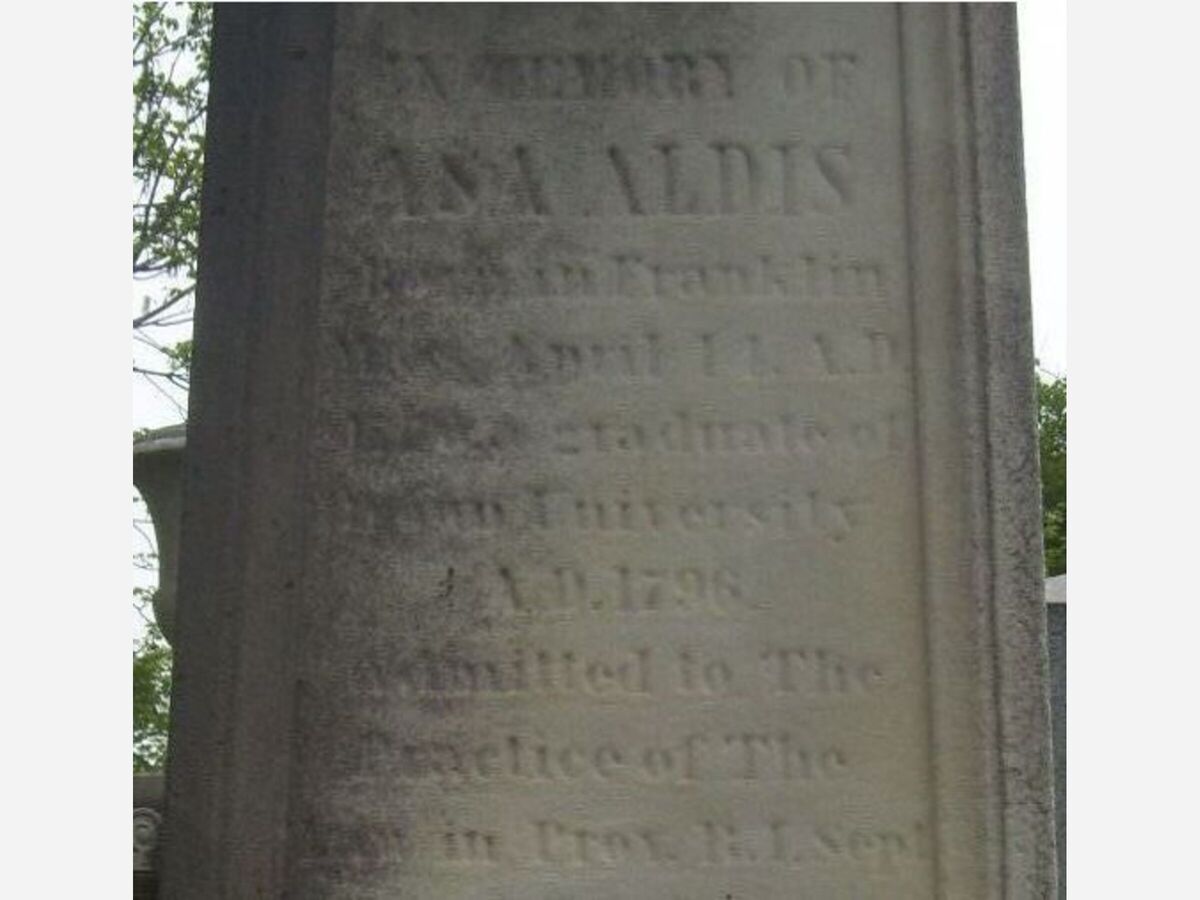
Above, the St. Albans Vermont grave marker of Franklin-born Asa Aldis, a Chief Justice of the Vermont Supreme Court.
We quote here in its entirety a fascinating biographical sketch from Blakes’ centennial History of the Town of Franklin:
Judge Asa Aldis, son of Nathan and Sarah (Metcalf) Aldis was born in Franklin 14th April, 1770. His mother was a daughter of Jonathan Metcalf. She died, leaving only this child, a little over two years old. His father was a merchant in Franklin, but was preparing to move to Boston when he died, in May, 1775, thus leaving Asa an orphan of five years.
His father was accused of being a Tory, which his intimacy with a British officer and his removal to Boston, seem to justify, but which his friends, Dr. Emmons in particular, would not admit. he probably dreaded disturbances and took no side in the coming strife. The people, however, on his death, demanded the confiscation of his property, and a mob broke open his store and seized the goods, but they found no account books, notes, or papers of value to confirm or dispel their suspicions.
Judge Stephen Metcalf, the brother of Asa’s mother, took the guardianship of the lad, and placed him with a sister of his mother, the wife of Rev. Daniel Pond, in Medway. This family were warm Republicans [in other words, Patriots], and his aunt had made a vow, when the tea was thrown overboard, that another cup of tea should never be made in her house. The only Boston paper taken in their neighborhood came to Mr. Pond’s, and on its weekly arrival, all gathered at his house in the evening to hear it read. They sat in the large kitchen – little Asa on the dye-tub on one side of the fire-place, while his uncle read. The listeners had relatives and friends in the war, and the news was commented upon and deeply pondered in this, as in all New England homes.
One illustrative incident of the sprit of the lad. A certain cooper alone disapproved of Washington. For week he had said, “Washington should have been here – he should have been there – he was always doing wrong.” No one ever replied. One night, when they were all gone, the little boy stretched up to his aunt saying, “Aunt, why don’t they put out Washington and put in cooper White?”
Another anecdote illustrates the spirit of the household. ON a dark, windy, rainy November night, as they were all sitting around the fire, there was a knock on the outside door. On opening, there stood a man belated, and it was some ways to a tavern. Attracted by their light, he had stopped to ask for a night’s lodging. “Certainly, we can keep you,” said both Mr. and Mrs. Pond, for they were hospitable. “Have you a horse?” “Yes.
and out went Mr. Pond and a boy to take care of the horse. the stranger was given a seat by the fire. One learning that he had no supper, Mrs. Pond and her daughter prepared the table, and Mrs. Pond was soon cooking some meat over the fire, when the conversation took a religious turn. In reply to something he said, she answered, “But Moses, in describing the plague of Egypt, said –“ “What of that,” says he, “Moses was nothing but a conjuror!” Mrs. Pond looked around at him and asked, “What did you say about Moses?” “I said Moses was nothing but a conjuror, and he was not.” Off came the pan from the fire. “I can cook you no supper; no man who disbelieves the Bible and calls Moses, the servant of the Lord, a conjuror, can stay in my house over night.”
Just then Mr. Pond came in from feeding the horse. She repeated the conversation, adding, “We cannot keep him.” “No, said Mr. Pond, “I will get your horse.” The man begged to stay, but to no purpose, and he had to go on his journey in the dark.
It was in such a family Asa passed his childhood and laid the foundation of his character. He afterward said of them, he never knew them to do a thing they believed to be wrong.
At the close of the Revolutionary War, and when the Independence of the States had been acknowledged, Judge Metcalf received a request from a Mr. Amory of Boston, to bring Mr. Nathan Aldis’ son to Boston
He went and was advised to ascertain from the General Court, then in session, what disposition was to be made of Mr. Aldis’ property. On the declaration of the lawyer, Mr. Sullivan, that Mr. Aldis died one year and two months before the Declaration of Independence, and that no evidence existed that he had ever said or done anything against the cause or measures of the revolutionary party, the court decided unanimously that there was no law that would warrant the confiscation of the estate and that it should be restored to the son. After the decision Mr. Amory informed Judge Metcalf that he had just received Mr. Aldis’ papers, which were supposed to be post. Capt. John Goldsbury [A local man of Tory sympathies who later relocated to Nova Scotia], foreseeing the tumultuous times coming, had, on Mr. Aldis’ death, privately to Franklin, and secured teh papers, and, unknown to his relatives, and sent them to England. These papers had just been sent back
An anecdote is connected with these papers illustrative of the times. Judge Metcalf said to Asa, as they examined them, “I think Dea. Slocum owed your father several hundred dollars, but I find no note. “Go and ask the deacon.” He did so. “Yes,” said the deacon, “I owed your father, and you will find the note among the papers.” Still they could not find it. ‘Well,” replied the deacon, “If you don’t find it, I owed it, and shall pay you all the same.” About two years after Asa received the letter from Capt. Goldsbury in Halifax, N.S., wishing to see him. He went at once to his father’s old friend, who told him much about his father, and the difficulties he had in getting the papers in Franklin. Inquiring after Dea. Slocum, he took a paper from his pocket-book, and handing it to young Aldis, said, “Asa, Deacon Slocum saved my life. I wanted to see a young lady friend of mine near Franklin. We had not evacuated Boston. Washington was encamped at Cambridge, and I could get to Franklin only by crossing through his lines. I forged a pass which took me through but they soon discovered Washington’s signature to be false, and sent a detachment after me as a spy. I was no spy, but I fled for my life.
I hid three days in the woods. Dea. Slocum fed me, and then secreted me in his own house till I got off to Boston. When I saw this note against him among the papers, I took it out and kept it. It is the only paper I ever withheld. I vowed that if you got the money, I would bring you the note, but if that cursed government got it, they should never have a penny from the deacon!”
Mr. and Mrs. Pond and their daughter were now dead, and during the settlement of the estate Asa made his home mostly with his uncle, Ebenezer Aldis, in Mendon. He always acknowledged this period – from 15-19—to have been the wild period of his life, when he went for fun everywhere. His aversion to ardent spirits saved him. He said Dr. Emmons never gave him up, but passed many an hour with him, talking of his parents and other things interesting to a youth. At 19 he applied to Rev. Caleb Alexander, of Mendon – afterwards a celebrated teacher in Fairfield, N.Y. – to fit him for college; but he hesitated on account of his then reckless and disputatious reputation. But Dr. Emmons urged him and he took young Aldis into his family, and when he left Mr. Alexander said he never had a more obedient pupil. Aldis’ gratitude to Dr. Emmons lasted through life.
As Aldis was graduated at Brown University, in 1796, and studied law with Judge Howell of Providence. After a short residence in Chepachet, RI.I., he was married and in 1802 removed to St. Albans, Vt., where he entered upon his profession with characteristic zeal. In the years of the embargo, and during the War of 18912, he was a zealous supporter of Jefferson’s and Madison’s administrations. This was the unpopular side in northern Vermont, but his violent political opponents were often his warm personal friends.
On one point he was almost alone. He would never admit one dollar’s worth of smuggled goods to be brought into his house, and even refused to be retained by his old clients in any case, if they were smugglers. But while he was the Government’s supporter and adviser, he refused all office and gave his advice gratuitously. At the close of the ware of 1812, he was persuaded to accept the office of Chief Justice of Vermont, but declined a second election, in spite of the entreaties even of political opponents.
Judge Aldis was a supporter of John Quincy Adams, especially in his anti-slavery sentiments. Having joined an abolition society while in Providence, he adhered to its principles in its darkest day, and was among the leaders of the liberty party in his State.
At 50 years of age, he professed religion and was confirmed in the Episcopal church by Bishop Griswold. He was also an especial friend of schools. Of his integrity it was said, after his death, that no one could say he wronged one man. He died 16th October, 1847, aged 77 years. he left at least one son, Hon. Asa O. Aldis, an Associate Justice of the Supreme Court, and a daughter, the wife of his successor, Judge L.C. Kellogg of Vermont.
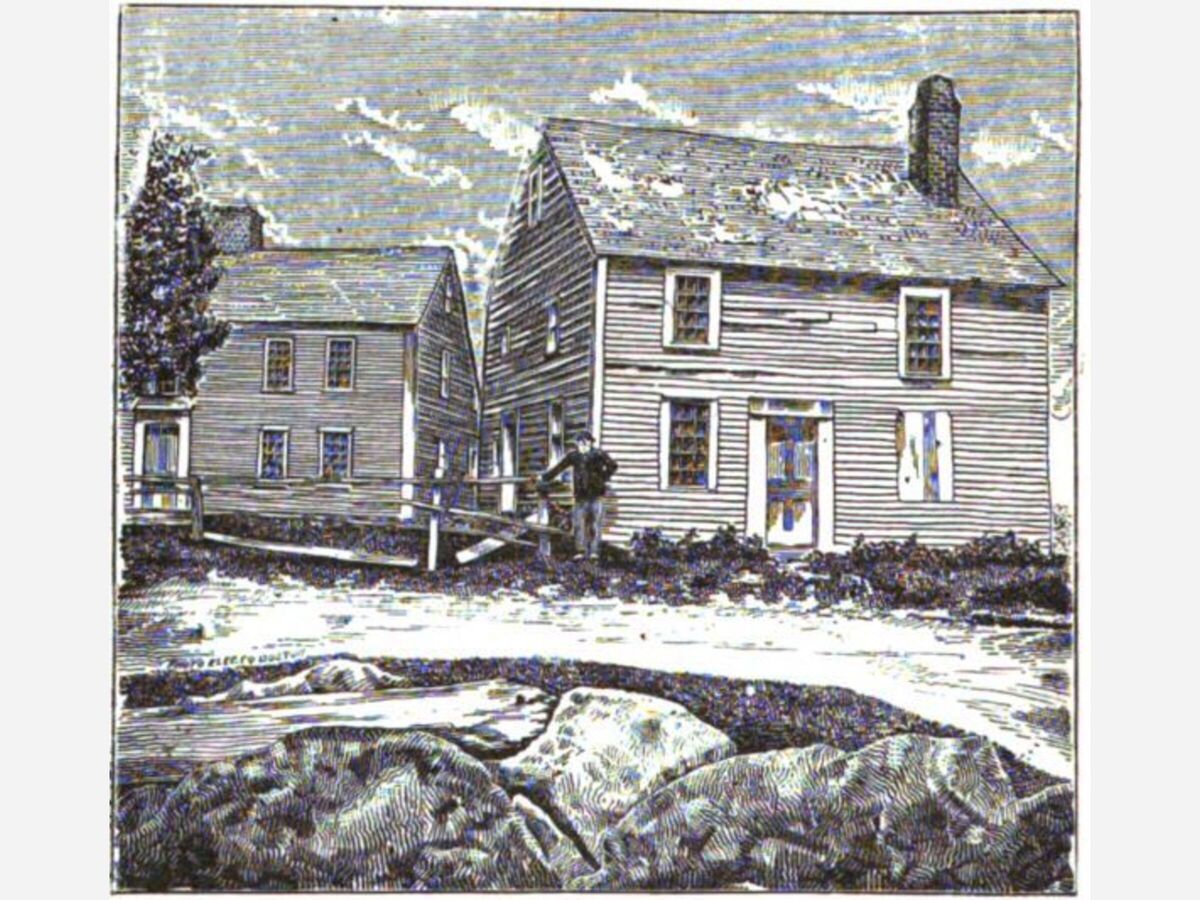
Below, an image of the Aldis homestead and store still standing in the 1870s.



Patchy rain nearby, with a high of 93 and low of 63 degrees. Sunny during the morning, clear overnight.