

Image
In a lengthy article for Wicked Local and its associated periodicals earlier this month, journalist Heather McCarron investigated the story of Franklin Library’s missing painting – a story later picked up by other media including WBZ radio.
At the center of the story is Henry Hammond Gallison (usually known just as H.H. Gallison), who had strong family ties to the area. A trained medical doctor and lawyer, Gallison also took up painting later in life and became part of the Cape Ann art scene along with friend and mentor, Tommaso Juglaris – an Italian with a growing international reputation.
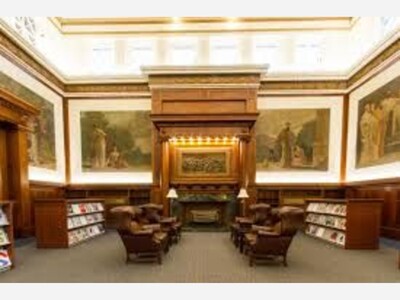
It so happened that Gallison’s circle in the Franklin area included the Ray sisters, Emily Rockwood Ray and Annie Ray Thayer. It was he that suggested the creation of the Ray Memorial Library as a monument to their wealthy parents and it was his design ideas that set the architects on the path to creating the familiar structure we know today.
Gallison also concerned himself with the art that would go into his temple of learning, and was instrumental in engaging Juglaris to create the huge classically themed murals. But Gallison wrote himself into the story, too.
Indeed, when the library opened in 1904, his fanciful, big-canvas landscapes were prominently displayed.
That his work was part and parcel of the library became catechetical and no one, it seemed, looked more closely at the story or the art, until about 20 years ago when reference librarian Vicki Buchanio Earls was prepping for a tour and reviewing an original century-old brochure. It was then that she was shocked to discover that one of the artworks described was no longer in the library. A 20-year quest ensued that has only deepened the mystery. She was able to find even more documentation of the painting’s location in the library at its opening but no mention of its absence or fate in later documents, newspapers, auction catalogs, or museum records.
Earls hopes the additional visibility from McCarron’s story might jog loose information from a family diary, or some other unexpected source and maybe even help restore the painting to its proper location. It’s a long shot but ‘lost” Juglaris works have also recently resurfaced.
But it’s not the only Gallison art mystery.
Involved in two major expansions of the library during her career, the first in 1989-91 and the second in 2014- 2015 Earls had a chance to delve further into the history of the library and also discovered that before his death in 1910, Gallison apparently completed a fanciful landscape mural, for the original children’s room, populated by magical gnomes and other creatures.[ The original children’s room is now a study and meeting space on the ground floor – to the right as one enters from the School Street side of the building.]
A contemporary article in the 1908 Franklin Sentinel newspaper described the murals as follows:
A Handsome Painting
Artist Henry H. Gallison has recently completed a large decorative frieze for the “Children’s room” of the Ray Memorial library, the dimensions of which, 118 ft. by 7 ft, give some idea of the work involved.
The whole decoration has been kept in a light key, with landscape and figures painted in such a way as to avoid too deep shadows or violent perspective. Although the work is divided into panels, the main idea of landscape and designed is carried along continuously,
The placing of important spots, the lines of the river banks, the various markings on the surface of the g round, the outlines of the hills—all follow and harmonious plan.
Fairies, gnomes, strange fish, and savage beasts, are the inhabitants of this world of dreamlike beauty. One pane is of a sandy inlet with the traditional mermaid rising from the water, while nearby some startled dwarfs are grouped together watching her. Another panel is a pool of clear water in which gayly colored, uncanny fish swim. Another is a lake, filled with the broad leaves of water lilies, one of which serves as a raft for a brisk gnome, who uses a bit of stick as a paddle.
Other gnomes in another group are about to attack a huge land turtle of formidable size, and in still another place some dwarf-lie individuals are preparing for a struggle with a big rabbit, surprised in his hold. Miss Z.M. Plaisted has assisted Mr. Gallison in the work on this decoration.
Again, the research Earls conducted shows that the work was completed and discussed and appears to have been an integral part of the children’s room perhaps as late as the 1940s at which point, a 1943 document reveals a contract to paint over the entire surface.
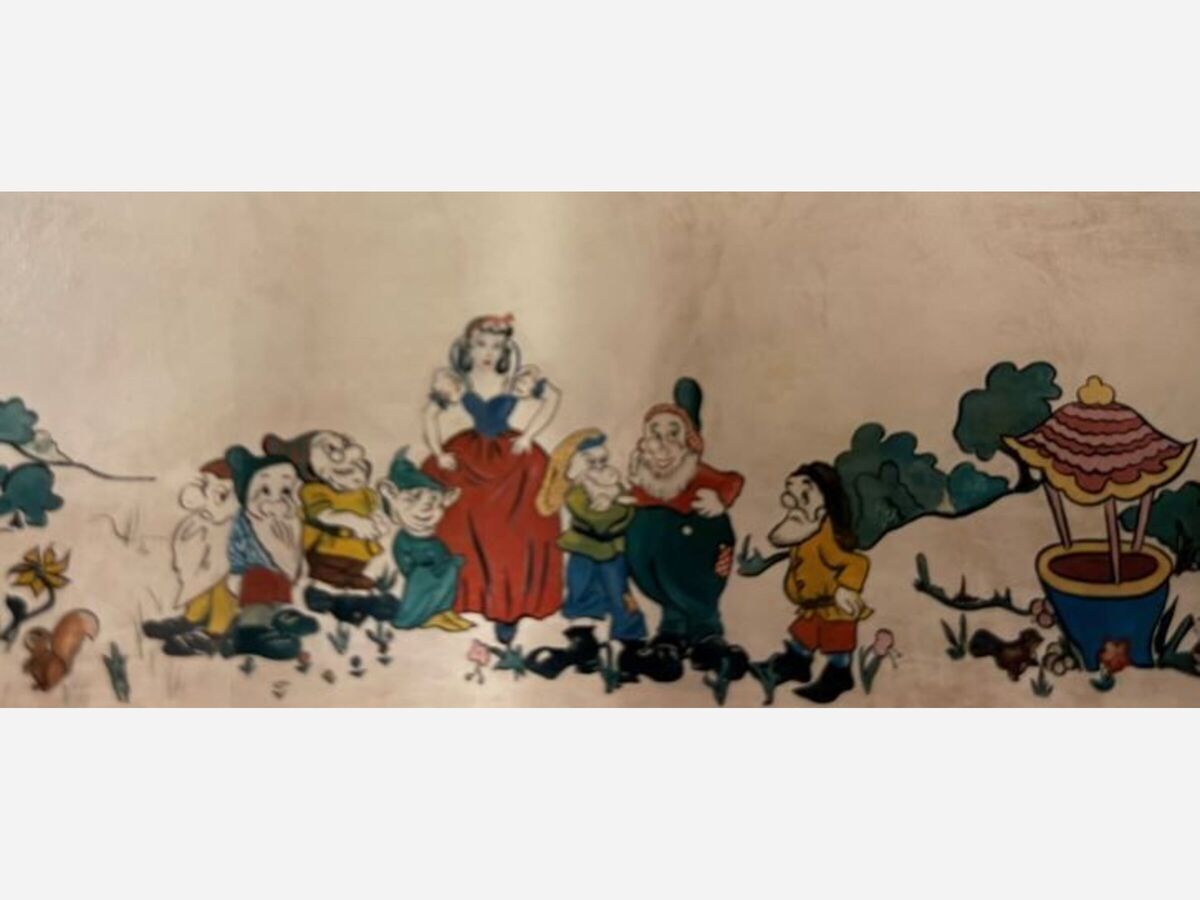
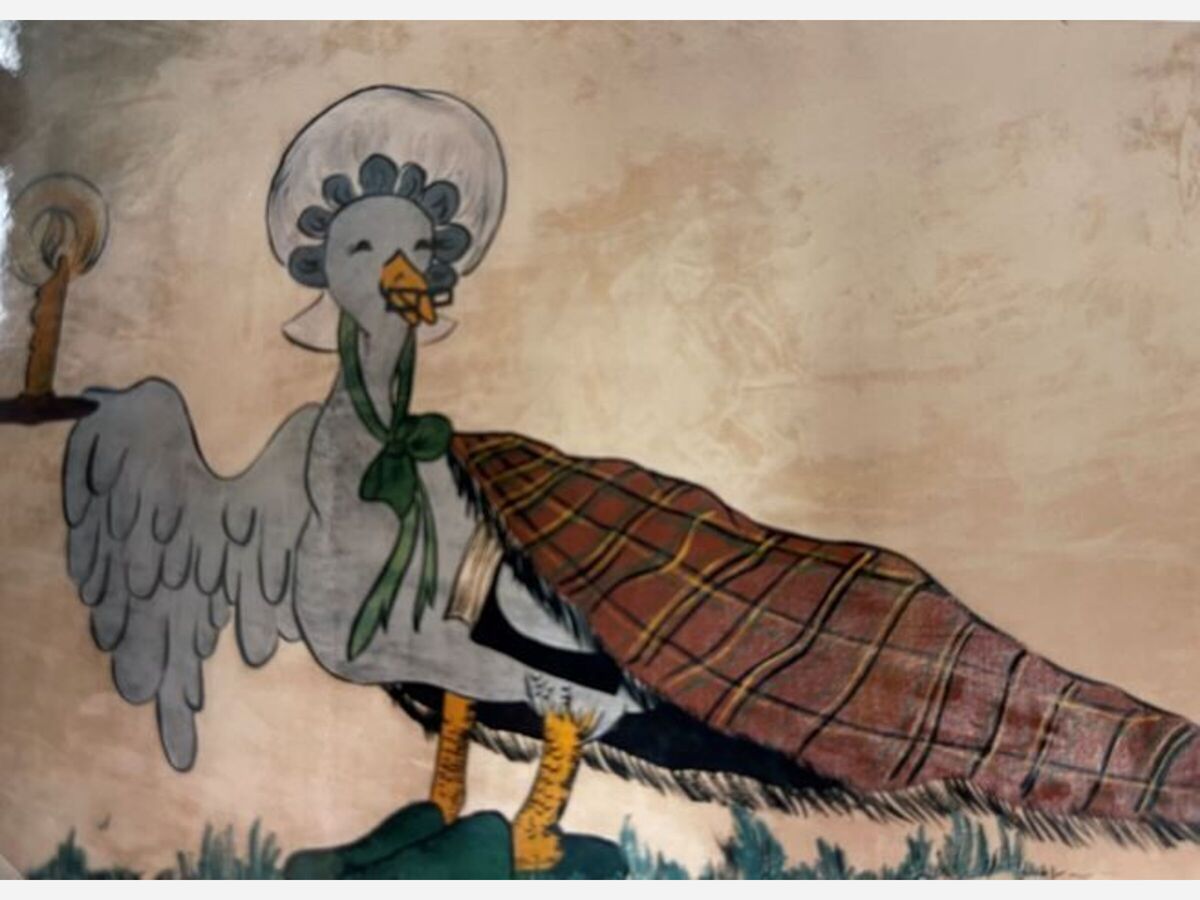
Then, in 1949, students from Dean Junior College, as it was then known, were engaged to paint conventional scenes related to Mother Goose stories and fairy tales over those same walls, and that became the new motif for the children’s room until it too was painted over in connection with the first library addition, around 1989-91
Sadly, not only was art by a noted artist – the original visionary of the library – painted over, not to mention the unnamed talents from Dean, but it seems that no visual record; neither snapshots nor drawings, were ever made of the Gallison work. However, as Earls noted, a few photos from the late 1980s do record the work of the Dean students and also betray tantalizing “shadows” beneath the light-colored paint of the 1949 fairy tale scenes that hint at what’s hidden below that layer of circa 1943 paint.
Exactly when and exactly why all these changes were made also appears to have escaped documentation. But Earls is always looking for clues.
A sad codicil: A group of older ladies, graduates of Dean, visited the library with family members in 2019 to show off their 1949 art project. They were devastated to discover it painted over and forgotten.


Sunny, with a high of 43 and low of 25 degrees. Sunny during the morning, overcast during the afternoon and evening, clear overnight.