Image
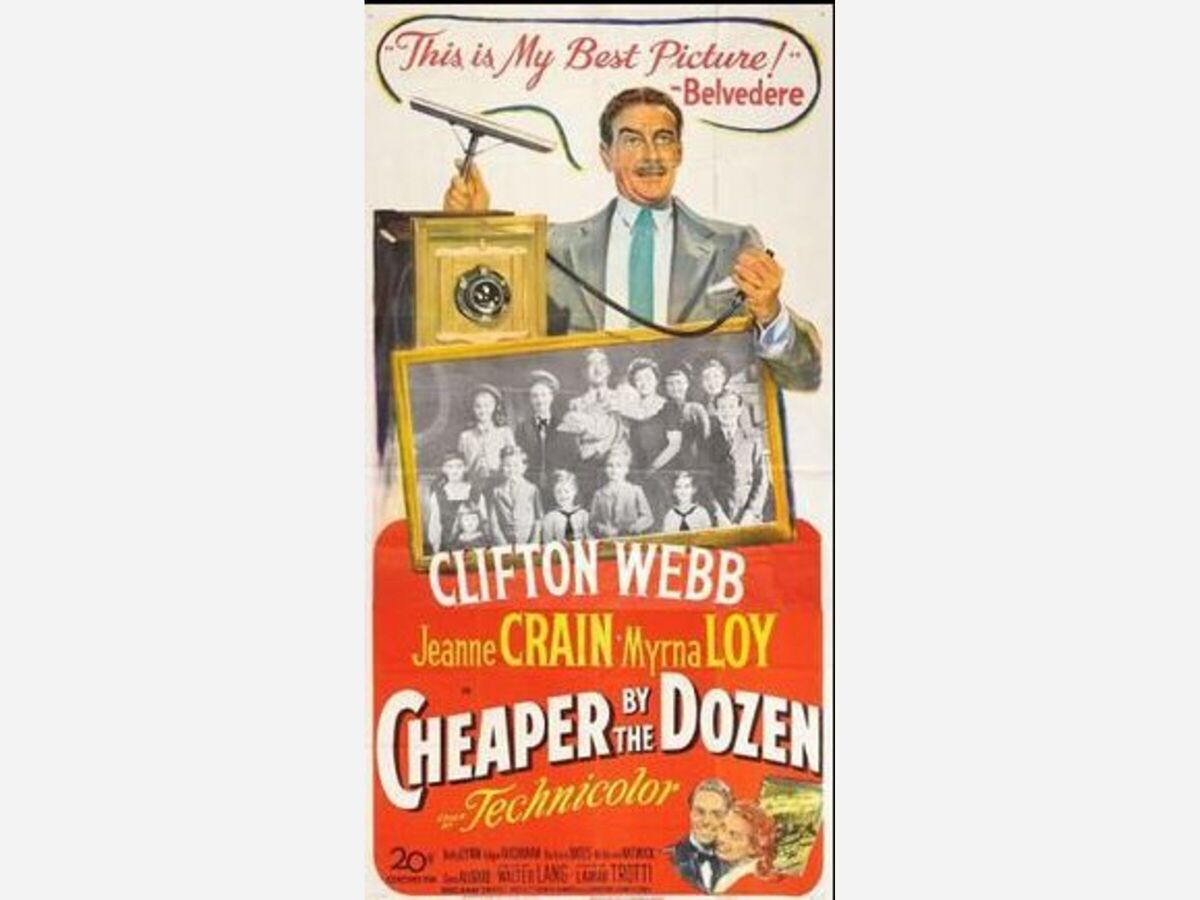



Above, the move poster for the original 1950 film, Cheaper by the Dozen.
One of the many interesting details in the history of the Ray Memorial Library, we are told, is that the general contractor for the project was none other than Frank B. Gilbreth, a well-regarded builder of many famous structures; industrial, civil, and much else beside.
Gilbreth was nothing if not a character. Born in Maine, after the sudden death of his father when he was a small child, the family slid economically, forcing a move first to Andover, Mass. and then Boston, where his mother opened a boarding house to support the family. Rather than attempt admission to MIT, Gilbreth instead went to work, determined to remedy the family’s economic situation. Hired by a contractor who was also his Sunday school teacher, Gilbreth began at the bottom, learning how to lay bricks.
Before long, though, he had come up with improvements in method and tooling that considerably improved the centuries-old craft. Rising rapidly within the company as he acquired mastery of every facet of the business, within a few years, in 1895, Gilbreth had set up on his own, all the while inventing his own brand of Scientific Management to make his company and his workers more efficient. His firm built factories, paper mills, canals, dams, powerhouse and, according to a company advertisement, an entire town in a matter of just a few months. And the Ray Memorial Library.
Over the course of his career he also earned more than a dozen patents.
Just about the time the library project was finishing in Franklin he married Lillian Evelyn Moller on the other side of the country, in Oakland, California, a union that produced 12 children in about that many years – an accomplishment that yielded the paternal quip that two of the children later turned into the title for their semi-autobiographical book.
Evelyn was herself a psychologist, industrial engineer, consultant, and educator and part of the movement of which Frank Gilbreth was an important apostle, of using time-and-motion studies to make work more efficient (the best-known figure in the field was Frederick Winslow Taylor, whose name became virtually a byword for the practice).
Starting in 1910, the husband and wife became full time “efficiency experts” and were much in demand. Frank, alas, died of a sudden heart attack in 1924 at age 55. Evelyn continued the business on her own for many more years.
The two apparently applied their organizational gusto to family life giving their accomplished children a stimulating if unusual upbringing.
The memoirs, Cheaper by the Dozen (1948) and Belles on Their Toes (1950), written by two of their children (Ernestine and Frank Jr.) were hot sellers and both were turned into humorous movies, the former featuring a wry encounter between Evelyn and a disciple of Margaret Sanger. Part way through the latter’s sales pitch for family planning, the multitude of Gilbreth children began to assemble leading to hilarity as the aghast family planner beats a hasty retreat.
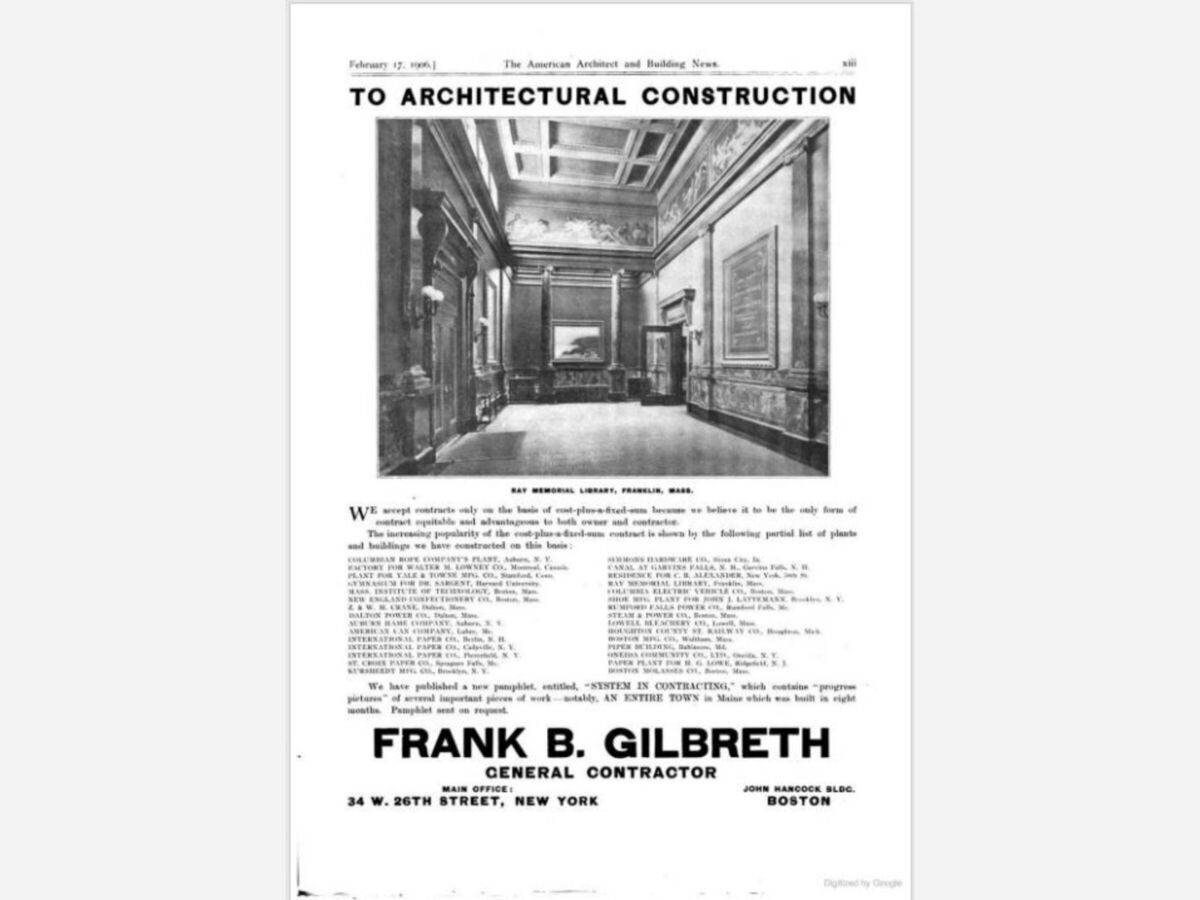
Neither work mentions the Ray Memorial Library. But Gilbreath himself used a photo of the library in his advertisement (illustration below, courtesy Franklin Library) from 1906 to promote his contracting company’s work.



Sunny, with a high of 73 and low of 40 degrees. Sunny in the morning, clear in the afternoon and evening,