


Image
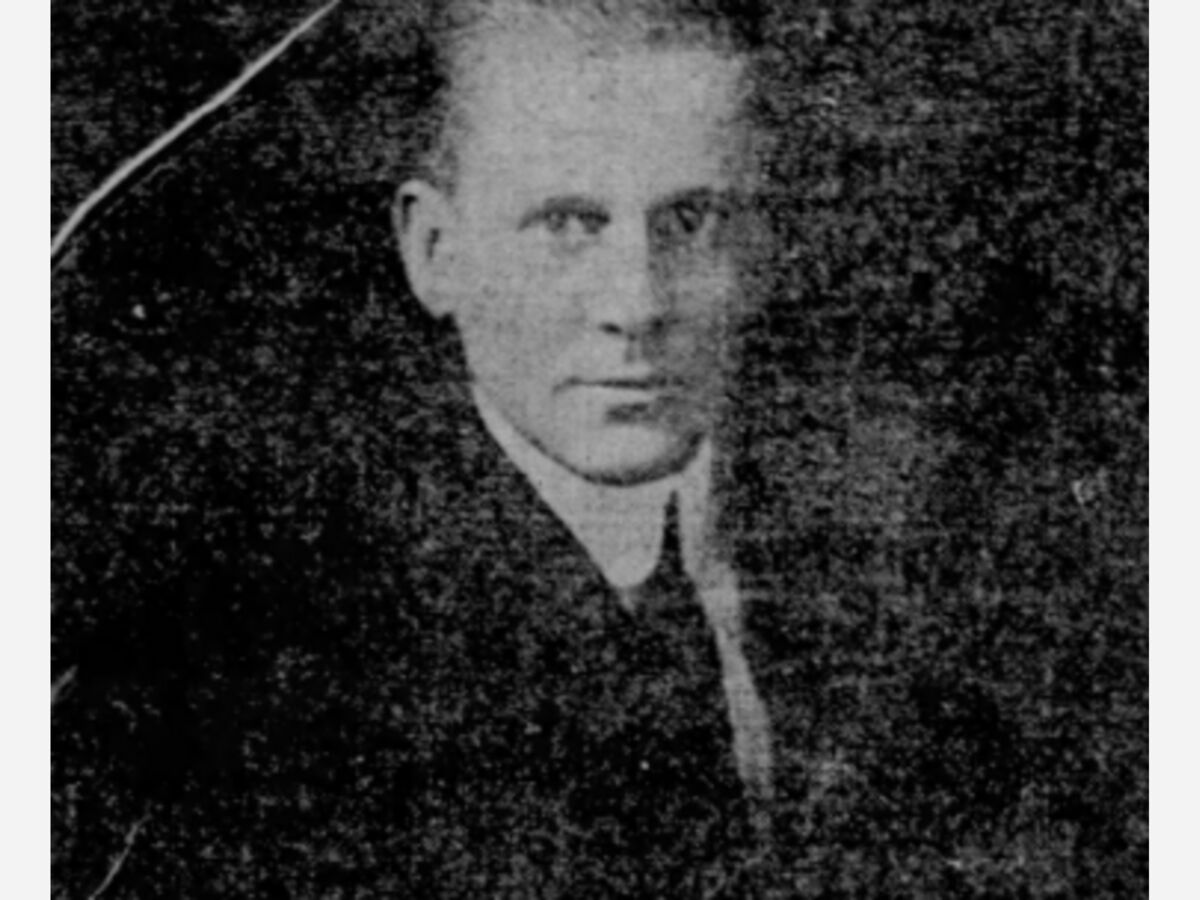
Born in Roxbury in 1880 and subsequently raised and educated in Franklin, Paul Jones Chute went on to conquer the emerging world of dance, with prominent roles in Paris, and pioneering presentations in the US, where dance as an art form was all but unknown.
When and how Chute became a recognized star is not clear, but by 1909, when he was 29, he was showing up as a major public artist up and down the Eastern seaboard.
And he wasn’t above returning to his home town. A Sentinel article from 1911, describing a production at the Morse Opera House in Franklin states, “Great interest has been manifested in “The Spring Idyll,” arranged by Mrs. Darling’s brother, Paul Jones Chute of Boston, and adapted for production in which he appeared in a large garden fete, two years ago in Paris, while he was in that city studying with Mons. De Clustie and La Loie Fuller...Mr. Chute was correctly garbed in the dress of a Greek boy, wore a white robe about the body. In his dance he gave a magnificent prelude, followed by evolutions which characterize the dances of the Greek ceremonial occasions. He had splendid support from the young ladies whose graceful posturings and steps gave a most charming finish. The dance was repeated, and in response to an emphatic re-call, Mr. Chute went forward and bowed his acknowledgments.”
A 1916 article from the Berkshire Eagle, in Pittsfield, Massachusetts, continues his story.
Paul Jones Chute, who instructs the dance groups for the musical pageant, “The Chosen King,” which is to be produced at the Colonial theater on October 19, 20, and 21 is one of the best interpreters of the early classical dance before the American public, being the first male dancer to introduce the classic dance in this country. Mr. Chute has made a very thorough and exhaustive study of the ancient customs and religious ceremonies connected with and expressed by dance. In the various numbers which Mr. Chute instructs in “The Chosen King,” nearly all the human emotions are expressed. To one less versed in his art it would be a difficult task indeed to take so large a number of people and in so limited a time produce such a wonderful array of accomplished dancers as he does.
A spectator watching Mr. Chute on the floor at rehearsals, gazes with a feeling that it is inspiration indeed that lends to his work the convincing quality that gains recognition and admiration from those who are associated with and under his direction. Paul Jones Chute has been associated with the younger set of Boston, Newport, and New York for the last few years producing many of the society fetes and pageants. He was also ballet master for Miss Christie MacDonald in “The Spring Maid.” He was soloist for Le Loie Fuller at the opera in Paris and has danced before nearly all of the crowned heads of Europe and in this country has appeared in all of the leading theaters as a feature of many of the well-known productions. Mr. Chute was the feature soloist of Mrs. Larz Anderson’s Persian fete in Brooklyn (sic, almost certainly Brookline), a few months ago and was also the soloist of port.
Chute’s 1918 draft card, filled out when he was 38, states that he is an actor not presently employed and that he is partially blind and living on Newbury Street in Boston. He is described physically as short, slender, with blue eyes and light brown hair.
In 1921, an article about his niece, Elizabeth Partridge Darling of Attleboro, also a dancer, noted that Chute was associated with Monsieur De Clusted and La Loie Fuller of Paris and had been called “the most graceful man in America.”
And, according to a 25-years-ago-today article from 1947 (therefore, an event in 1922), “Paul Jones Chute of Boston gave a tea in his Beacon Street home ... in honor of his niece, Miss Elizabeth Darling. A number of guests distinguished in state and political life were present. Among the guests was Tyrone Power, leading man in ‘The Wandering Jew’ company, and his wife.”
A 1927 news story was mysterious and perhaps concerning. An article from the January 19 Boston Herald told how Chute had created a silhouette of Mrs. Coolidge, the First Lady, from a photograph, and mailed it to the White House, asking for a signature of the President for his growing collection in return [ later in life Chute had also become an antique dealer].
An anonymous writer, claiming to be a woman reporter from Boston, wrote to the White House at about the same time, clearly with knowledge of Chute’s correspondence. What exactly was said in the letter may exist in an archive somewhere but was not revealed in the story.
The ending, however, was. Chute found a plainclothes member of the Secret Service at his door with questions and with the silhouette, which they returned with an admonition to not send anything further.
In 1930, a news clip fragment, notes, "Paul Jones Chute of Dartmouth Street [Boston], formerly of Franklin, died suddenly on Tuesday afternoon at his summer cottage at Stony Beach, Hull, after a day's illness.
“Mr. Chute, who never married, leaves besides his father, Rupert J. Chute, of the Boston Transcript, a sister, Mrs. Fannie Chute Darling of Franklin, a brother George Blanchard of Providence, two nieces, a nephew and two grand-nieces. The funeral will be held in Franklin on Friday in the Universalist Church.”
Chute is buried in Franklin.



Heavy rain, with a high of 53 and low of 42 degrees. Sunny in the morning, light rain for the afternoon, partly cloudy for the evening, patchy rain nearby overnight.