36° and Clear


Image
Sam Drysdale | SHNS
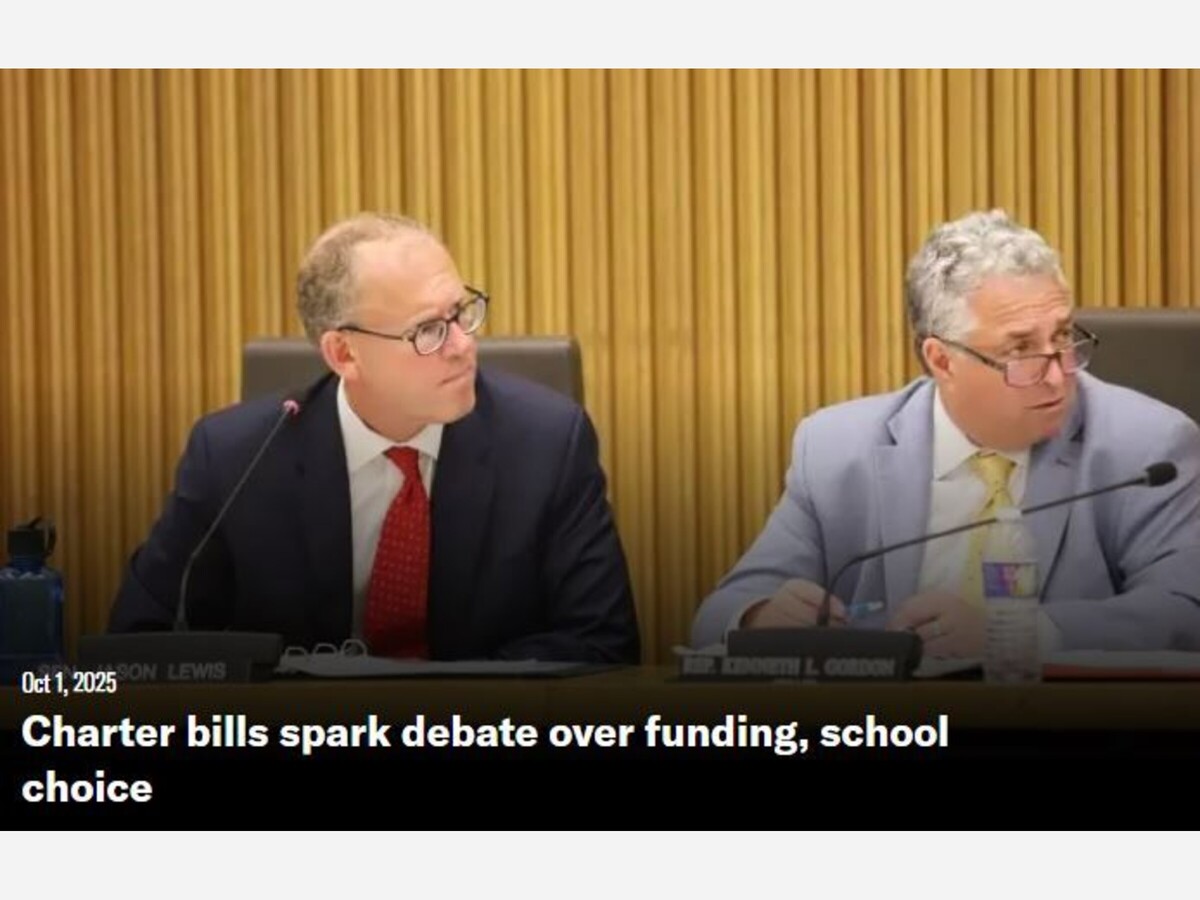
Sparks flew at the State House Tuesday as lawmakers, educators and charter school advocates packed a hearing over a slate of education bills that could reshape how charter schools are funded and approved in Massachusetts.
At the heart of the debate was the financial tug-of-war between district public schools and public charter schools, and whether new legislation should curb charter growth in order to protect strained district budgets. Lawmakers on the Joint Committee on Education weighed bills that would both soften the fiscal blow of charter enrollment and impose stricter caps and oversight on how new charters are authorized.
Much of the testimony centered on bills (S 389 and H 577) filed by Sen. Robyn Kennedy and Rep. Brandy Fluker-Oakley that propose changes to the state’s reimbursement formula.
Massachusetts provides state reimbursement to public school districts when students living in those districts opt into attending charter schools, based on a tiered schedule that typically covers 100% of tuition increases in the first year, 60% in the second year, and 40% in the third year. The bills propose changes to the state’s reimbursement formula by adding a fourth year of aid at 40% and boosting the second-year reimbursement to 80%. by adding a fourth year of aid at 40% and boosting the second-year reimbursement to 80%. Supporters say the updates would help districts retain essential services as more students opt into charter schools.
Deb McCarthy, vice president of the Massachusetts Teachers Association, described the impact on her South Shore district when a charter school opened in the 1990s.
"While I will always support the need for multiple pathways for our learners, when we rob Paul to pay Peter in a town that had less than 10,000 residents the challenges of supporting two school systems was Herculean," she said. "The district was forced to eliminate buses for our after-school programs, eliminate foreign language teachers, our librarians and our nationally acclaimed band program."
Keith Michon of the Fall River Educators Association said the formula called for under the legislation could have brought his district an additional $1.8 million in reimbursements — enough to expand early college programs and sustain pre-kindergarten offerings.
"We cannot afford to lose ground. Our students deserve a stable, well-resourced education system that gives them every opportunity to succeed," he said.
But charter school leaders criticized bills filed by Sen. Jo Comerford and Rep. Mindy Domb (S 2614 / H 4511) that would tighten the cap on charter tuition payments and give the state Board of Elementary and Secondary Education greater authority to weigh financial harm to districts when considering new or expanding charters.
The bill would set a hard 9% cap on charter tuition payments as a percentage of a district’s net school spending, eliminating the current law that allows that cap to rise to 18% in so-called "bottom 10%" districts based on MCAS performance. It also directs the board to consider financial, enrollment, and long-term viability impacts on districts when evaluating charter applications, expansions, or renewals, and mandates public comment periods and hearings before such decisions.
Massachusetts Charter Public School Association Executive Director Tim Nicolette said the bill could cut charter funding by up to 72%, triggering widespread school closures and displacing tens of thousands of students.
"If you’re cutting schools’ funding in half or by two-thirds or by three-quarters, they can’t operate," he said.
Pressed by Rep. Manny Cruz, Nicolette acknowledged that the bill "grandfathers" current students to protect their places in the schools, but said it shifts charters to rely on annual state appropriations rather than the more consistent Chapter 70 formula, creating what he called a "very separate and unequal funding system."
"It would essentially say the state has to come up with the money elsewhere in the budget," Nicolette said.
Sherley Bretous of the Benjamin Banneker Charter School echoed the warning about the bill's impacts.
"These laws, these legislations that are passing would devastate our schools," Bretous said.
Sen. Jason Lewis, co‑chair of the committee, pressed charter leaders on the logic behind the current “bottom 10%” rule, which allows certain districts to exceed the 9% cap and reach up to 18%. He argued that that rule is largely tied to MCAS scores and data that he said are more correlated with poverty than school quality.
"By then deeming districts to be in the so-called bottom 10%, it stigmatizes them. These are often districts that serve largely low-income students, disproportionately students of color, multilingual learners, and now we're stigmatizing them by saying you're in the bottom 10%" Lewis said.
After Lewis asked whether the state should rethink how it determines spending caps altogether, Nicolette said the intent of the bottom 10% mechanism is to increase educational opportunity in high‑need communities.
"Families deserve the opportunity to send their kids to a high-quality public school and charters have an important role to play in helping provide high-quality options so that families can stay in their communities, don't have to leave, and for families that can't afford to move or to pay these really high tuition rates at private schools," he said.
Lewis countered that relying on MCAS scores to define "quality" reinforces inequities: “I really think we should rethink the fact that we deem a school to be low-performing just because they have lower MCAS scores.”
Nicolette said charter school advocates were open to conversations about adjusting how caps are set in different districts, but said those conversations should not undermine the principle that families must have access to strong public school options, whether charter or district.
The tensions echo the high-profile 2016 charter school ballot fight, when Massachusetts voters decisively rejected Question 2. That proposal that would have lifted the state’s cap on charter expansion. Opponents, backed by teachers unions and civil rights groups, argued that charter growth siphoned money from already underfunded public districts. Despite a well-funded pro-charter campaign, the measure lost 62% to 38%.
"It’s really clear from the results of this election that people are interested in public education and value that," then-Massachusetts Teachers Association president Barbara Madeloni said at the time. "There should be no conversation about expanding charters," she added, "until the Legislature moves to fully fund our public schools."
That broader funding conversation still looms. Despite the 2019 Student Opportunity Act injecting $1.5 billion into K–12 education, many districts — particularly rural and regional ones — say they’ve been left behind.
Rising special education costs, inflation, and enrollment dips have forced some districts to attempt Proposition 2½ overrides and local tax hikes just to keep classrooms staffed and programs running.
"In the Massachusetts school funding system, we place an enormous strain currently on municipal budgets," said Comerford, testifying on her reform bill. "I believe it's the state's duty to find a structural and financial path forward that takes the pain out of the entity-to-entity conversation and puts us on a more sound path."
Sen. Robyn Kennedy brought up one of those "entity-to-entity" conversations. A charter school affiliated with the Old Sturbridge Village museum was approved in 2023, with a curriculum based on engaging with cultural institutions in central Massachusetts.
Kennedy, who represents Worcester, said only 354 students attend the school, and by state law, Worcester's public school district helps fund the charter. Nearly 25,000 students are in the public district system.
"What happens to the other 24,000 students that I'm responsible for in the Worcester Public Schools that aren't able to access those same types of supports, those same types of opportunities?" Kennedy said.
Nicolette replied that focusing solely on funding misses the voices of families who actively choose charter schools.
"The first place the conversation goes is dollars," he said. "I actually think that one of the keys to improving outcomes for all of the kids in Worcester, but also beyond, is actually listening to some of the voices of some of the charter school students and families."

Sunny, with a high of 60 and low of 37 degrees. Partly Cloudy in the morning, overcast in the afternoon, clear in the evening,