78° and Clear



Image
by Aaron Singer, CommonWealth Beacon
October 11, 2025
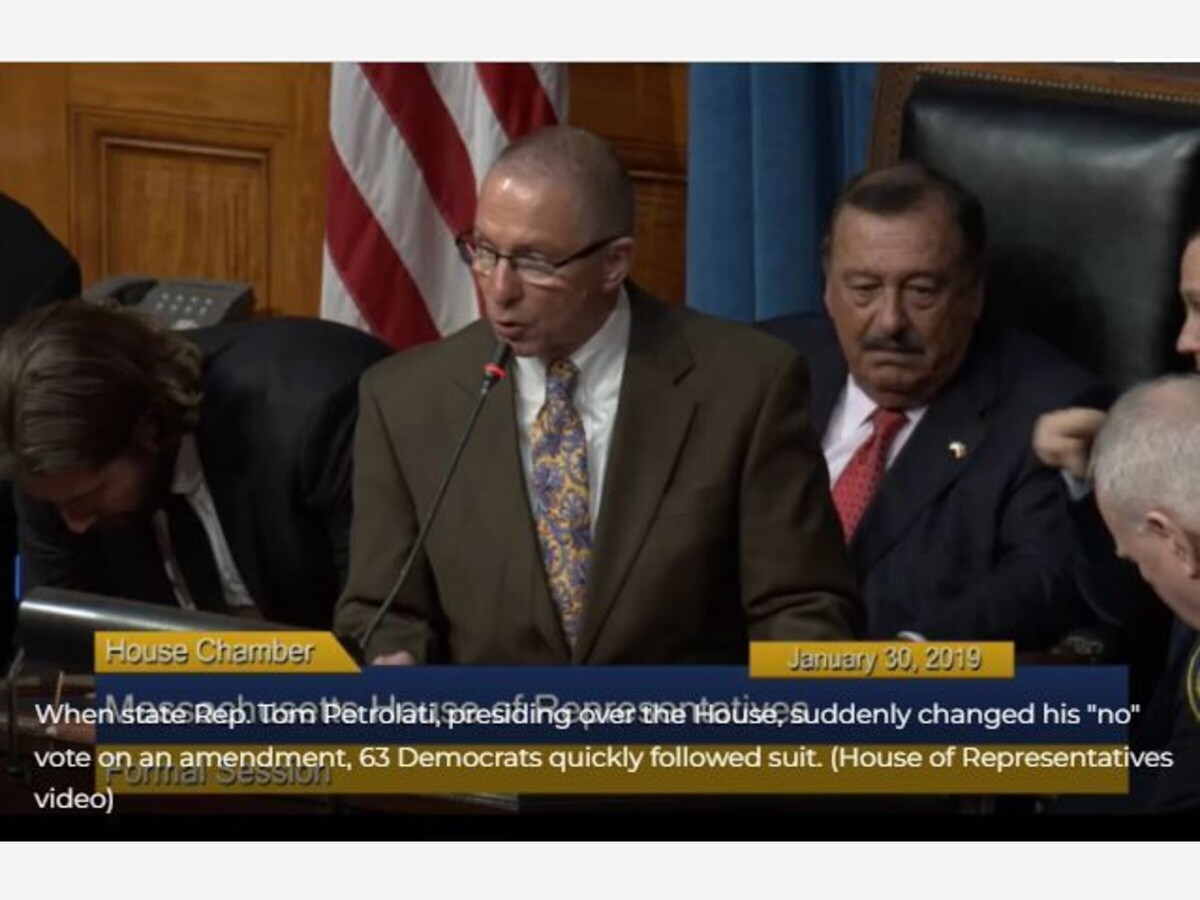
FIVE AND A HALF hours into a tedious rules debate at the Massachusetts State House in January 2019, acting Speaker Tom Petrolati ordered a roll call vote on a noncontroversial amendment, and voted no. Within seconds, red lights, representing “no” votes, lit up the electronic vote-tally board in the House chamber as dozens of rank-and-file members followed his lead.
Then, realizing he had made a mistake (but not realizing his mic was still on), Petrolati stammered: “It’s a yes?... Switch ’em. Yes, yes, yes, yes. Yes. Yes!”
After his vote on the large display board flipped to green for “yes,” so, too, did the votes of at least 63 Democratic representatives. (The video of this moment remains on the Legislature’s website, beginning at 5:35:49.)
Beacon Hill Roll Call reporter Bob Katzen’s write-up of the all-too-common event didn’t mince words: “Did these 63 even know what they were voting on? Did they care? What would cause them to switch their votes other than they decided to follow the ‘suggestion’ of the speaker?”
In a separate interview, Rep. Russell Holmes, one of the few at that time to openly criticize the system, offered a blunt assessment: “The entire legislative establishment is a scam. [The Speaker] is like a shepherd leading the sheep. Most reps vote the way he tells them to vote.”
Having grown up in deep-blue Massachusetts, I viewed politics through a national lens. Beyond knowing my rep’s names, I never thought much about what goes on under the Golden Dome on the corner of Boston Common.
Like many, I assumed that Massachusetts was liberal, and therefore, so was our State House. If a progressive policy was doable, the same electorate that chose Elizabeth Warren and Ed Markey would have chosen a Legislature excited to make it happen.
That assumption crumbled when I started working on a documentary about why daylight saving time (DST) reform won’t pass the Legislature, despite broad public support.
What began as an attempt to use the Legislature’s clunky website to trace the path of a DST bill quickly turned into a ten-month (and counting) investigation. Interviews with lawmakers, activists, and reporters all confirmed the same truth of how laws actually pass in Massachusetts: Just a few members of leadership decide which bills live or die. Debate is staged, and the real lawmaking happens behind closed doors.
Massachusetts has one of the least transparent, least productive legislatures in the country. Despite our state’s progressive reputation -- and a Democratic supermajority in both chambers -- our State House won’t pass basic party priorities. This includes bills to:
The “Act to Stop Wage Theft” referenced above? It had a supermajority of co-sponsors in the House a few years ago, yet it never received a vote. Here’s why.
Each law must go through several committees led by handpicked allies of the leadership; committee votes were completely opaque until mounting public pressure spurred changes this summer.
These committees serve as bottlenecks, allowing leadership to effectively choose what bills get a vote by the full chamber. When committee chairs go against the Speaker or Senate president, they risk losing this position and the extra salary that comes with it. Representatives have even lost pay and power just for being critical of leadership.
Former rep. Denise Provost has pointed out that leadership used to poll members before major bills. But after a threshold of lawmakers with leadership-controlled stipends was reached, the polling stopped.
This top-down dynamic should frustrate Republicans as well: Minority Leader Brad Jones cooperates with the Speaker to block some roll-call votes Democrats prefer not to be recorded on.
No House committee is more important than the Ways and Means Committee. Internal rules require that many bills go through that committee, before the full House can vote on them, making Speaker Mariano’s handpicked chair, Rep. Aaron Michlewitz, one of the most powerful people in the Bay State.
For big money industries, like private insurance, this structure is a gift. Instead of persuading 160 representatives to kill or pass a bill, they only need to win over a small handful of gatekeepers. And if you wonder what their preferred method of persuasion might be, just look at Michlewitz’s campaign reports: Since 2009, he’s run unopposed, yet between 2020 and 2024 he raised $1,995,765.21.
Beacon Hill’s contempt for the public will is perfectly illustrated by a largely forgotten incident from two decades ago, whose key players now run the Legislature.
In 2003, Massachusetts residents petitioned to put a constitutional right to affordable health care on the ballot. “Romneycare,” the bipartisan Massachusetts law that served as a blueprint for the Affordable Care Act, was still being shaped, and activists feared lawmakers would gut patient protections to appease the powerful insurance lobby.
After collecting over 71,000 signatures to begin the process for amending the Massachusetts Constitution, the hard part was finished. All that remained was getting 25 percent of the Legislature to approve it in two sessions. When the first vote confirmed it, 153-41, the second seemed like a formality. However, the vote would never happen.
When the next session convened, House and Senate leadership backed an effort to send the question to study, a procedural trick to kill a measure without taking a public stance. Lawmakers fell in line, 118-76, and voters never got to decide if affordable health care should become a right.
Then-committee chairs Ron Mariano and Karen Spilka were among the few legislators to openly argue for the motion on the floor, a gamble that should have made them the face of killing affordable health care. Ultimately, their gamble paid off: Today, House Speaker Mariano and Senate President Spilka each sit atop massive campaign accounts fueled by lots of money from the health care and insurance industry.
Today, the “study” maneuver is a convenient tactic to quietly kill bills, as citizens are misled into thinking their bill is being actively considered; lobbyists know better.
When activists challenged the scuttled ballot question at the state’s highest court, justices agreed that lawmakers violated their constitutional duty by failing to hold a second vote on the proposal, but the court said it had no authority to compel action by lawmakers under the separation of powers. The only recourse, the justices said, was at the ballot box.
It’s taken nearly 20 years, but recent events suggest that political recourse may finally be within reach, and that frustration with Beacon Hill’s establishment is near a breaking point.
First came last fall’s closely watched contest in Cambridge, when Democratic union leader Evan MacKay took on Rep. Marjorie Decker, a fixture in local politics, making legislative reform the cornerstone of their primary challenge. MacKay attacked Decker for repeatedly taking votes that strengthened leadership’s power over rank-and-file members, undermining the progressive values she claimed to support.
To say Decker was favored would be an understatement: Her campaign had a four-to-one spending advantage, bolstered by a rooftop fundraiser that drew a who’s who of party insiders, including Gov. Maura Healey. Despite all that, MacKay came within 41 votes of an upset, marking the first time Decker dropped below 83 percent support as an incumbent.
Then, in June, after mounting criticism for their slowest start in 40 years (six laws passed in six months), legislative leadership caved to rule reforms they had stonewalled for years. Public committee votes, publicly available testimony, and plain-language bill summaries may sound like basic democratic norms, but on Beacon Hill, they were fought tooth and nail. Their sudden passage was such a shock that one activist excitedly texted me: “It looks like we won on nearly everything.”
Perhaps most telling of all, 72 percent of voters supported a ballot question last November authorizing the state auditor to audit the Legislature, an unmistakable mandate that Beacon Hill can’t police itself. Like clockwork, the Legislature brazenly ignored the result, arguing it was an unconstitutional violation of the separation of powers.
Let’s be clear: this argument is cover for preserving unchecked power. The auditor is an independent, voter-elected watchdog; she’s neither appointed by nor answerable to the governor. She is “executive” only in a technical, structural sense, not in any chain of command way that would trigger separation of powers concerns.
If you’re an aspiring activist who feels waving around a “No Kings” sign falls short of impactful activism, look at state government as an avenue for change. Lobbying your state rep will do far more than mailing a postcard to Wisconsin for a judicial election. Medicare for all is likely to happen here long before Congress secures a filibuster-proof majority.
If your rep is one of the 85 percent of House Democrats who voted with the Speaker 100 percent of the time in 2024 (full list here), ask them directly: Are they proud that their paycheck and ability to represent the district depends on their loyalty to the House speaker? Are they open to supporting new leadership and new rules that put constituents first?
And if they shrug you off, connect with local advocacy groups and find a candidate worth backing, or consider becoming that candidate yourself. Only under the threat of losing their seats will rank-and-file members reclaim their power to oust authoritative leaders and rewrite the rules to favor voters.
For decades, Beacon Hill has shamelessly ignored voters, because the public has never held them accountable. Mariano and Spilka weren’t shamed for helping kill affordable health care, they were rewarded. But sooner or later, enough people will learn how democracy in Massachusetts is a lie. When they do, leadership’s iron grip will crack, not because those in power wanted to change, but because voters finally forced them to.
Aaron Singer is a Walpole-based filmmaker and activist. He’s crowdfunding “Shadows on the Hill,” a documentary that investigates how widely supported bills stall in the Massachusetts State House—and the broader lessons for Democrats’ ability to deliver at the federal level.
This article first appeared on CommonWealth Beacon and is republished here under a Creative Commons Attribution-NoDerivatives 4.0 International License.

PARSELY = { autotrack: false, onload: function() { PARSELY.beacon.trackPageView({ url: "https://commonwealthbeacon.org/opinion/why-the-democratic-supermajority…", urlref: window.location.href }); } }


Sunny, with a high of 89 and low of 72 degrees. Overcast during the morning, partly cloudy in the afternoon, clear for the evening,