71° and Sunny



Image
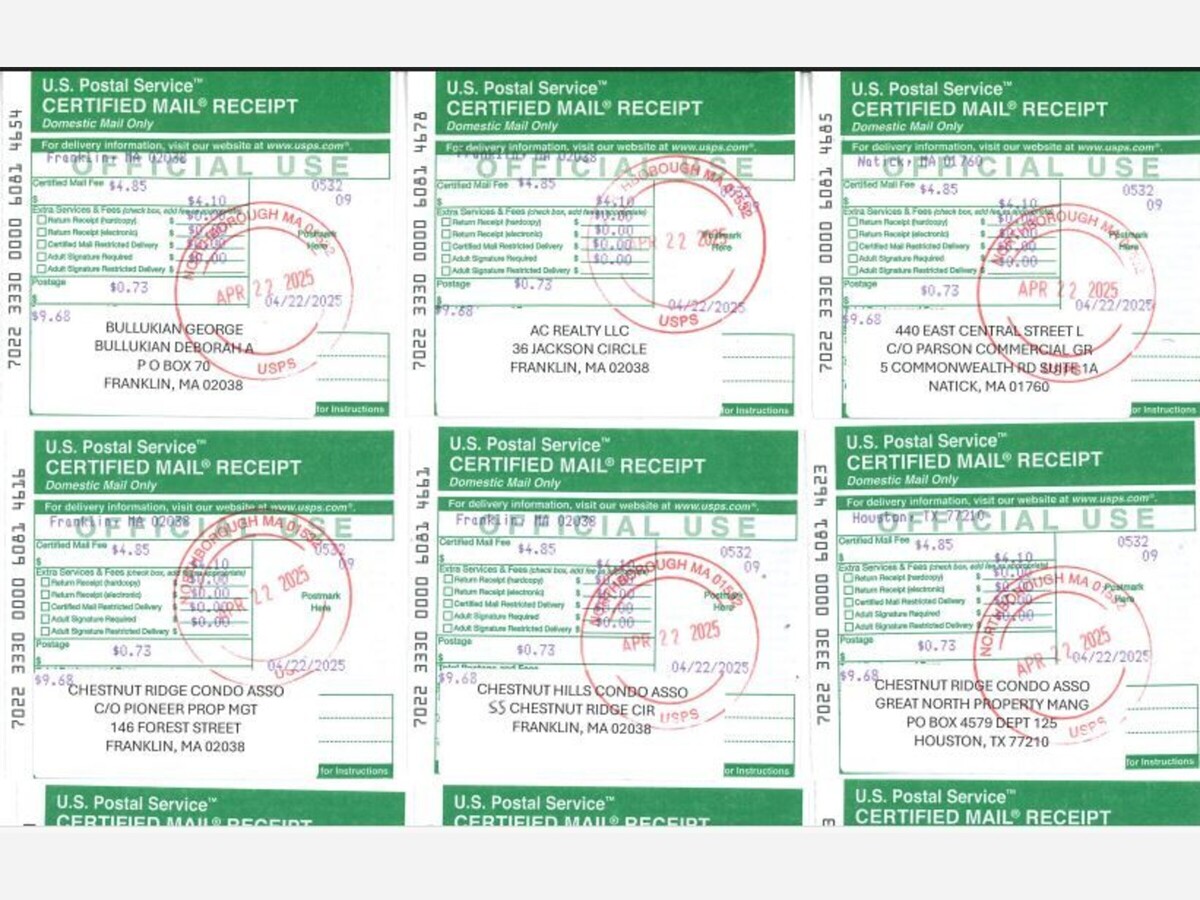
[Above, an images of some of the registered mail receipts from a belated town mailing to abutters.]
During this week's Zoning Board of Appeals hearing, at which the 444 East Central Street 40b project was given the go-ahead, a ZBA member referenced "the letter" sent by the Town Council to the state's Executive Office of Housing and Livable Communities, to clarify their own position and the facts they believed warranted a wihtdrawal of actions taken by the previous Council. Having heard from at least two people asking about the contents of the letter, we inquired with Town Manager Jamie Hellen and he pointed us to the document. It is reproduced below.
Robert Dellorco, Chair
Franklin Town Council
355 East Central Street
Franklin, MA 02038
December 17, 2025
Edward Augustus, Secretary
Catherine Racer, Undersecretary
Derya Samadi, Esq., General Counsel
Rieko Hayashi, Director, Local Initiative Program (LIP)
Commonwealth of Massachusetts
Executive Office of Housing and Livable Communities
100 Cambridge Street, Suite 300
Boston, MA 02114
Re: Local Initiative Program (LIP) Development Project – 444 East Central Street, Franklin, MA
Dear Secretary Augustus, Undersecretary Racer, Attorney Samadi, and Director Hayashi:
The Franklin Town Council submits this correspondence to explain the basis of its November 19, 2025 vote to withdraw municipal support for the proposed Local Initiative Program (LIP) development at 444 East Central Street. This decision is grounded in the requirements of the LIP Guidelines, particularly those beginning at page 70 concerning material changes to the project and in the Applicant’s failure to follow the amendment procedures required under those guidelines. These guidelines were adopted to create a collaborative process between the Applicant and the Town’s governing body. This did not happen in this case as no amendments were requested for the Determination of Project Eligibility (even as multiple material changes were made to the project plan), and neither did the Developer secure concurrence of the Town Council or Town Administrator to confirm continued local approval.
The Town of Franklin remains strongly committed to affordable housing. Our concern here is not with affordable housing itself, but rather with ensuring that the LIP process is followed faithfully, transparently, and collaboratively, as intended.
I. Role of the Town Council
The Town of Franklin has adopted a Home Rule Charter. Under the Charter, all general, corporate, legislative and appropriations powers of the Town are vested in the Town Council.
The Town Council appoints the Town Administrator who is the chief executive and administrative officer of the Town and is responsible to the Council for the effective administration of all Town affairs placed in his charge, including affordable housing matters.
II. Background and Original Support
On June 5, 2024, the Town Council voted to support a specific set of plans that were jointly submitted with the Applicant to EOHLC. The Project Eligibility Letter (PEL) issued in February 2025 was based on that original configuration and reflected a careful balance of density, site layout, setbacks, environmental protections, and compliance with local standards. Those components formed the foundation of the Town’s support.
The ZBA subsequently opened the hearing in March of 2025, during which the ZBA provided feedback to the developer on an issue with the number of parking spaces being too low. The response from the applicant in June was to substantially change the project, removing many of the benefits including combining the two buildings closest to the abutters into one large 4 story building that created a wall effect within a few hundred feet of the abutter’s property.
After considerable pressure from residents, the Town Council submitted a letter to the ZBA, in August 2025 and before the election of the current Town Council, stating they were no longer in support of the project. Subsequently, the Applicant again adjusted its design to remove 10 apartments, remove one story from the building closest to the abutters and make other changes to reduce the parking requirement originally requested by the ZBA. During this period, to our knowledge, the Applicant did not submit an amended PEL nor did it ever request that the Franklin Town Council approve of these changes.
The LIP process is clear as to how changes need to be handled procedurally because it is meant to provide for cooperation between the Town’s governing body and the Applicant. This cooperation, to date, has not happened. By choosing to work solely with the ZBA, which is not familiar with this process, the Applicant prevented the Town’s governing board from providing any feedback on the design changes.
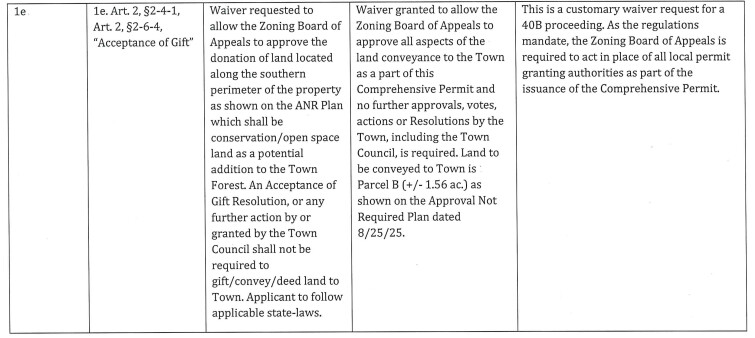
The Town of Franklin, being above the statutory minimum of 10% on the Subsidized Housing Inventory (SHI), should retain control of the project at 444 East Central Street. Since the Town Council believes the project is not consistent with local needs, it has voted to remove its support within the LIP program. This project, with 39 requested waivers to local bylaws, rules, and regulations (up from 18 waivers requested at the time that local approval was granted), is no longer consistent with what the Town originally approved and therefore the Town Council has rescinded its support.
III. The LIP Requirements for “Material Changes” and Amendments
The LIP Guidelines (Section VI.8) require that when a project undergoes material changes, the Applicant must amend the determination of project eligibility.
a. Amending the Determination of Project Eligibility
(1) Material Change - Any material changes in any of the conditions of a Determination of Project Eligibility (e.g., a change in the development team, the number of units, unit mix, size, design, location, extension of the term of the Determination of Project Eligibility, proposed sale of the project, etc.) REQUIRE that the Determination be amended. DHCD shall be notified immediately if either the Developer or the municipality anticipates any material change in the terms of the initial Determination of Project Eligibility.
(2) Local Approval - The Developer must secure concurrence of the chief executive officer for the proposed change. DHCD will not issue an amended Determination without such local approval, unless it is unreasonably withheld, and without compliance with these requirements.
(3) DHCD Review - DHCD may perform an additional site visit, meet with representatives of the municipality and the Developer, and/or request additional financial information, revised site plans, etc., prior to acting on a requested amendment.
(4) Final Approval Withheld - Final approval may be withheld if the Project is not consistent with the Determination of Project Eligibility.
IV. Material Changes Made Without Following the LIP Amendment Process
The Applicant made multiple changes to the project that were significant enough to require an amendment under VI.8, including, but not limited to:
a. Additional Waiver Requests
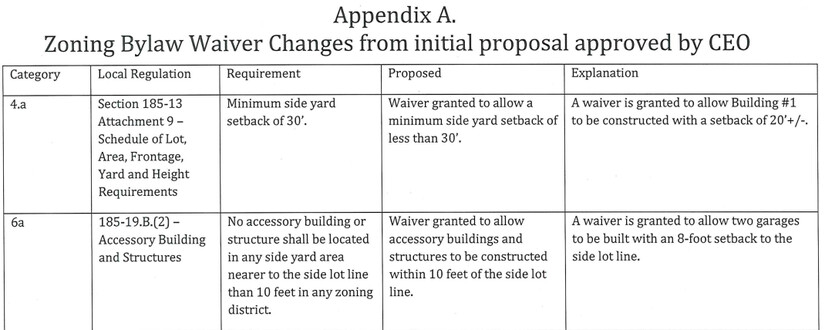
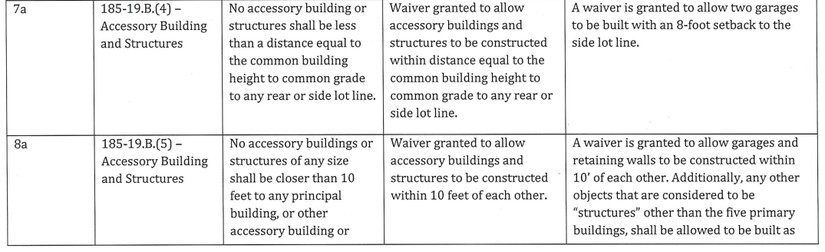
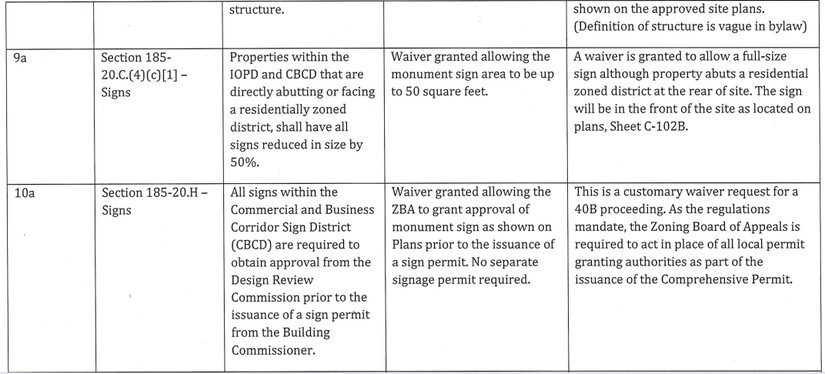
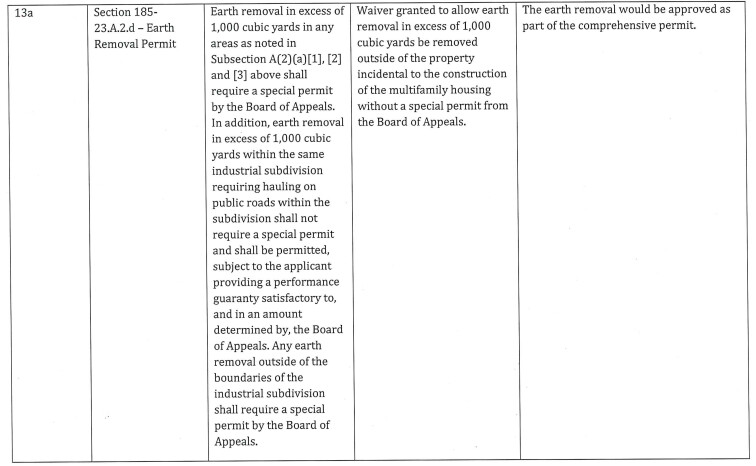
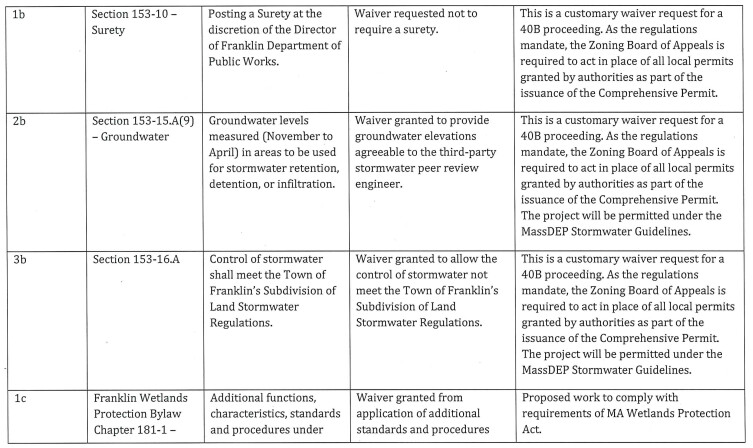
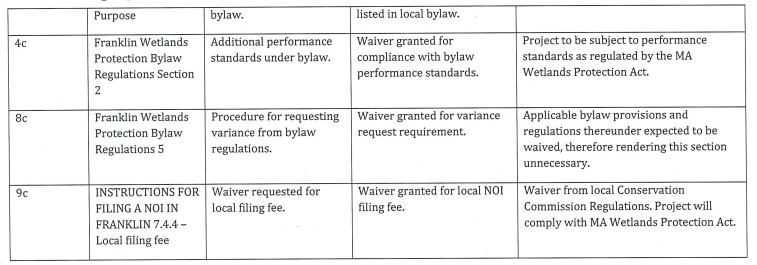
The original LIP-supported plan included approximately 18 waivers. The revised submission now contains 39, an increase of 86%, as documented in the Applicant’s filings. A list of waivers added since the original proposal is in Appendix A.
These new waiver requests include:
• Reduced side-yard setbacks for primary and accessory structures (4.a, 6a, 7a, 8a), moving development closer to abutters.
• New parking dimension waivers (12a) allowing denser parking fields.
• A major earth removal waiver (13a) eliminating protections normally required for large-scale excavation.
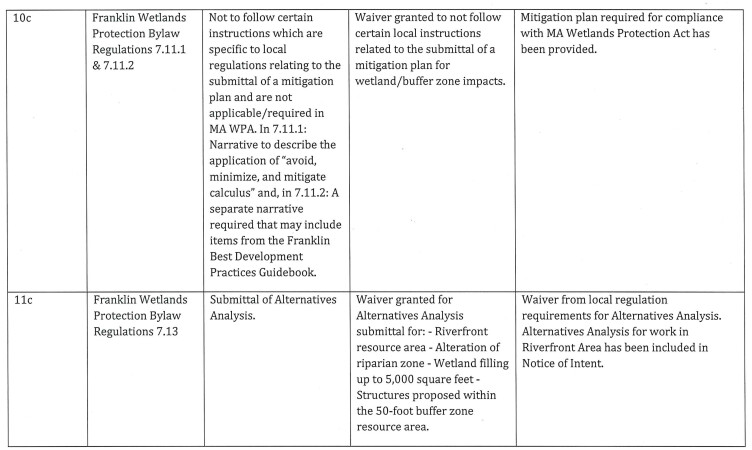
• Numerous new stormwater and wetlands waivers (1c–18c, 2b, 3b), replacing Franklin’s local environmental safeguards with state minimums.
• Expanded signage waivers (9a–10a) affecting aesthetics and neighborhood character.
These changes directly affect the design, intensity, environmental impact, and zoning compliance of the project, and thus constitute material changes.
b. Loss of Benefits That Formed the Basis of Original Support
Several benefits embedded in the original LIP-supported design were weakened or removed, including:
• Larger buffers and deeper setbacks,
• Compliance with local stormwater standards,
• Local wetlands protections above the state minimum,
• A more limited number of accessory structures and site disturbance, and
• Lower impervious surface coverage.
While the Applicant reverted from a four-story building to the originally supported height near abutters, this modification came at the cost of expanded zoning relief and weakened environmental protections elsewhere. The net result was not a reduction in impact—it was a redistribution of impacts and an increase in regulatory exceptions.
By definition, these are material changes under the LIP Guidelines.
V. How the Failure to Follow Guideline VI.8 Prevented a Collaborative Solution
The LIP process depends on transparency and ongoing collaboration. Guideline VI.8 provides the mechanism for ensuring that municipalities remain active partners when material changes occur.
Had the Applicant followed VI.8,
• The Town would have formally reviewed the revised plans early;
• The CEO could have provided concurrence or requested adjustments;
• EOHLC could have evaluated whether the revised project remained consistent with its LIP objectives; and
• The project may well have advanced with continued municipal support.
In other words, if the Applicant had followed the amendment process required by the LIP Guidelines, it is entirely possible that a revised project could have earned continued Town Council support.
Instead, the Applicant advanced a materially different project through nearly a full year of ZBA hearing sessions without seeking an amendment or CEO concurrence. This procedural failure—not political dynamics—left the Town Council with a project significantly different from the one it had approved and no opportunity to address these changes through the required LIP framework. Therefore, since the project no longer meets the LIP Guidelines, your agency should rescind its Determination of Project Eligibility.
VI. Answers to questions provided by the EOHLC
Your agency provided the following answers highlighted in red in response to the questions that precede them:
Question 1: If a developer is already in the ZBA public hearing process of a Friendly 40b filed under the LIP program and the town, who has partnered and written a letter in support for that project, now decided to withdraw its support (through a letter from the CEO aka Town Council), what happens to the project? Without the town support, the project would no longer be able to proceed under LIP. However, the developer could apply for a project eligibility letter and then a comprehensive permit on its own through a different program.
Question 2: If the support is withdrawn and the developer has to file on their own to continue with the project: A) Does the project start over from a timeline perspective? If the developer is no longer proceeding under LIP and wanted to pursue a different program, the developer would need a new project eligibility letter and comp permit application. B) Can the ZBA invoke Safe Harbor? Yes, if a board believes it has satisfied a safe harbor for a new comp permit application, it can assert that claim in accordance with the timing and procedures provided in 760 CMR 56.03(8).
Question 3: I've found the following passages in the LIP section of the Comprehensive Permit guidelines. I give specific pages.
My question is: If a 40b project has undergone considerable changes, does the CEO need to continue to confirm support and if they do not, what happens to the project? Material changes would require an amendment of the project eligibility letter, and EOHLC would not issue an amended PEL without the CEO's concurrence, in accordance with the 40B guidelines, including the provision you cited below. If the CEO withdraws their/the municipal support, then the project would not be able to proceed as a LIP.
VII. Conclusion
For all of the reasons described above, the Town Council’s withdrawal of support is consistent with LIP Guideline VI.3.1(a), which allows municipalities to withdraw support when a project undergoes material changes that make it no longer consistent with what the municipality approved.
The Town Council acted not out of opposition to affordable housing, but to uphold the integrity of the LIP process. The Applicant’s failure to comply with the amendment procedures deprived both the Town and EOHLC of the collaborative tools necessary to maintain municipal support.
Franklin remains committed to the LIP program and to working in good faith with developers who follow its requirements.
Respectfully submitted,
Robert Dellorco
Chair, Franklin Town Council
cc:
Jamie Hellen, Town Administrator<
Mark Cerel, Esq., Town Attorney
Julie McCann, Town Council Operations Manager<
Franklin ZBA




Sunny, with a high of 91 and low of 63 degrees. Sunny during the morning, partly cloudy for the afternoon and evening, clear overnight.