55° and Fog



Image
Sam Drysdale |SHNS
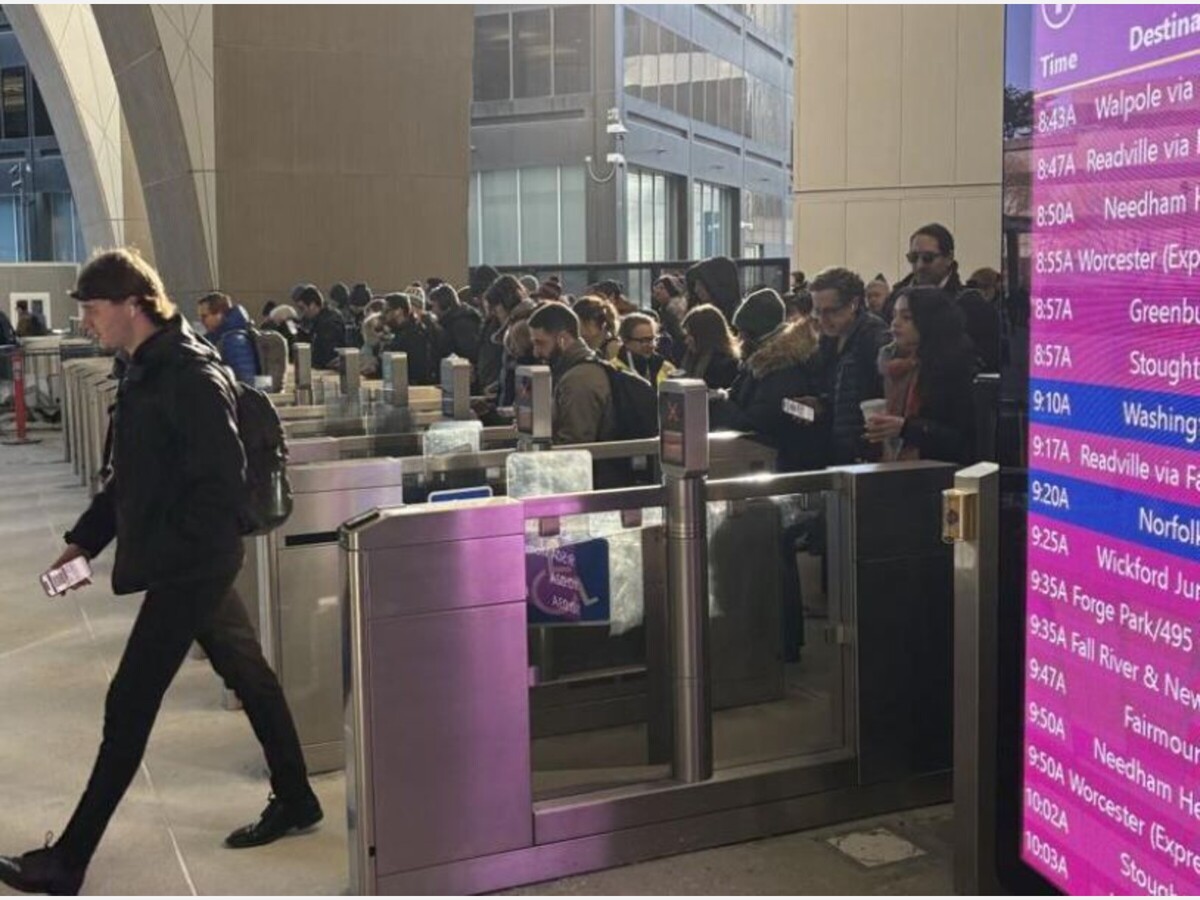
New fare gates at South Station have frustrated hurried travelers this winter with weather-related operational issues, but MBTA General Manager Phil Eng says they're still doing the job: increasing fare payments.
Greater Boston Chamber of Commerce President Jim Rooney asked Eng about the "bumpy rollout" of the commuter rail gates during a chamber event on Thursday.
Eng replied that since they opened in late December, there's been an increase in ticket validation of more than 40%. A T spokesman said the increase was across the commuter rail system.
The increase stems in part back to how often ticket checkers on trains failed to validate tickets in the past.
The gates were launched as part of the MBTA's crackdown on fare evasion under Eng. However, twice in their two months of operation they have proved unable to handle Boston's frigid weather and major snowstorms. Once in January and again in February, they were knocked out of service and wrapped in tarps and plastic.
Eng brushed off Rooney's question about the gates, pointing to increased collections.
"I think for too long we've allowed the feeling that not paying a fare is okay, and it's become a little bit of a culture thing, where we just want to remind people, whether it's a railroad fare, whether it's a bus fare, whether it's a subway fare, those dollars make a difference to everything that the public we serve relies on," Eng said.
The MBTA has made an effort to crack down on fare collection across its system over the past year.
In September, the agency announced that subway and bus riders who fail to pay could face tickets and fines by newly empowered civilian "fare engagement representatives." It deployed 15 of these fare collection enforcers across the subway and bus systems.
Eng said Thursday that he is not looking to raise fares on the T imminently — though he did not discount the idea in the future — and instead is focused right now on better enforcing existing fares. He acknowledged that significant new state investment in the T allows them to keep fares steady.
"Right now, the governor's proposal for the budget funds our operating needs. That doesn't mean that, in the future — but right now, I'm not looking at increasing fares of that nature. My thing is to continue to collect the fares that should be collected," Eng said.
Gov. Maura Healey's fiscal 2027 proposal (H 2) includes $1.1 billion in operating support for the MBTA across two bills, with $645 million from the income surtax on high earners. The package includes $470 million in state contract assistance, $122 million in surtax dollars for safety and federally mandated work, and $523 million to replenish the T's deficiency fund and provide operating liquidity.
State support for the T has skyrocketed in recent years, largely due to the newly-available pot of money from the tax on wealthier households. The infusion comes as the T faces ridership challenges and structural deficits that its own revenues — fares and dedicated sales tax — cannot close on its own.
"Pre-COVID, the MBTA generated about $607 million in fare revenue. Last year, the MBTA collected $440 million in fare revenue," Elizabeth Winters Ronaldson, deputy chief of fare revenue for the MBTA, said in September.
The last system-wide fare increase at the T was in 2019 under former Gov. Charlie Baker. That hike averaged 5.8% across subway, commuter rail and some bus fares. The last increase before that was in 2016.
State law allows the MBTA to raise fares no more than once every two years, and at a cap of no more than 7% for each increase.
The standard one-way subway fare on the MBTA is $2.40, or $1.10 for participants in the reduced fare programs the T offers.
Sam Drysdale is a reporter for State House News Service and State Affairs Pro Massachusetts.



Patchy rain nearby, with a high of 70 and low of 53 degrees. Don't forget your umbrella! Fog during the morning, overcast for the afternoon, clear for the evening, fog overnight.