37° and Light sleet



Image
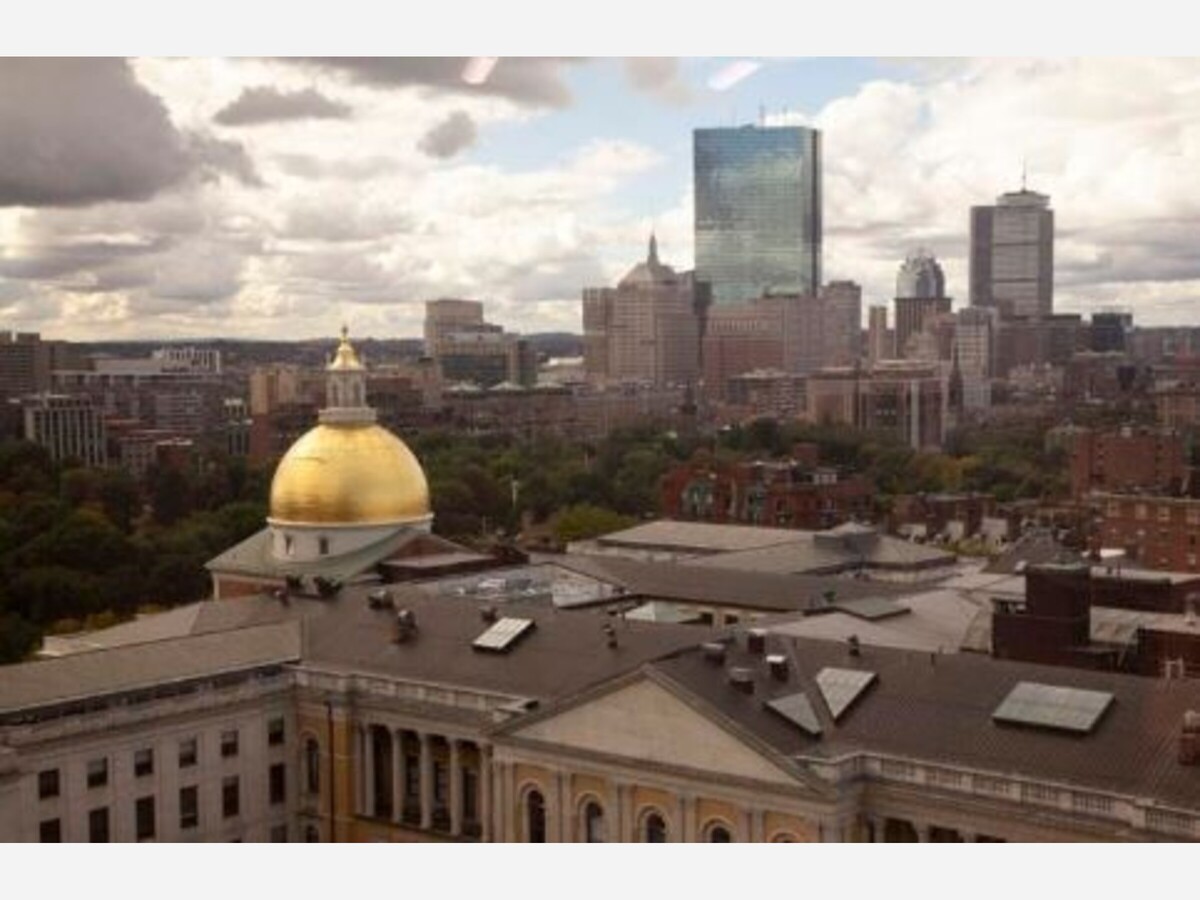
Ella Adams | SHNS
In March 2025, only a few weeks into President Donald Trump's second term, House Speaker Ron Mariano captured the sentiment that proved to be a throughline for the entire year.
"Every day something is changing, something's being eliminated, and by the end of the day, it's back in place," Mariano said.
The sense of policy whiplash permeated Beacon Hill and as the year ended, Mariano's bottom line observation seemed as true as ever: "It's hard to have any idea of how this thing is going to play out."
At this point in 2024, we were reflecting on a few certainties that capped off that year, like the erosion caused by the fall of Steward Health Care, the continuation of the state's emergency family shelter crisis, and the major dysfunction of Beacon Hill tinged with severe tension between the two branches.
But a plotline that was developing a year ago overshadowed this year's Top 10 by a longshot, perhaps as a result of its uncertainty: Trump's arrival and impact on Beacon Hill. The arrival wasn't physical but it may as well have been — the press conferences, statements, protests, bills and more that were birthed as a result of Trump's actions in Washington showcased just how intensely the implications of rapidly shifting federal policy can penetrate all State House business. The press corps pinned the fiscal and policy uproar of the second Trump administration as the biggest story this year, as it has painted an altered future for budget and policy writers who are grappling with how to adjust programs and services to less federal support.
Several faces on this list are appearing for the third year in a row — a testament to persistent issues and personalities now embedded in the fabric of Beacon Hill. Those include Auditor Diana DiZoglio and her audit battle, the Cannabis Control Commission and its leadership, and MBTA General Manager Phil Eng, who now is also state transportation secretary. And there are other plots still unfolding here, like the future of graduation requirements sans MCAS and the shaky health care sector and energy policy landscape in Massachusetts.
The State House Press Association's democratically selected top 10 stories of 2025 are:

Presidential candidate Donald J. Trump rallies supporters in Asheboro, N.C., on August 21, 2023. (Credit: Clifton Dowell)
Clifton Dowell / NC Insider
1.) Trump 2 collides with Massachusetts: Donald Trump's return to the White House was based in Washington but his indefatigable efforts to remake the country to fit his views made his presence felt every day on Beacon Hill. The first year of Trump's second term unfolded here like a campaign. His team relished its reversal of Biden-era policies favored in Massachusetts and Democrats here ripped his agenda and his tactics. But it was not a political campaign. It was real, and Democrats here are still adjusting to Trump 2 and the velocity, volume and volatility of this White House. On one front after another — higher education, scientific research, energy, food aid, health coverage, equity, immigration, transportation — the ruling Democrats here felt under attack from the federal government in a way they haven't before. House Speaker Ron Mariano summed it up early in the year, saying the state had lost its federal partner. But with so much policy and funding tied up in Washington, Democrats spent time learning how to stay engaged with the feds, telling voters they could not replicate the federal government's role, and resisting Trump's agenda while defending their view of Massachusetts interests and values. With help from her counterparts, Attorney General Andrea Campbell was on pace for almost a lawsuit per week against the Trump administration and its vast use of executive orders. "The fact we're at 45 [lawsuits] in less than a year tells you this is not Trump 1.0, Trump 2.0 is very different," Campbell said in December. The year exposed one key dynamic that analysts might not have fully expected: Republicans in Congress marched nearly in lockstep behind the president's agenda. That boosted Trump's power and raised the stakes for the 2026 midterm elections where a track record of votes and laws — the One Big Beautiful Bill Act chief among them — are there for voters to judge. - Michael P. Norton
2.) Finale of Treasurer Goldberg vs. CCC Chair O'Brien: In December 2024, Cannabis Control Commission Chairwoman Shannon O'Brien was fighting for her job in court after Treasurer Deborah Goldberg — who appointed O'Brien — had fired her. The roughly two-year legal battle ended in September when Goldberg surrendered her legal effort to block O'Brien from returning to the commission. Goldberg said she had "profound issues" with a court ruling that reinstated O'Brien as chair of the CCC with backpay as a result of her unlawful suspension and then firing by Goldberg. "Even when granting the Treasurer's fact-finding all the deference due it under the substantial evidence standard, and even considering the facts Goldberg found in their totality, her case for removal amounts to thin gruel," Superior Court Judge Robert Gordon wrote in his ruling. O'Brien has returned as chairwoman and Goldberg's powers over the commission are now on the chopping block. Both chambers have passed bills to overhaul the commission, including stripping Goldberg of her appointing power. House Speaker Ron Mariano suggested Goldberg and O'Brien's legal battle played a role in crafting the bill; Senate President Karen Spilka brushed aside that idea. The commission is closing out 2025 on a higher note, having finalized the long-awaited rules for establishments where people can use marijuana together and adding Carrie Benedon to the board, which was operating with three of its five-member body for months. - Katie Castellani

Auditor Diana DiZoglio (left) collects signatures for a 2026 ballot campaign to subject the Legislature and governor's office to the state's public records law.
3.) DiZoglio vs. Beacon Hill: It's state Auditor Diana DiZoglio against the (Beacon Hill) world — a top three storyline for the second year in a row. After more than 70% of voters supported a 2024 ballot question that would give her office the ability to audit her former colleagues in the Legislature, DiZoglio stayed locked on the mission this year. But her claims that lawmakers were "breaking the law" by not complying with the audit fell on mostly deaf ears, as top Democrats cited concerns about constitutional issues related to separation of powers. And while the Senate engaged to an extent with DiZoglio's office, wielding questions about the audit's scope, the House retained outside legal counsel in preparation for a possible legal battle. DiZoglio repeatedly called on Attorney General Andrea Campbell to intervene, or to allow the auditor to seek outside counsel for legal help. Campbell reminded DiZoglio to respect the "process" and continued to request more information from the auditor. Cue the audit deadlock, which remains. But DiZoglio's transparency crusade is metamorphosing. Again alongside advocates from across the political spectrum, she has her eyes on the 2026 ballot and a new measure that would subject most records held by the Legislature and the governor's office to the Massachusetts public records law. DiZoglio didn't file the question, but is helping lead the campaign. It's an old adage at play: If at first you don't succeed, try, try again. - Ella Adams

Ralliers cheer outside the State House on May 15, 2025 at an event calling for Massachusetts elected officials to push back against the Trump administration's immigration enforcement approach.
4.) ICE rattles Massachusetts: The increased presence of U.S. Immigration and Customs Enforcement officers in Massachusetts rattled many people this year. Targeted operations in some cases led to hundreds of people being apprehended, and certain detainments drew headlines, like those of Turkish Tufts University student Rümeysa Öztürk and Marcelo Gomes da Silva, a Brazil-born Milford High School student. Anxiety within immigrant communities grew, and reports suggested some paused going to school or work, fearful that leaving their homes would put them in danger regardless of their immigration status. ICE blamed "sanctuary" immigration policies in cities like Boston for interfering with its immigration enforcement and deportation efforts. Healey repeatedly said that Massachusetts is not a "sanctuary state," while Mayor Michelle Wu testified in D.C. in March alongside other U.S. mayors to defend Boston's approach to immigration enforcement, arguing that the city doesn't violate federal law by limiting local law enforcement interactions with federal immigration authorities. A Department of Justice suit against Boston, Wu and the city's police commissioner in September sought to have a federal judge invalidate Boston's "sanctuary" laws. Advocates took to the streets and State House steps, calling on lawmakers to pass bills to protect immigrants. Top Democrats acknowledged immigrants' fear and spoke against ICE, but did not support related bills. Gov. Healey denounced ICE's tactics, while applauding Trump's border control policies. After Healey's first two years in office were pigmented by an influx of migrants entering Massachusetts' overwhelmed shelter system, shelter populations dropped as reforms took hold and the state closed all remaining hotel and motel shelters in 2025. - Ella Adams
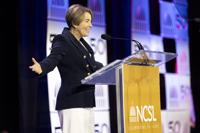
Massachusetts Gov. Maura Healey speaks at the National Conference of State Legislatures summit in Boston on Aug. 5, 2025.
5.) Energy policy slams into federal headwinds: Massachusetts's energy agenda in 2025 was defined less by marquee clean-energy wins than by a recalibration driven by federal roadblocks, affordability anxiety and reliability concerns. Offshore wind — long touted as a cornerstone of the state's climate strategy — was battered by the Trump administration's permitting freezes and stop work orders, culminating late in the year with Interior Department action pausing leases for five large projects. The move swept in Vineyard Wind 1, until then the lone project delivering power to Massachusetts, and other East Coast developments. Major projects like SouthCoast Wind and New England Wind remain stalled as lawsuits mount and timelines slip. Against that backdrop, Gov. Maura Healey leaned into the "all-of-the-above" energy strategy, emphasizing reliability and cost containment alongside decarbonization. Healey publicly backed long-term natural gas contracts and new pipeline capacity to stabilize winter prices, even as regulators continued to scrutinize gas utilities' climate compliance. The messaging shift — from climate-first to climate-plus-affordability — reached the Legislature. House leaders advanced and then paused a sweeping energy bill focused on competitiveness, Mass Save cost controls and looser restrictions on gas and nuclear power. The New England Clean Energy Connect transmission line moved toward delivering Canadian hydropower by year's end, promising clean power and modest bill relief after years of delays. Meanwhile, cracks appeared in the state's once-ironclad climate consensus, with some lawmakers openly questioning whether Massachusetts can meet its legally binding 2030 emissions target amid federal interference and grid constraints. - Sam Drysdale

Josh Kraft takes reporters' questions after launching his mayoral campaign at the Prince Hall Grand Lodge in Dorchester on Feb. 4, 2025.
6) Boston Mayor Michelle Wu vs. Josh Kraft: The race makes this list mostly because insiders closely watched it in the same way rubberneckers slow down to eyeball a fiery crash. The Wu train hit the Kraft campaign at full speed and didn’t stop until September, when a 49-point loss in the preliminary caused Kraft to drop out despite him punching a torn and frayed ticket to the November election. The most memorable campaign trail moment may have come not in Boston, but in D.C., where Wu, with newborn Mira in tow, appeared before a hostile Congressional committee and forcefully defended “sanctuary city” policies. In that moment, the campaign may have been over before it started. Clips and photos from her testimony remained in circulation until the September election. Wu was as relentless in pressing her incumbent advantage as Kraft was hapless on the trail, struggling when he looked away from his talking points. The lopsided result, and the millions of dollars that Kraft and his super PAC spent, left some shaking their heads. “[It’s] too bad that Josh Kraft — a Newton resident for most of his adult life who moved to Boston in 2023 and just quit Boston’s mayor’s race — didn’t try to be mayor of Newton instead,” where there was an open race, wrote Greg Reibman, the head of the Charles River Chamber. He also noted it would have cost Kraft a lot less money, too. Wu’s reelection left insiders wondering what’s next for her. She provided an answer weeks later: Another battle with the state Senate over her property tax shift proposal. – Gintautus Dumcius
7) Mounting health care challenges: The state health care system wouldn't have measured up at a wellness check this year — if it could have secured a doctor's appointment. Just 2.1% of residents lack health insurance, according to the 2025 survey from the Center for Health Information and Analysis. That still translated into 139,741 uninsured residents, despite the universal coverage envisioned under the 2006 reform law that some called RomneyCare and which later contributed to ObamaCare. Some 300,000 more residents are expected to lose coverage due to federal changes enacted this year. Health care was at the center of the nation's longest federal government shutdown but the reopening plan didn't save the subsidies that Democrats say are needed to keep people covered. Beacon Hill leaders faced constituents fed up with skyrocketing premiums or struggling with high deductible plans that caused them to delay seeking care or take on medical debt. Officials pledged to deliver primary care reform but made no demonstrable progress. A task force got behind an old idea, recommending doubling primary care spending, and a Department of Public Health report broached integrating abortion care within the sector. Inundated by the surging demand for GLP-1 weight-loss drugs, the Group Insurance Commission nearly ran out of money to pay claims and needed a $240 million infusion from Beacon Hill. The GIC has turned to a vendor for managing the costly prescriptions, while other health plans dropped GLP-1 drugs altogether, citing costs and looking past their benefits. - Alison Kuznitz
8) Eng's double duty at MassDOT and MBTA: Phil Eng captured readers' attention again this year. But it's not just for his work revamping the MBTA. In October, Gov. Maura Healey tapped MBTA General Manager Eng to serve as interim transportation secretary after Monica Tibbits-Nutt resigned. Eng is taking on two grueling jobs at once, and pledged his commitment to both responsibilities "is not going to waver." Others have expressed confidence in Eng, including transit advocates and lawmakers like Senate Transportation Committee Chair Brendan Crighton, who said he has "the utmost confidence in Phil to balance the two roles." As interim secretary, his tasks include replacing Cape Cod bridges and rebidding the state’s highway service plaza redevelopment contract. He has been credited with improving the MBTA since taking over the beleaguered agency in 2023, including by reducing slow zones, launching the South Coast Rail and boosting ridership back to closer to 2019 levels. There's a ways to go as the MBTA has still been regularly shutting down services in core channels so workers can complete infrastructure upgrades. Eng's timing is good — many of the system's recent investments have been made possible by funding from new surtax on high earners that has infused the T with revenue and taken some of the edge off of its regular budget dramas. - Katie Castellani
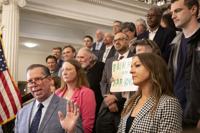
Bar advocate Sean Delaney (left), joined by a couple dozen of his peers, rallies inside the State House on July 31, 2025 calling for lawmakers to boost pay for the attorneys beyond what legislative leaders proposed.
9) Bar advocates spur court crisis: Bar advocates are private attorneys who represent indigent clients and they stopped taking new cases in May, triggering a fight that ended with lawmakers coughing up millions of dollars to mitigate justice system disruptions. The work stoppage came as the bar advocates, who handle about 80% of the state's public defense caseload, demanded pay raises as they trail behind their New England peers. The Committee for Public Counsel Services in mid-June filed an emergency petition that said more than 850 defendants lacked representation in Suffolk and Middlesex counties. The maneuver prompted the Supreme Judicial Court to activate the Lavallee protocol, which calls for the release of defendants or dismissal of cases after a specified time lapses without counsel. The case continues to play out, as CPCS urges the SJC to order higher pay for bar advocates — beyond what Beacon Hill authorized. The Legislature in July agreed to a $20-an-hour raise over two years, which a leading bar advocate called "a slap in the face." House Ways and Means Chair Aaron Michlewitz accused bar advocates of holding people's "constitutional rights to counsel hostage" and said "many people would be thrilled at a 30% raise." The Legislature also moved to reduce the state's reliance on bar advocates by allocating $40 million to CPCS, with the aim of hiring about 320 additional public defenders. CPCS in the fall offered a $2,500 incentive payment for bar advocates to take on certain new cases as hundreds of people still lack counsel. - Alison Kuznitz
10) MCAS fallout reshapes graduation rules: Voters in 2024 scrapped MCAS as a high school graduation requirement, setting off a scramble in 2025 as state leaders tried to answer the question: what, exactly, should a Massachusetts diploma mean now? Gov. Maura Healey convened a 31-member K-12 Statewide Graduation Council, tasked with designing a new statewide framework. While interim rules tied graduation to coursework through grade 10, the class of 2025 became the first to graduate under a system without a consistent statewide benchmark. The class of 2026 is now on track to do the same as the council's work continues. Late in the year, the Healey administration unveiled an initial framework centered on a "demonstration of mastery," pairing state-designed end-of-course exams with locally scored capstones and portfolios. Passing the tests would not be required to graduate, a distinction Healey stressed as consistent with voter intent and the state's "high expectations." Opponents, led by the Massachusetts Teachers Association and ballot question advocates, argued the proposal revives standardized testing under a new name and "defies the will of the voters." Business groups and some education officials countered that statewide assessments are essential for equity, accountability and workforce readiness. With final recommendations not due until summer 2026 — and legislative action required — the debate over what replaces MCAS has outlived the ballot question campaign as Massachusetts navigates the uncertain "what's next" for future graduates. - Sam Drysdale
Runners-Up: Rules Reforms; Lamar Cook Arrest; Legislative Spending; John Lawn Arrest; Property Tax Shift 3.0.
With mixed results, the Legislature agreed to a package of significant internal reforms in a bid to increase transparency by aiding the flow of bills to the House and Senate floors, changing reporting deadlines and opening the curtain to committee decisions. Gov. Healey aide Lamar Cook was arrested in October, charged with cocaine trafficking and subsequently fired. Healey has stayed mum about a 2001 incident involving the former deputy director of the governor's western Massachusetts office, citing the ongoing criminal investigation as the reason she can't speak on any knowledge of Cook's past. The Legislature passed a slew of supplemental spending laws this year — enough that when all fiscal 2025 spending is tallied, the state finished the year more than $3.2 billion above the $60.9 billion fiscal 2026 budget starting point. Rep. John Lawn was arrested for operating under the influence near the State House in July, after which he admitted to the facts of the case in court and faced fines, required alcohol treatment and education, and a 45-day loss of his license. He didn't face any public consequences from House leadership. A flashpoint of 2024 came back around in late 2025, when Mayor Wu pushed the Legislature again to pass her property tax shift home rule petition, but senators especially were not interested and this time turned some attention to their own property tax bills. - Ella Adams



Moderate rain, with a high of 38 and low of 35 degrees. Don't forget your umbrella! Light sleet for the morning, patchy rain nearby for the afternoon, overcast in the evening, clear overnight.