52° and Cloudy
Image
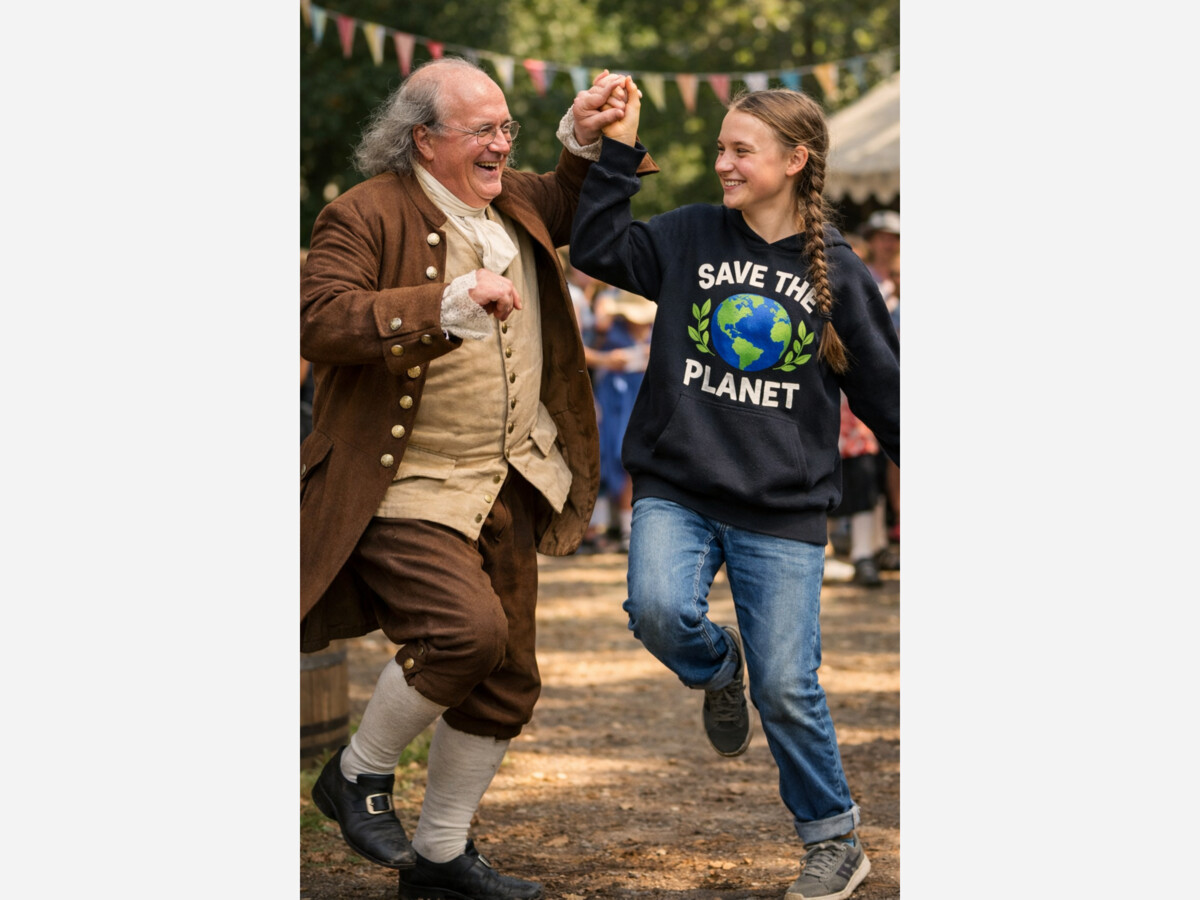



Historian Joyce Chaplin, who is speaking at the Franklin library on Saturday at 4pm as part of Ben Franklin Month, offers a strikingly modern reinterpretation of a familiar Founding Father in her new book, The Franklin Stove: An Unintended American Revolution. Rather than treating Benjamin Franklin’s famous stove as a footnote in early American ingenuity, Chaplin argues that it reveals Franklin as one of the world’s earliest thinkers about climate, energy, and the movement of heat on a planetary scale. In short, someone who would probably have a lot in common with a modern climate activist like Norwegian, Greta Thunberg.
Chaplin shows that Benjamin Franklin was deeply interested in how heat and cold circulate through enclosed spaces, cities, and even the atmosphere itself. His experiments with airflow, convection, and insulation led him to broader insights about how warmth moves through oceans and air. Most remarkably, Franklin helped identify and map the Gulf Stream, recognizing it as a massive, heat-carrying current that shapes weather patterns across the Atlantic—an insight central to modern climate science.
The Franklin stove, Chaplin argues, was not just a clever heating appliance. It was an early environmental intervention. Designed to produce more heat from less fuel, the stove dramatically reduced the amount of wood—or later coal—needed to warm a home. In an era of deforestation and smoky cities, Franklin worried about fuel scarcity, air quality, and human impact on nature. His stove represented a deliberate attempt to conserve resources and reduce pollution by improving energy efficiency.
Chaplin’s most surprising conclusion is that Franklin was thinking in systemic terms: how individual choices about heating could scale up to affect forests, cities, and climate itself. In this sense, The Franklin Stove reframes Franklin not only as an inventor and statesman, but as an early climate-minded scientist grappling with humanity’s relationship to energy and the environment—centuries before climate change had a name.
Her talk, which is derived from her book, also sees the unintended consequences of Franklin's approach to science -- and invention. Just as today, he believed humans could solve the problems they faced, even the ones they created. And in the case of the stove, its creation and manufacture also required intensive use of resources.
In short, then and now the challenges are similar and the answers not always simple or clear.

Sunny, with a high of 55 and low of 40 degrees. Sunny for the morning, clear during the afternoon and evening,