63° and Overcast



Image
James C. Johnston Jr.
In my rather long life, I have seen a lot of “Crazy”. As a very young child, I became aware of a man named Adolf Hitler, and the fact that he was a very mean person who was responsible for my father being in a big ship near some place called the Philippines which were a bunch of islands very far away where it was warm almost all the time and had jungles.
My mother showed me all of these places in her encyclopedias along with pictures and maps. I loved maps, and I began drawing maps of all kinds of places both real and maps made up of places in my own private world which originated deeply inside of my head. By the time I was seven, I could draw the world from memory. Take a piece of blank paper and try it some time. You might be surprised by how much you know about this crazy little planet we share withmore than eight billion other folks.
Drawing maps drove my rather unsophisticated second grade teacher crazy, and I enjoyed that. There were a fairly nice group of teachers Iencountered during some of my early years in the Franklin Public School System, but a great number of them were rather limited in their outlook on the larger world that I knew existed beyond the narrow confines of this little town.
They didn’t seem to want us to know much about that bigger world either. I thought that that was just a tad crazy. I ran into a lot of, “Why do we have to know that for?” back in those days.
I thought that it was a great thing to know as much as was possible, because the world is just so damned interesting. I wanted to know history. I wanted to know where all the “Crazy” guys like Hitler came from. As time went by, I actually got to know some kids, and even a few grown-ups who thought that Hitler had some good ideas about things like patriotism, hating your enemies, keeping people in order, especially those that , ”Do not know their place, and people who question the way we run things!”
Now that is crazy---Right?
I ran into a good deal of local people who didn’t like people from other parts of the world. After “The War”, that is World War II, there seemed to be a lot of different people around who were not previously living in Franklin. One of these women was a very nice and pretty lady who used to come to the house and cut and dress my mother’s hair. I loved her at first sight. I could tell that she was very smart. She spoke English flawlessly and knew a great deal about history, geography, literature, and nice old things. We used to talk a great deal.
She had two sons, a husband, and her elderly father. I learned that she was an artist like my mother. Her name was Tina, and she was a gifted sculptor. Her sons were also very smart and somewhat older than me, but they were always doing interesting things like digging their mother a fish pond for her carp. Tina’s husband Jack used to go down to the pond and call out, “Fish-Fish- Fish!” in his basso-profundo voice! Seconds later the water would begin to roil as if ten-thousand furies were swarming to the pond’s surface. “By God!’’ I thought, “They know what’s going to happen!”
And indeed they did. They knew that something great was going to happen. They knew that Jack was going to feed them. Great huge carp at least a foot long breached the churning water’s surface as Jack continued to call out, “Fish-Fish-Fish!” And as he called out to his finned friends, it was absolutely frightening and wonderful all at the same time! It was a feeding frenzy. If carp could have frat parties, this would be one to remember-that is-if they could! It was “crazy”-“Nice Crazy!”
Tina had been a lawyer back in Latvia, as had been her father, and her husband Jack, but in order to come into the country in those days, one had to have a trade. Being a lawyer did not qualify one as having anything useful by way of making a living even though you might be able to speak eight languages as all three of the adults in the family could! So, Tina was a hair dresser, Jack was an able bodied worker, and Tina’s father was a nice Old Retired Gentleman supported by his daughter and son-in-law. That “job thing“ was a bit of “Crazy” considering that they all had Doctor Juris degrees.
Tina got a job at King Phillip High School teaching languages, and then later she joined the faculty of Dean Junior College as it was back in those days.
We were so lucky to meet these very nice people. Later on I learned that Mr. Smits, Tina’s father had been a lawyer in the Russian Empire and had worked directly for Alexander Kerensky who led Russia between the two Russian Revolutions. He had been tried by the Communists when Lenin came to power and then exchanged by the Latvians for some high ranking Bolshevik.
Mr. Smits would become the chief prosecutor in Latvia where he fought against capital punishment and frequently lectured at the University of Riga now The University of Latvia at Riga. From the time I was seven or eight, I would walk half a mile down the road, as we called the “Old Rout 140” to see my friend Mr. Smits. I guess that I was not much of a replacement for Dr. Kerensky and the other luminaries who governed Russia and decided the fates of whole peoples, but at least I was there.
We discussed Central and Eastern European History for hours and hours. It was fantastic for a boy of seven, eight, and nine who knew enough to know that he was talking to a real historic figure who had actually been at the center of so many historic affairs. When I was eight, I made my huge historic faux pas! I mentioned something about The Prussian Empire!
Dr. Smits, as he should have been addressed properly, took off his glasses, and fixed me with his eyes. “My boy,” he said not as sternly as he would have had I been a bit older than eight, “There never was a Prussian Empire. There was the Kingdom of Prussia, and in 1871, The Second Reich or Empire was proclaimed in the Hall of Mirrors at Versailles by Otto von Bismarck, the Prussian Chancellor, and he named his King William, who was the King of Prussia, as Emperor of Germany, but remember William was also still King of Prussia which was not quite the same thing at all. He served as Emperor of Germany and King of Prussia at the same time. Now, never forget that, and I never did. That was good crazy.
My mother was always an artist. She painted and made things like baskets. Later on she would make Nantucket Baskets, and I would sell then for her for thousands of dollars a set. She was a woman of great modesty who knew other peoples’ baskets might command those prices but not hers. Let’s just say over the next several decades of mortal time I educated her to the reality that she was a great person whose work was more than worthy in every respect. I charged real money for it, and it took a while for her to realize just how good she was. Sometimes my students needed a bit of that.
Once, my mother put one of her paintings out into our little barn where I almost ran it through with a pitchfork one sunny day. It was a fairly large work of art and to me a glorious thing! It was a painting of a farm not unlike that of her grandfather’s farm in Upton, Mass. It had a wonderful naive quality to it. In the American Art World, this naïve quality is called “Primitive”. I carried it up to the house and said, “Look at what I found in the little barn! A master work!”
“It’s a funny little thing that I painted last winter,” my mother said.
“Well I am going to get it framed the next time I go to The Woodshed frame shop.
My very good friends, the Woods, ran this oasis of culture in Greater Franklin. Anne Woods, a very accomplished artist in her own right, looked at the painting and expressed her joy in seeing it. “My mother does not appreciate her own art work. How crazy is that?”
“She was most likely brought up to be a modest girl,” Anne replied.
I looked at Anne and said, “No doubt, and how crazy is that!” We both laughed over that one, because Anne knew my views on modesty and humility in general. I do not rank either of these pseudo virtues very highly.
I picked this pastoral painting up a few weeks later. It looked just right in its simple one-and-half-inch-gold-leafed frame. “That looks nice,” my mother said.
“What do you want?” I replied. “I know the artist. She is a great primitive interpreter of bucolic country life, and a true master of her craft.”
Over the years, I had gained a great deal of knowledge regarding the finer points of the early artifacta of New England life and of antiques in general. At one point I had a rather good following who sought me out for the bargains I had scored. One day a fellow who owned a rather impressive gallery dropped by and I sold him a Carl Valenkamph that I had on consignment from a friend, a Bass Otis Portrait of a Sea Captain, a smallish Frederick E. Roberts, and a few other things. And then he saw it.
“What’s that? What are you holding out on me?”
“It’s a new talent I have discovered locally. No doubt this gal is the next Grandma Moses.”
“She is damned good. I love it. How much is it?” he asked.
“Not much. She’s only asking twenty-two hundred and fifty dollars for it. I’m not even taking a commission.”
“Not bad. Add it to the pile,” said my excited friend.
Later on my mother could not believe what I got for her painting taken from the Little Barn after it had almost been impaled on the tines of my pitchfork. She was more shocked by this sale than she had been by the sale of the baskets! Back thirty-odd years ago, that painting took care of funding her Florida vacation to visit her sister. I am glad that my mother discovered her worth, not necessarily in terms of dollars and cents, but in the appreciation of her art, and her talent, and her delightfulness as a fully actualized artistic human person. This too is a fine sort of “Crazy”
Now all of this was not crazy to me, but my mother was always impressed by what people would pay for her under-appreciated efforts when I sold her folk art. She did some pretty sophisticated work as well. Her tole painting on tin was even recognized by the Brasher Guild for its excellence. When she revived her tole painting on tin, she used to give her art away. But the people she gave it to appreciate it for the most part, and if they didn’t, I bought it back from some of them some time later. She would have thought that crazy. That is a good sort of crazy I suppose. She did wonderful gold-leaf work. She was a master at shading it to absolute perfection. Ah yes! The best od all possible crazy.
But there is a lot of bad crazy around these days that I hope will pass. I am by nature an optimist. I believe in the youth of this country, and I believe that they can see the future with love and some excitement. I believe that young people will not abuse the natural world as older generations did. I believe that young people will fight the good fight against prejudice, racism, and classism, and be a more open-minded generation than those that have preceded it.
I hope that young people will also fight xenophobia that is fear of people from different parts of the world. I hope that the older generation will not give their hates, fears, and prejudice to the young, and I hope that I am not crazy in that respect. Quite frankly after these last few years, I am very sick if all this negative crazy that tends to divide the world into “Them” and “Us”. That situation does not have to be part of any healthy people in a much saner world far removed from all pernicious craziness.
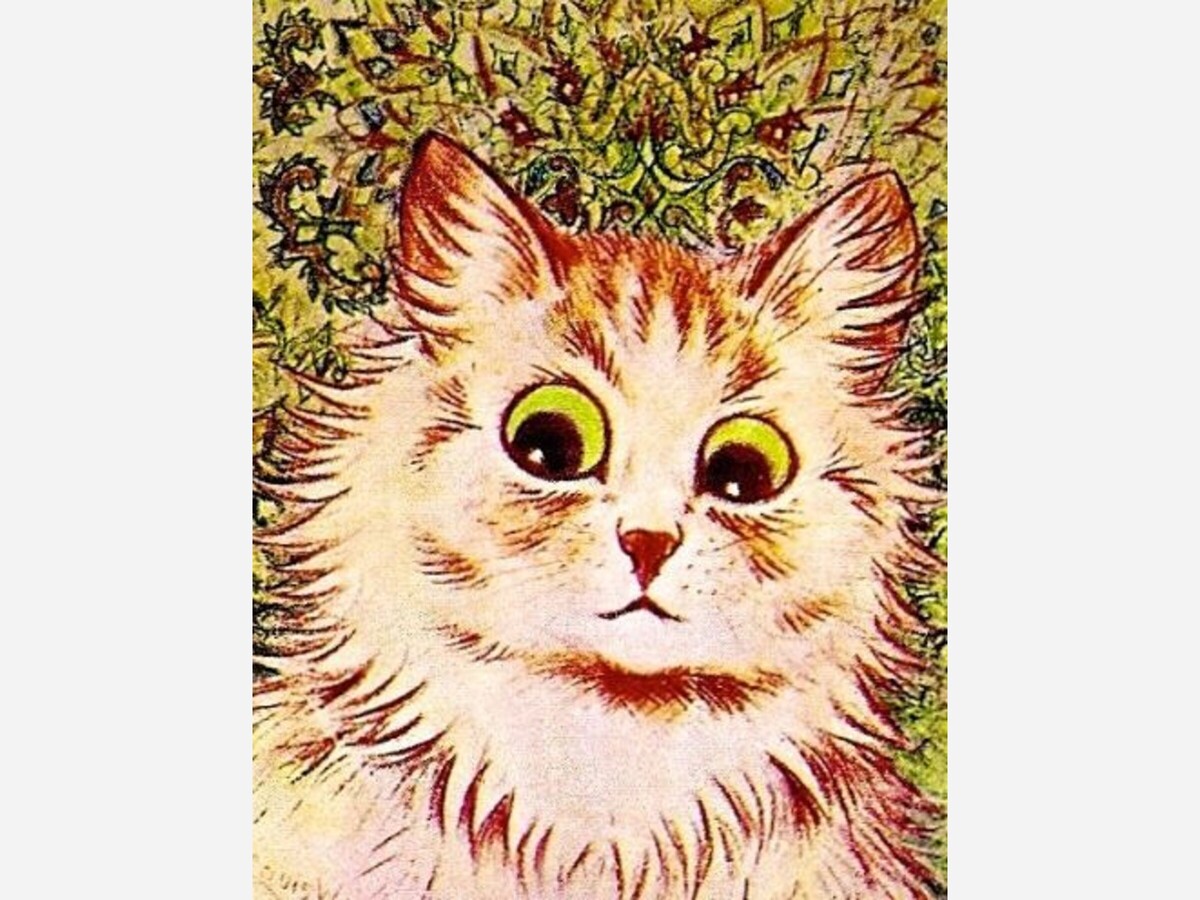
(Image: One of the hundreds of cat paintings of early 20th century English painter Louis Wain.)

Patchy rain nearby, with a high of 80 and low of 64 degrees. Overcast for the morning, cloudy in the afternoon, sunny for the evening, clear overnight.