74° and Clear



Image

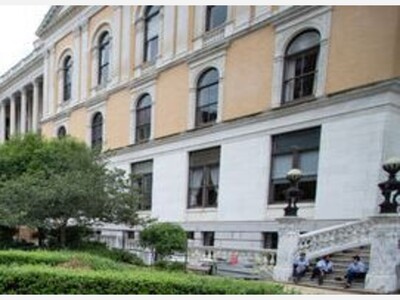
Above. the front desk of the former Best Western on Upper Union, two and a half years ago, before operators turned the place over to the state.
More than two-and-a-half years ago, Franklin Town Administrator, Jamie Hellen, was notified that the Commonwealth of Massachusetts had entered into a one-year lease with the Best Western Plus Executive Residency on Upper Union Street in Franklin to shelter "undocumented incoming migrants lacking clear legal status. It turns out that Massachusetts law required cities and towns to find housing for migrants or anyone else present in the state under a right-to-shelter provision in state law. No local approvals were required. Nor could locals say no. At the time, a Best Western front desk employee said rooms at the Franklin facility typically had a rate of $120 to $160 per night, which contributed modestly to the town's budget through a local option hotel tax.
Eventually, more than 300 individuals moved into the facility....which ended generating dozens of students needing language support in town schools and further needs for other municipal support.
Under political pressure to rein in the shelter program and to stem the tide of undocumented arrivals, which was broadly unpopular with voters, about a year ago, the Healey administration committed to scaling back and then ending the mass housing of migrants in the region's hotels. And, true to is word, the population on Upper Union rapidly declined, reaching zero in the summer of 2025, as many or most were transition to other less visible forms of subsidization or simply moved onto the competitive rental market.
Then What Happened?
According to Kevin Connor, Deputy Director of Communications at the Commonwealth's Executive Office of Housing and Livable Communities, the state contract with the hotel ended at the end of June 2025 (the end of the state fiscal year).
State law requires a hotel guest to pay local room tax for the first 90 days of occupancy, after which it’s considered long-term occupancy. The state paid local room occupancy tax to the Town for the first 90 days of occupancy, as required by law, according to Connor.
Then, after the first 90 days of occupancy the state reimbursed communities with hotel shelters (including Franklin) for potential lost occupancy tax revenue. Potential lost revenue was estimated by comparing the prior fiscal year’s local room occupancy tax revenue with the current year’s revenue.
For example, if a hotel produced $5k in local occupancy tax revenue in FY23, and in FY24 it produced only $3k in revenue while it was serving as a shelter, the state would have reimbursed the community $2k to offset potential losses.
Between FY24 and FY25, the total reimbursement to Franklin was approximately $10,000, said Connor.
Now, of course, the situation has changed. Once the hotel population left, the owners apparently decided there was no way to get back to normal without major changes. Damaged rugs and worn or ruined beds were gathered up and piled in dumpsters. And no one rented any rooms, so the town got now hotel tax revenue.
Today, although trucks appear at the location regularly, there is no clear indicator of progress. The town has declined multiple requests to share whether any building permits are active or whether there is any other indication of an effort to get the hotel back in business. Nor has the owner, been forthcoming.
The facility, with an assessed valuation of nearly $8 million dollars, is owned by Giri Franklin, LLC, which in turn is apparently a business of Giri Hotels, headquartered in Quincy. According to an article published in 2025, Giri Hotels has expanded rapidly from 16 to 54 hotels since 2016, primarily across Massachusetts and Maine, with additional growth underway. Led by principal partner Ryan Amin, the company emphasizes a close-knit, family-oriented culture, reflected in its preference for properties within driving distance and active involvement of family members in operations.
Originally founded in 2006, Giri both owns and manages its hotels, focusing increasingly on upscale resorts while divesting midscale assets. Though about 60% of its portfolio is branded, higher-value assets are largely independent resorts, including the $100 million Anchorage by the Sea in Maine.
Giri is vertically integrated, handling construction, procurement, and even proprietary technology solutions such as OTA payment software and employee tipping systems. Its operations are highly seasonal, requiring supplemental staffing, including H-2B visa workers and recruits from Puerto Rico.
The company also leverages a 60-person support team in India and continues investing heavily in technology and property upgrades. Despite potential headwinds from rising costs and slower revenue growth, Amin sees strong opportunity in independent hotels, which benefit from increased agility and improved technology.
Efforts to get in touch with Giri by both telephone and email have not been successful. So, what next?
With hotel rates setting regional records for the upcoming FIFA events in June and July of 2026, the town seems likely to be missing a hefty chunk of cash. For June 23, a weekday roughly in the middle of the FIFA run, Hotels.com lists no vacancies in Franklin and minimum nightly rates in the $400-500 range with locations close to the stadium costing thousands per night. The loss of hotel revenue by itself is modest but the absence of hotel guests also means a big reduction in potential business for restaurants and others Franklin area businesses.
Maybe, somehow Best Western will be back in operation in June. but don't hold your breath.

Patchy rain nearby, with a high of 80 and low of 64 degrees. Overcast for the morning, cloudy in the afternoon, sunny for the evening, clear overnight.