

Image
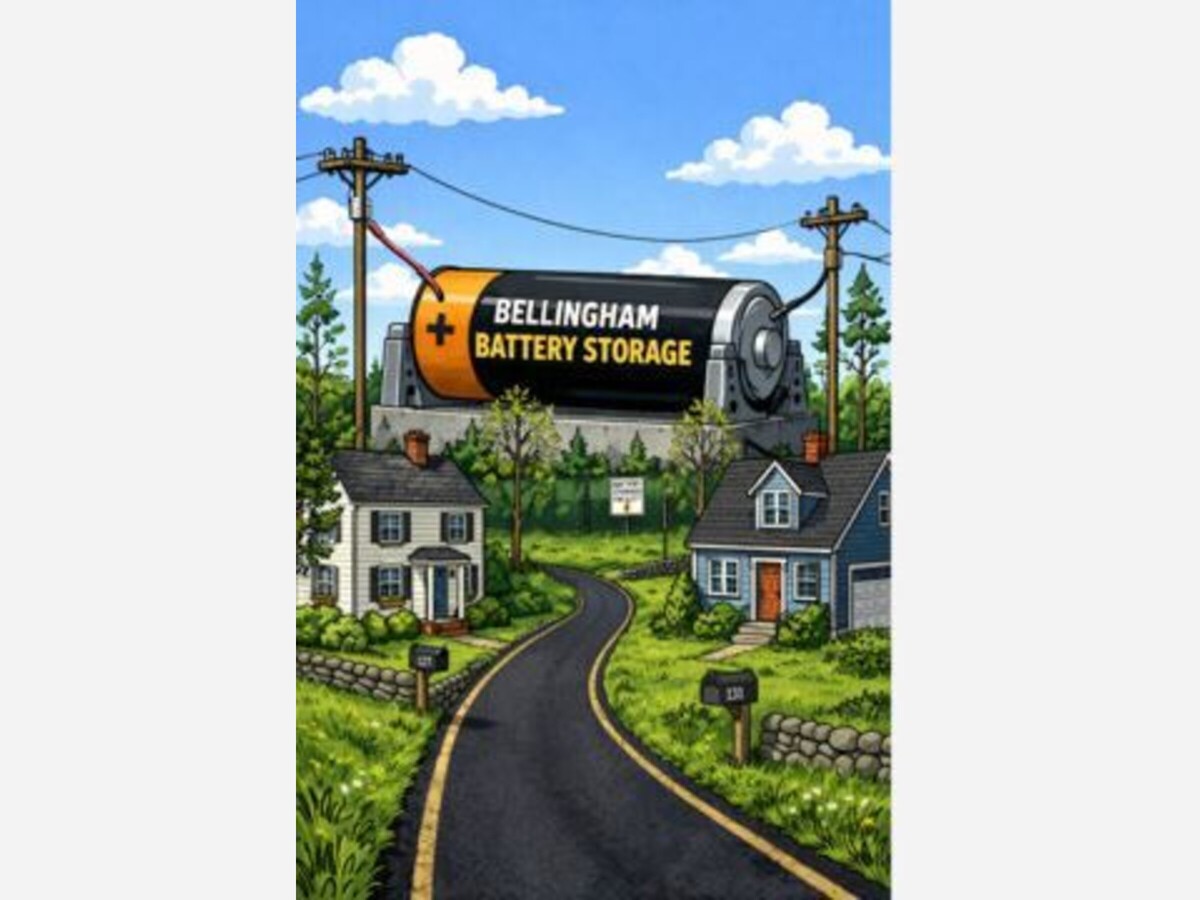
According to a Boston 25 report, a newly proposed lithium battery park on the line between North Revere and Saugus is stirring up controversy between city officials and town residents. Revere officials are working with a third party to develop plans for a lithium battery park that would provide an upgrade to the city’s outdated energy grid. But the proposed plan would put the plant between Saugus and North Revere off Muzzy Street.
It's hardly a unique situation. Medway recently brought a giant lithium battery project online, not far from the Bellingham and Franklin town lines and now Bellingham is proposing a lithium battery project of its own along Pearl Street (the continuation of Franklin's Beech Street) and just over the Charles River from Plain Street, Franklin.
So far, the project looks like it is sailing ahead smoothly. In a letter to constituents concerned about the project, Franklin Town Councilor Max Morrongiello concisely summarized the situation: "the site is a 20-acre town-owned parcel that Bellingham put out to bid in 2020 and authorized through its own town meeting. Zero-Point Development was awarded the contract, and a ground lease has been in place since 2021. The developer filed a Special Permit application with the Bellingham Zoning Board in February 2026, which is the first step in a multi-stage process that will also include Bellingham's Planning Board, Conservation Commission, and MassDEP before anything can be built."
Tom Corbett, Senior Project Engineer at Zero Point, the company developing the site, said, he has been permitting projects of this type for last five years "and there tend to be many questions," from the public.
According to Corbett Zero-Point Development has recently submitted to the Bellingham Zoning Board of Appeals for a Special Use Permit for the property as required by the RFP. Full project scope filings also will be going to the Bellingham Planning Board and Conservation Commission as well as the MassDEP at a later date. These processes will review the project and it’s compliance with all local, state and federal requirements such as adherence to UL Standards, NFPA Codes and Standards as well as development standards within the town of Bellingham.
The project proposes a 5-Megawatt / 20-Megawatt Hour Energy Storage System (ESS) utilizing Lithium Iron Phosphate chemistry for the Li-Ion Batteries. The project proposes to connect to Eversource’s 3-phase electric distribution circuit, providing a direct benefit to the local grid structure within Bellingham and surrounding areas; increasing resiliency, reliability, and power quality for the area. The project connects to the grid in the same way Large-Scale Ground-Mounted Solar Arrays do, via the streetside 3-phase circuit. The current system design includes five energy storage containers as well as auxiliary power equipment to make the connection to the local grid.
Corbett points out that the technology is not novel but the scale is a bit bigger. "There are many energy storage systems currently in operation in Bellingham, Franklin, Blackstone and Mendon but they are co-located with solar arrays that were developed through the Solar SMART 2.0 Program. In fact, he noted, there are hundreds of Megawatts of batteries co-located with solar arrays throughout the Commonwealth, largely built since 2018 under the state program.
But the focus from the state has shifted, as noted in Jeremy Spector's Canary Media article, reprinted in Observer on Saturday: The wave of battery megaprojects marks a new chapter for the region, which until recently was focused on building small-scale batteries. Massachusetts encouraged this by requiring energy storage alongside many distributed solar projects that received payments through the state’s main solar incentive; this rule led to a buildout of systems in the range of 1 to 5 megawatts.
The Medway Grid project is roughly a mile northwest, as a bird flies, from the subject property, according to Corbett. "To my knowledge, Medway Grid is a 250-Megawatt / 500-Megawatt Hour system that interconnects to the 115 kV high tension lines. Zero-Point Development’s project is 1/50th (or 2%) the size of the Medway Grid project and encompasses only 12,000 square feet of actual project space on the parcel."
Still, as might be expected for a project that is in a relatively dense residential neighborhood, there are those expressing concern. On the Franklin side, for instance, Michele Sherwin, who attended one of the Bellingham hearings said she is concerned because there have been fires at these kinds of sites in other states "I would think there is some kind of study that has been done to measure the impacts of these sites on residential neighborhoods; if not there needs to be one first before putting that in a residential neighborhood," she wrote in an email. She also questioned whether the size and type of battery structure being proposed is covered under the codes being applied.
So far, it seems like Franklin's town government is keeping its distance from the issues. Morrongiello, in his letter, noted that it is purely a Bellingham matter.
However, another Bellingham project, nearly a quarter of a century ago, drew a fierce response from local residents and ultimately a vigorous governmental response, too. When American National Power constructed a gas-turbine-powered peak-generating station on Maple Street in Bellingham, that town received a number of mitigation payments or benefits, but Franklin did not. However, eventually the company was prevailed upon to change its tune and Jim Vallee, the State Rep. at the time, shepherded House Bill No. 4072 from 2003 (2003–2004 session) through to passage. It was an act establishing an infrastructure and town property Capital Improvements Fund for the Town of Franklin to accept and use the mitigation payments, which totaled some $7 million dollars, according to a former town official.. This legislation allowed the town to create a dedicated fund for capital projects and for affordable housing.
For the Pearl Street battery project, it is still early days, but with the state electrical grid badly fractured by its rapid reconfiguration to meet climate goals, and the source and location of power generation still in flux, the demand for battery systems to help keep the lights on is not likely to go away any time soon.


Sunny, with a high of 84 and low of 61 degrees. Sunny in the morning, partly cloudy for the afternoon, sunny in the evening, clear overnight.