53° and Overcast



Image
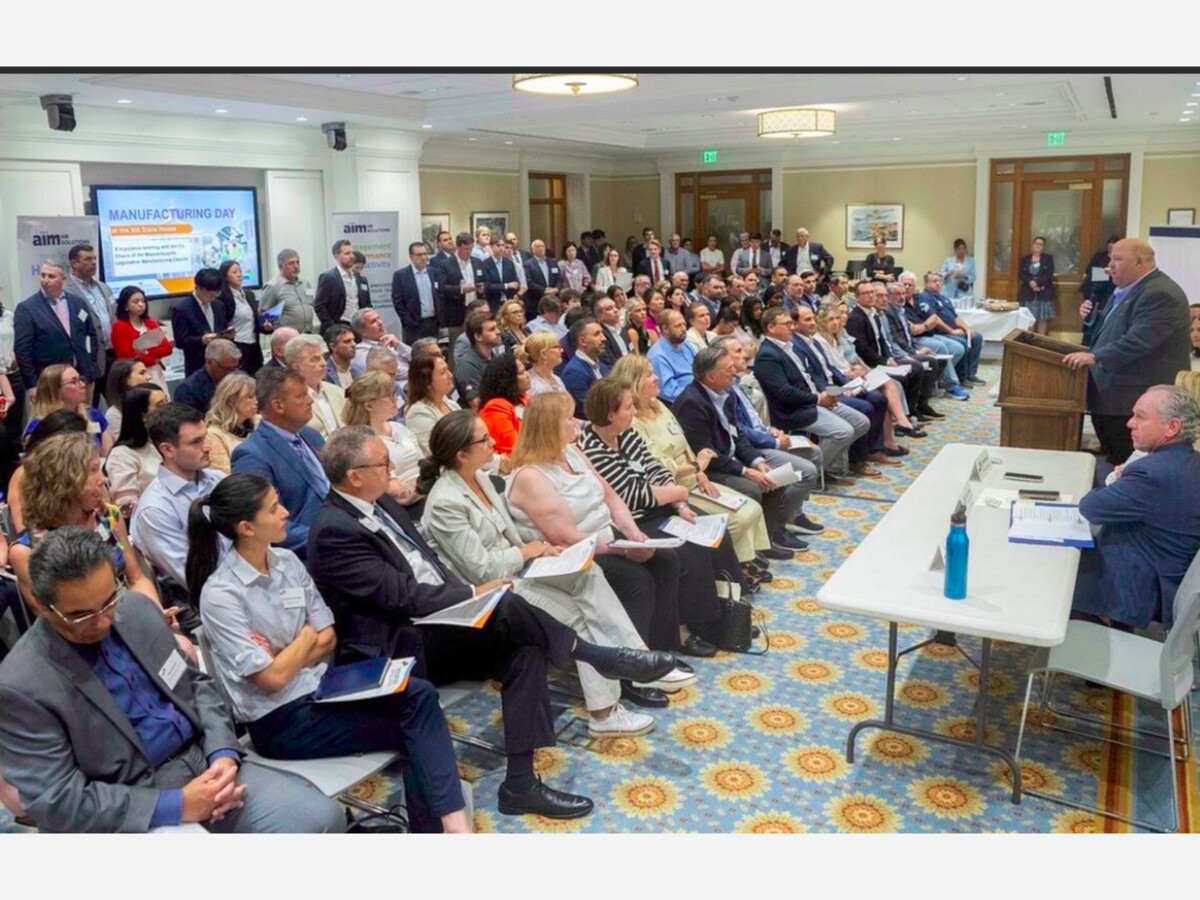
Above, recent Associated Industries of Massachusetts (AIM) lobby day at the State House. State Representative Jeff Roy (D-Franklin) and State Senator Paul Feeney (D-Foxborough) are to the right.
New England, and Massachusetts in particular, gave birth to much of America's early industry. Whether it was textiles in Waltham, Beverly, Lowell, or nearby in Rhode Island, metallurgy, machine tools, computers, or biopharmaceuticals, many firsts were recorded here.
More recent history hasn't always been kind to the pioneers as the empty or repurposed industrial structures of many so-called Gateway Cities, testify. Even Franklin and Medway have their share of disused mill and factory structures. But while the decline has been real, there has also been a robust renaissance going on and getting too little attention.
To bring some visibility to the state's current manufacturing story, industry leaders and state legislators gathered earlier this month for a packed Associated Industries of Massachusetts (AIM) lobby day at the State House to champion the future of manufacturing in the Commonwealth. Addressing a standing-room-only crowd of manufacturers, State Representative Jeff Roy (D-Franklin) and State Senator Paul Feeney (D-Foxborough), co-chairs of the Legislative Manufacturing Caucus, stood alongside AIM President and CEO Brooke Thomson to push back against the narrative that manufacturing is leaving the state, highlighting a major upcoming economic development bond package instead.
The day's events also featured a major celebration of local industrial achievement, reported here previously, as AIM presented its Excellence in Manufacturing Award to Plansee USA, a Franklin-based leader in powder metallurgy.
The lobby day took place just hours before the Massachusetts House of Representatives took up a comprehensive end-of-session economic development bill (H5562) . The proposed $425 million bond package directly targets the manufacturing sector's growth, including $100 million for the defense sector and national security infrastructure, $25 million for emerging technology and robotics, $25 million for applied artificial intelligence and quantum computing, and $25 million in capital support for expanding companies.
During the event, manufacturing representatives outlined five key legislative priorities they see as key to sustain this momentum: expanding vocational schools, funding the Center for Advanced Manufacturing, aligning state and federal tax codes, increasing capital grants, and scaling existing programs that are already working well.
Energy costs, often a bugaboo for the sector, were not mentioned.
Speaking to the crowded room of advocates, Rep. Jeff Roy emphasized the critical role state support canplay in unlocking the industry's full potential:
"We are not a state that just thinks; we are a state that makes. When people think of Massachusetts, they often think of our incredible universities, our historic cities, and our medical breakthroughs. But what makes those breakthroughs real, what scales them, and what brings them to the world is the grit, precision, and passion of Massachusetts manufacturing.”
The Legislature's pending economic development bill aims to directly bolster this vision by prioritizing regional competitiveness, advanced technology, supply chain support, and streamlined regulatory permitting to give Massachusetts manufacturers and award-winning employers like Plansee USA the edge they need in a rapidly evolving global market.
"Investing in industries like clean energy and AI allows our manufacturing sector to adapt, grow, and lead the nation," said Sen. Paul Feeney, addressing the advocates in attendance. "People say to me, 'Feeney, you have this idea, this vision that doesn't exist anymore.' It exists in every single one of you, and it exists in the work that you do in our communities."
In Massachusetts, there are 228,000 people employed directly in manufacturing jobs across the Commonwealth. As Rep. Roy noted, “every single day, they clock in to push the boundaries of what is possible. And their impact is immense: manufacturing drives a massive 7.9% of the total Massachusetts GDP. This isn't just a legacy sector; it is a vital, living engine of our modern economy.”


Overcast, with a high of 61 and low of 47 degrees. Patchy rain nearby during the morning, overcast in the afternoon, clear during the evening, overcast overnight.