57° and Clear



Image

Union members hold up signs supporting project labor agreement legislation at a rally in front of the State House on Wednesday, June 26, 2024. -- Sam Doran/SHNS
SHNS/Franklin Observer
A conservative-leaning think tank urged Gov. Maura Healey on Friday to rescind her executive order aimed at bolstering the use of project labor agreements, releasing a report that argues the policy ratchets up construction costs and could possibly carry implications for replacing the Cape Cod bridges.
A Healey spokesperson called the Fiscal Alliance Foundation's new study "junk research," sharing additional analyses with the News Service that assert PLAs do not raise costs and instead reduce expenditures, while also boosting competition and leading to quicker project completion times.
In March 2025, Healey issued an executive order directing executive department agencies to consider whether PLAs are in the best interest of projects, workers and communities for public works projects with construction costs topping $35 million. The order, aimed at boosting access to good-paying jobs for diverse workers, does not require PLAs for any construction projects.
What is a PLA?
As Massachusetts continues to roll out major public infrastructure initiatives, a key administrative mechanism—the Project Labor Agreement (PLA)—remains at the center of how the Commonwealth builds.
A PLA is a specialized, pre-hire collective bargaining agreement negotiated between labor unions and project managers for a specific construction job. Defined in state legislative language, the framework sets standard workforce rules across an entire job site, binding participating contractors and subcontractors to a single set of operational guidelines.
While often confused with the state’s mandatory prevailing-wage laws, which require labor rates that would be above what the market alone might dictate, a PLA operates on a broader scale. Rather than simply establishing a pay floor, it sets comprehensive rules governing wages, benefits, shift schedules, hiring procedures, and apprenticeship requirements. Crucially, these agreements almost always incorporate strict no-strike and no-lockout clauses, along with structured dispute-resolution channels designed to prevent costly work stoppages.
Impact on Local Projects
Consider a municipality embarking on a hypothetical $60 million high school construction project. Under standard public procurement rules, the general contractor and various trade subcontractors operate under their own distinct labor arrangements, tied together only by basic state requirements like prevailing wage laws.
If the local awarding authority opts for a PLA, compliance with the project-wide agreement becomes a mandatory clause in the overarching construction contract. Contrary to a common misconception, state policy dictates that nonunion firms are not barred from bidding on these projects. Both union and open-shop contractors may compete, though any winning bidder must adhere to the PLA’s operational terms for the duration of the build.
The legal and regulatory backdrop for these decisions shifted under an executive order issued by Gov. Maura Healey. Under the policy, executive-branch state agencies are required to review any public works project valued above $35 million to evaluate whether implementing a PLA serves the best interests of the state, the workforce, and the local community. The mandate stops short of requiring PLAs on all major builds, leaving the ultimate decision to agency assessments of project scale, complexity, schedule constraints, and workforce requirements.
Weighing the Pros and Cons
For awarding authorities, the primary appeal of a PLA lies in streamlining management across complex sites involving dozens of separate contractors and trades. Proponents contend that establishing unified labor standards before breaking ground yields a predictable supply of skilled labor, expands training pathways, locks in labor costs, and eliminates inter-trade jurisdictional disputes. State policy also highlights PLAs as a mechanism to advance diversity goals, including expanded opportunities for women, minority tradespeople, and veterans.
Critics, however, raise concerns regarding competitive bidding. Industry opponents argue that requiring nonunion contractors to operate under union-negotiated terms deters open-shop firms from submitting bids, potentially shrinking the pool of competitors and inflating overall project costs.
Ultimately, public officials must weigh market conditions, labor supply, and structural complexity on a case-by-case basis to determine whether a PLA serves as a practical asset or an unnecessary hurdle for public works.t.
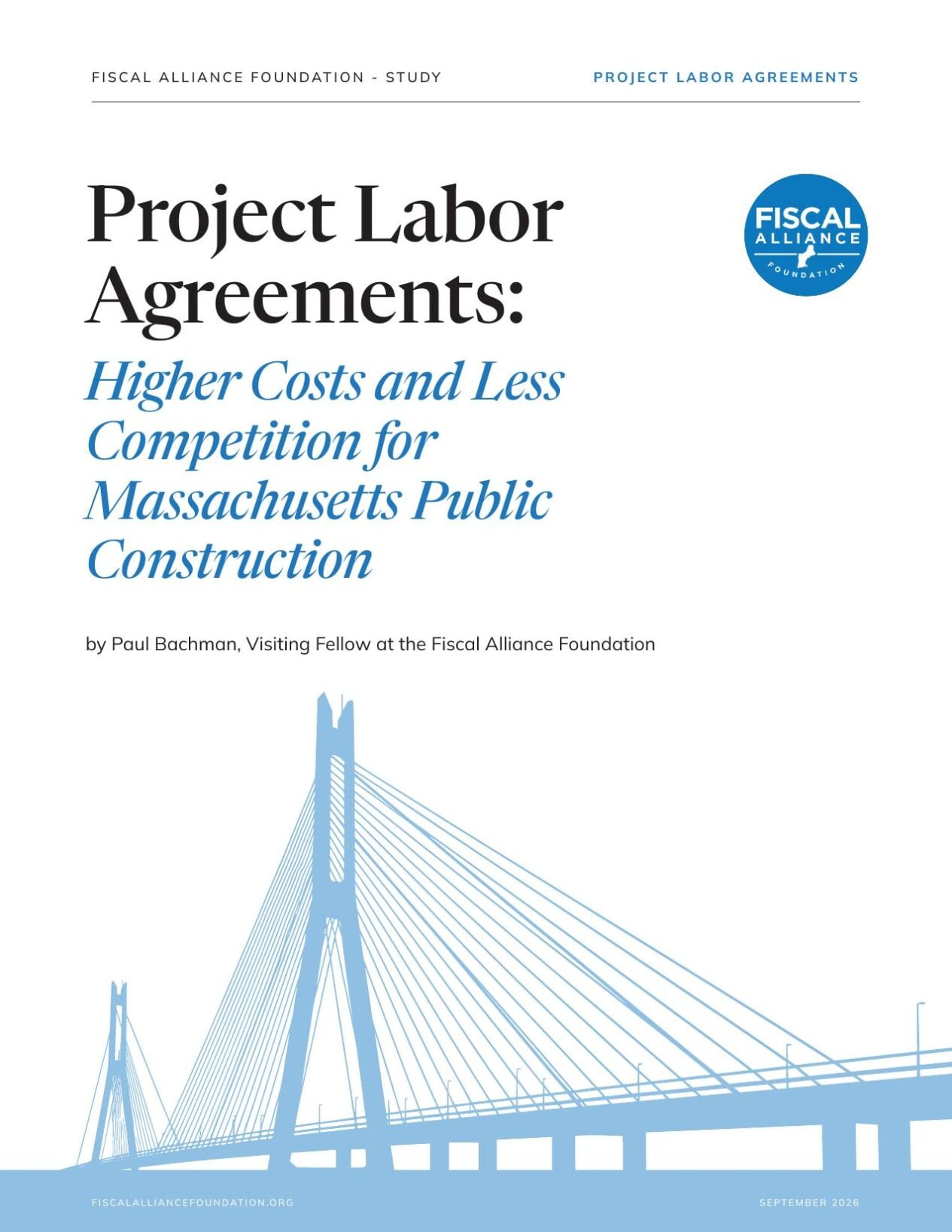
The Fiscal Alliance Foundation study ties PLA requirements with steeper costs, with an average cost premium of 16.2%. Identifying 166 projects within MassDOT and MBTA capital plans above the $35 million threshold, the study estimates the labor deals could translate into a $3.695 billion cost premium. The report argues PLAs "restrict open competition by imposing union hiring, benefit, and work-rule requirements that discourage open-shop contractors from bidding."
In a hypothetical scenario, the study said instituting a PLA for the Sagamore Bridge replacement project would cost the state an additional $293 million. While foundation executive director Paul Craney acknowledged that it's a federal project, he suggested Healey may still pursue PLAs as the state eyes starting construction for the new bridge in 2028.
"Will Gov. Healey, if she insists on PLA projects for major projects, jeopardize these huge infrastructure projects just for the sake of a PLA?" Craney said during a press conference, suggesting tension could arise depending on the outcome of Healey's reelection bid against Republican candidate Mike Minogue.
The study, Craney said, is meant to warn Bay Staters that Healey, "not only is she making costs higher, which means more tax dollars are needed for these projects, but she could be playing politics with a huge project that's very important to a lot of people in Massachusetts with these bridges."
Craney added, "I know that is taking some assumptions that she's going to want a PLA for that project, that this executive order would apply to that complex project, and that could be also the assumption that the White House may say no to the PLA."
Healey spokesperson Jacqui Manning quickly dismissed the study's findings in a statement Friday morning.
"No amount of junk research from a blatantly partisan organization can change what we know to be true from experience and from reputable studies: PLAs create good jobs and make sure projects get done on time and on budget," Manning said. "We've seen that with the Holyoke Veterans Home, Gillette, and TD Garden, as well as the North Station Draw One Bridge where our PLA will improve quality and lower costs."
Paul Bachman, a visiting fellow who authored the study, said he found only a "handful" of PLAs implemented since Healey announced her order about 18 months ago. The PLA for the North Station project is expected to raise costs by $163 million, according to the study.
"I suspect that the uptick will increase as we go on," Bachman said of PLA volume.
Healey's executive order arrived with statements of support from multiple labor and community advocacy groups, including the Massachusetts Building Trades Union and the Massachusetts AFL-CIO.
"These agreements ensure that projects create meaningful opportunities for workers across the board," Massachusetts AFL-CIO President Chrissy Lynch said at the time. "Currently, unions train 80 percent of all apprentices of color and 88 percent of all women apprentices in our state, and they have been critical to achieving the Commonwealth's diversity goals for construction."



Overcast, with a high of 66 and low of 46 degrees. Don't forget your umbrella! Overcast in the morning, patchy rain nearby during the afternoon, overcast overnight.








![Could Tesla Help Reduce the Region's Power Outage Challenges? [Updated]](https://franklinobserver.town.news/sites/default/files/styles/manual_crop_400/public/9677/2026-10/tesla_model_y.png?itok=Lu3Tmdge)