59° and Heavy rain



Image
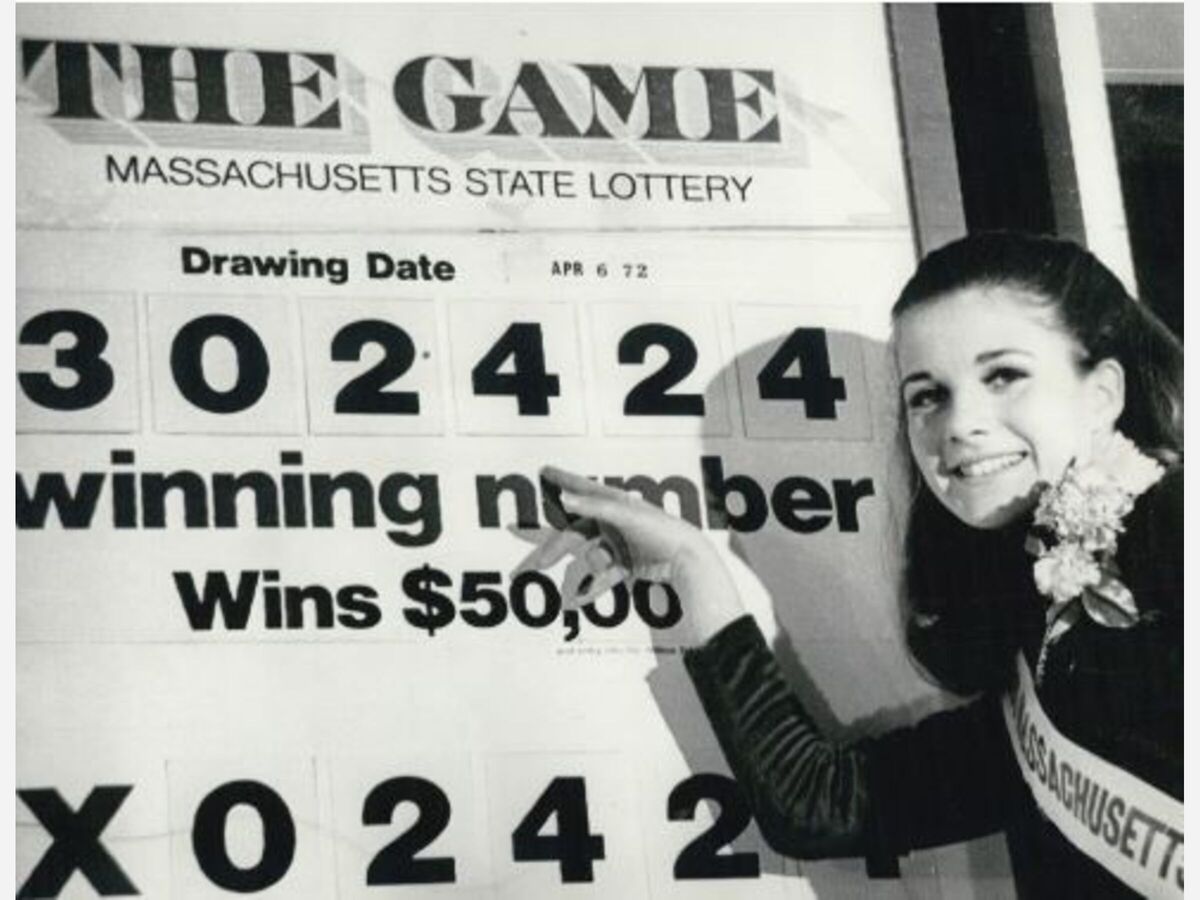
Miss Massachusetts Deborah Ann O'Brien was on hand at Faneuil Hall as the Massachusetts Lottery held its first-ever drawing 50 years ago last Wednesday, on April 6, 1972. [Courtesy/Mass. Lottery]
There were 4,783,000 tickets sold for the first drawing of The Game, but only seven had the winning numbers -- 302424. And among those seven winners, only one could say they were the very first Massachusetts Lottery winner in history.
Fifty years ago last Wednesday, on the morning of Thursday, April 6, 1972, the Massachusetts Lottery held its first-ever drawing at Faneuil Hall in Boston. Later in the day, Donald Cosentino of Gardner, then a 37-year-old furniture factory foreman, became the first lottery winner in state history when he certified his good fortune at Gardner City Hall.
"We have five children and I bought them all bicycles," Cosentino, who is now 87 years old and still lives with his wife, Aline, in the same house that they lived in 50 years ago, said of his jackpot winnings. "We also bought a camper so that we could all go camping together. We were able to put the money to good use."
Cosentino won one of the $50,000 top prizes by matching all six digits on the 50-cent ticket. He told the Gardner News in 2019 that a coworker at George B. Bent Co. bought a handful of tickets, held them out to him and told him to "pick one."
The $50,000 prize in April 1972 would have the buying power of $341,826.51 in today's economy, according to the U.S. Bureau of Labor Statistics, and the 50-cent price of a ticket would today be more like $3.40.
The other $50,000 winners of that first drawing, according to a UPI story reprinted by MassLive as a photo, were Mildred Foley of Wethersfield, Conn., Kathleen Egan of Whitman, Laurence Stewart of Lenox, Evelyn Walsh of Duxbury, Mary Cardosa of New Bedford, and Paul Cella of Framingham.
Thirty-eight other people won prizes of $2,500, 467 people claimed $250 prizes, and there were 4,332 players who won $25. All of the cash winners and 43,076 non-winning ticket holders became eligible for a $1 million drawing that was held on May 8, 1972.
Boston, Franklin and the ‘Numbers’
In 1972, Franklin was a solid working-class community and one its chief pleasures and most notable vice was the popularity of “numbers.”
According to Wikipedia, the Numbers game is a form of illegal gambling or illegal lottery played mostly in poor and working-class neighborhoods in the United States, wherein a bettor attempts to pick three digits to match those that will be randomly drawn the following day. For many years the "number" has been the last three digits of "the handle", the amount race track bettors placed on race day at a major racetrack, published in racing journals and major newspapers in New York.
Gamblers place bets with a bookmaker ("bookie") at a tavern, bar, barber shop, social club, or any other semi-private place that acts as an illegal betting parlor. Runners carry the money and betting slips between the betting parlors and the headquarters, called a numbers bank.
In Greater Boston, Wikipedia explains, as well as elsewhere in the northeast, the game was sometimes given a derogatory name, including in the city's newspapers, due to the game's popularity in black neighborhoods. The number was based on the handle from the early races at Suffolk Downs in Revere or, if Suffolk was closed, one of the racetracks in New York. The winner could be controlled by manipulating the handle.
After Jerry Angiulo became head of the Mafia in Boston, in 1950, again according to Wikipedia, he established a profit-sharing plan whereby for every four numbers one of his runners turned in, they would get one for free. This resulted in the numbers game's taking off in Boston. According to Boston Herald columnist Howie Carr, the Boston American (a predecessor tabloid) was able to stay in business in part because it published the daily number.
During the 1950s, Wimpy and Walter Bennett ran a numbers ring in Boston's Roxbury neighborhood. The Bennetts' protégé Stephen Flemmi took and collected bets for them.
Around the same time, Buddy McLean began forming a gang in Somerville, Massachusetts to, among other criminal activities, run numbers. This would become the Winter Hill Gang.
In Franklin, the numbers business was alive and well and appeared to work to groom its gamblers. One local resident, deceased a few years ago, recalled being convinced to play the numbers by an older coworker when he was a teenager. Miraculously, that first bet was a winner – giving him more money than he had ever had in his life. He was hooked.
Plenty of people earned side money or more running numbers. “Franklin had its share of gamblers and bookies,” says former Selectman Paul DeBaggis. “You could play the numbers almost anywhere, literally.” And so much a part of life was it in Franklin that a local barkeep never thought to exhibit any caution when two well dressed strangers came in and asked if she could help them play the numbers. She happily obliged and found herself in handcuffs – and in shock – a moment later as the strangers turned out to be undercover State Police.
Rose Turco, a retired Franklin High School teacher who grew up in town during the 1950s, “and was not into that type of activity,” said, “I can’t say for sure where the pickup and drop off points were located but my limited knowledge would be locations on Main Street and downtown East Central Street.”
Joel D’Errico, also a Franklin native and former Town Councilor, shared more specific memories. He said one member of the Franklin Police Force actually had an “office’ behind a curtain at one of the town’s convenience stores. His activity was an open secret, though he did ultimately get caught and served time, D’Errico said.
He said he believes Angiulo actually attended high school in Franklin, as did Illario (Larry) Zannino… “He was their number one guy to make people disappear; he went to FHS with my Dad,” said D’Errico.
“He would come to Class Reunions at Debbie’s Steakhouse with body guards,” D’Errico added.
Former Town Councilor Judith Pond Pfeffer recalled that there were many places in town when she was growing up, where bets could be placed and it was well known who some of these individuals were. “If I, a young female, was aware of their names and places, then it was not a secret,” she added.
“The most notable escapade I remember was a poker game at the old flower shop/ nursery at the corner of 140 and Cross Street where Walgreen’s is now,” she said. According to Pfeffer, the wife of the owner did not want the game there and probably didn’t want her husband to play so she called the State Police to break up game, not the Franklin police. “It was the talk of the town,” Pfeffer said.
When D’Errico served on the Keller-Sullivan building committee he had to talk to Zannino’s wife, Isabel (Zannino was in prison at the time) regarding the town’s purchase of their land on Lincoln Street, now the entrance to the school property.
State Marks 50th Anniversary
The Massachusetts Legislature passed the bill to create the Massachusetts Lottery as a source of local aid revenue for cities and towns on Sept. 27, 1971, and the new agency kicked off its sales for The Game on March 22, 1972. It was also made plain by supporters that they hoped legal gambling would cripple the illegal operations that helped sustain organized crime in the region. “Gambling has ruined many families and lives,” said Pfeffer.
Turco agreed, “The Mass. Lottery put an end to that industry.”
Since then, the Mass. Lottery has generated more than $137 billion in revenue, returned more than $30 billion in net profit for the Legislature to distribute to municipalities as unrestricted local aid, awarded more than $96 billion in prizes, and paid out more than $7.8 billion in commissions and bonuses to its statewide network of retailers.
For its first, partial year, the Lottery expected to provide about $21.9 million for local aid, the Newton Graphic reported in June 1972.
April 6 could be a lucky date for Lottery players. On April 6, 1999, the 27th anniversary of the first drawing, Maria Grasso cashed a ticket purchased at a Star Market in Boston and won a $197 million Big Game jackpot -- at the time the largest payoff to a single winner in American lottery history. Grasso was working as a live-in babysitter for Chris Gabrieli, the 2002 Democratic lieutenant governor nominee, a candidate for governor in 2006, and the current chairman of the state Board of Higher Education.
Mark William Bracken, the Lottery's interim executive director, said the agency plans to mark its 50-year anniversary throughout 2022 with special events and themed products.
"We are excited to show our appreciation for the customers, retailers, communities and employees who are all a part of our success story," Bracken said.
Through April 24, every 50th purchase of a draw game ticket of $2 or more will produce a free $1 "Quic Pic" ticket for one of the Lottery's in-state draw games (Mass Cash, Megabucks Doubler or Numbers Game).
And in March, the Lottery launched it largest ticket yet, an 8-inch by 8-inch "Jumbo Bucks" $10 scratch ticket with the same $50,000 top prize as the first drawing of The Game. Though not specifically tied to the 50th anniversary, the ticket promises the "best chance to win $50 in Massachusetts instant history" and all winning tickets contain prizes that add to at least $50.
The Lottery sold more than $13.96 million worth of the new tickets in its first week and about $16.5 million in the ticket's first nine days on the market.
Though the Lottery launched in 1972, it was not until May of 1974 that it became the first state lottery in the country to sell scratch tickets as an alternative to weekly draw games. Today, instant tickets account for about 70 percent of the Lottery's sales.
Three years after its launch, in March 1975, The Game was changed to the Big Money Game and the guaranteed top prize increased from $50,000 to $500,000. A half-hour television show based on the game began airing weekly in September of that year and stayed on the air for a decade.
Drawings became a daily event with the April 1976 introduction of the Numbers Game and 1978 saw the Mass. Lottery introduce the first "lotto-style" game in the country. Much like the modern multi-state MegaMillions or Powerball, players picked six numbers out of 49 possibilities and the game's jackpot would grow with each drawing that did not produce a top prize winner.
"The game is cancelled after only 13 weeks due to slow sales and a failure to produce large jackpots," the Lottery wrote in a 2013 document.
The Lottery has seen great success in recent years. Since fiscal year 2017, it has set and broken numerous sales and profit records and has topped the $1 billion profit mark three times. The agency is expected again to generate at least $1 billion for local aid this fiscal year.
But Goldberg and Lottery officials have also been unsuccessful in pushing for authorization for the Lottery to begin selling its products online, which the treasurer has said will be necessary for the Lottery to keep pace with casino gaming, daily fantasy sports, sports betting (if it is legalized here) and other gaming options.
Former Lottery executive director Michael Sweeney at various points compared the Lottery without an online presence to an old rotary phone -- "revolutionary in its time" but also "a little bit clunky" -- and to the Titanic -- "We have been doing very well, but what I like to remind people is that the night before the Titanic hit the iceberg, it was setting a new record for crossing the Atlantic Ocean."


Overcast, with a high of 66 and low of 46 degrees. Don't forget your umbrella! Overcast in the morning, patchy rain nearby for the afternoon, overcast overnight.




![Could Tesla Help Reduce the Region's Power Outage Challenges? [Updated]](https://franklinobserver.town.news/sites/default/files/styles/manual_crop_400/public/9677/2026-10/tesla_model_y.png?itok=Lu3Tmdge)