55° and Fog



Image
Locals are just getting their first glimpse of long buried grass and shrubbery and Spring is still days away. But it's already time to take on a worry of summer: drought.
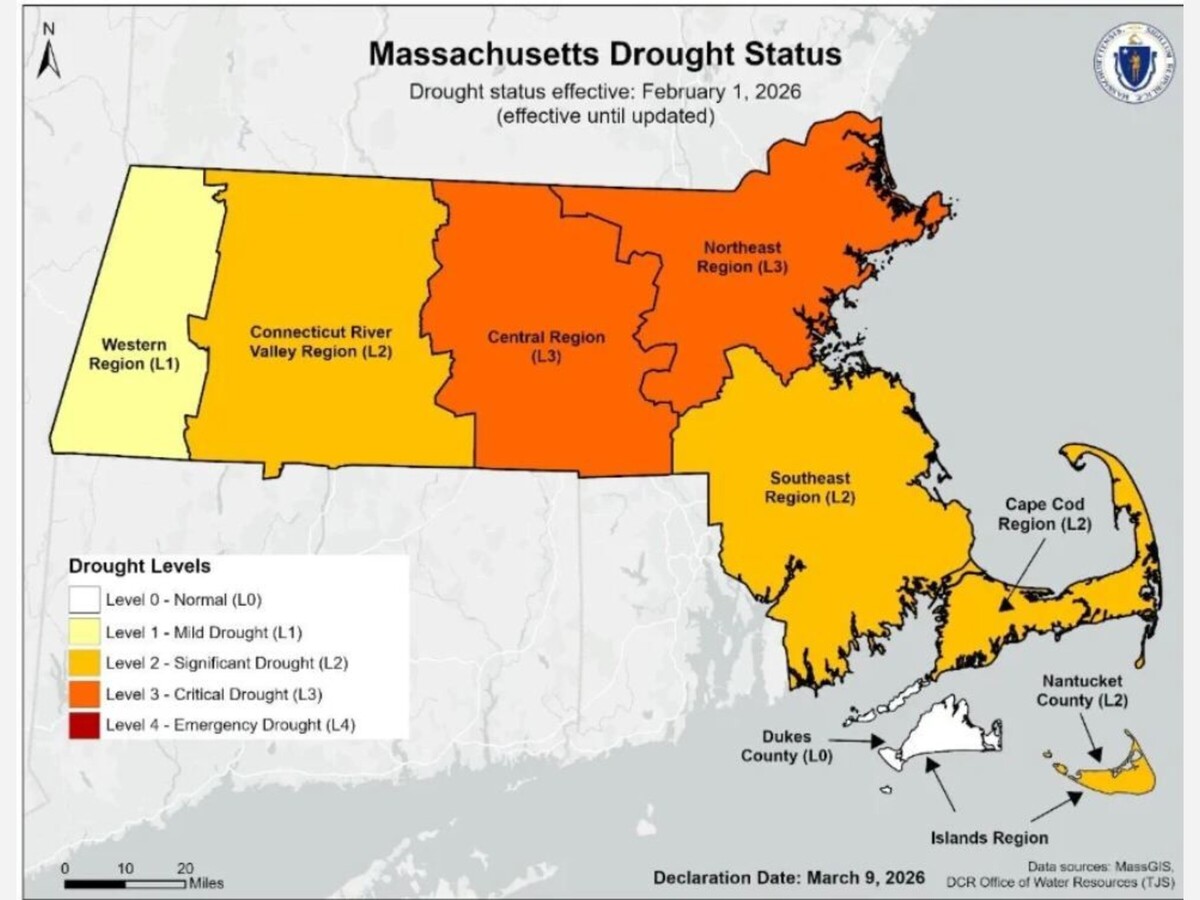
Monday, Energy and Environmental Affairs (EEA) Secretary Rebecca Tepper declared worsened drought conditions in several regions of Massachusetts due to limited groundwater recharge this winter. According to a news release from her office, the Central and Northeast Regions are now in a Level 3-Critical Drought. The Connecticut River Valley has moved to a Level 2-Significant Drought, and the Western Region is now in a Level 1- Mild Drought. Conditions slightly improved in Nantucket County, which is now at a Level 2-Significant Drought. The Southeast and Cape Cod Regions and Dukes County remain unchanged.
Drought is a` look back' at conditions over a period of time. The Drought Management Task Force (DMTF) collected and analyzed data from August 2024 through the end of February 2026.
Although Massachusetts received up to three feet of snow in February, that snowfall has not yet helped improve drought conditions. Most of that water is still locked in snow because February temperatures stayed well below freezing; the ground was also frozen. Even when it melts, the three feet of snow equals only about two and a half inches of water, which is not enough to fully recharge rivers, lakes, ponds, and groundwater after months of below-average precipitation and overall substantial water deficits. The above-normal temperatures that Massachusetts is now experiencing and the upcoming rains will start to slowly replenish water systems and be reflected in monthly totals for the month of March.
“This drought has been building since 2024, and we’re still seeing the effects in low streamflow and lower water levels across the state,” said EEA Secretary Tepper. “Even though we had a snowy February, it won’t be enough to replenish the groundwater after such a long period of drought. That’s why it’s important for everyone to be mindful of how we use water. Small actions can help protect our water supply while conditions recover.”
As outlined in the Massachusetts Drought Management Plan, detailed monitoring of drought conditions must continue. The drought levels also require ongoing coordination among state and federal agencies to implement drought response actions such as water-use restrictions. Additionally, engagement with municipalities, including local Boards of Health (BOH), is essential. This includes providing technical outreach and assistance to water suppliers and affected municipalities. Residents are asked to report to their local BOH if wells drying up; BOHs are asked to report here on the condition of local private wells.
Residents can report dry environmental conditions and submit photos to help monitor the situation on the Massachusetts Water Impact Reporter (here). Additionally, a FAQ is now available for questions regarding the current drought status and water conservation; and private well owners can go here for information on how the drought may impact them.
The Massachusetts Department of Environmental Protection (MassDEP) will continue to assist communities in managing their water systems. The Massachusetts Water Resources Authority (MWRA) water supply system is not experiencing drought conditions.
Below are recommendations for communities and individuals living and working within a Level 1–Mild Drought, Level 2–Significant Drought, and Level 3-Critical Drought, including those utilizing a private well. Residents and businesses are strongly urged to check with their local water system in case more stringent water restrictions are in place. Many systems may have other, more severe local conditions and constraints on water supply.
For Regions in Level 3 – Critical Drought
Residents and Businesses:
Immediate Steps for Communities/Municipalities:
Short- and Medium-Term Steps for Communities/Municipalities:
For Regions in Level 2 – Significant Drought
Residents and Businesses:
Immediate Steps for Communities/Municipalities:
Short- and Medium-Term Steps for Communities/Municipalities:
For Regions in Level 1 – Mild Drought
Residents and Businesses:
Communities/Municipalities:
State agencies will continue to closely monitor and assess conditions across the state, coordinate any needed dissemination of information to the public, and help federal, state, and local agencies prepare additional responses that may be needed in the future. The DMTF will meet again on April 7, 2026, at 9:30 AM. For further information on water conservation and what residents can do, visit the EEA’s drought and water conservation pages.


Patchy rain nearby, with a high of 70 and low of 53 degrees. Don't forget your umbrella! Fog during the morning, overcast for the afternoon, clear for the evening, fog overnight.