

Image
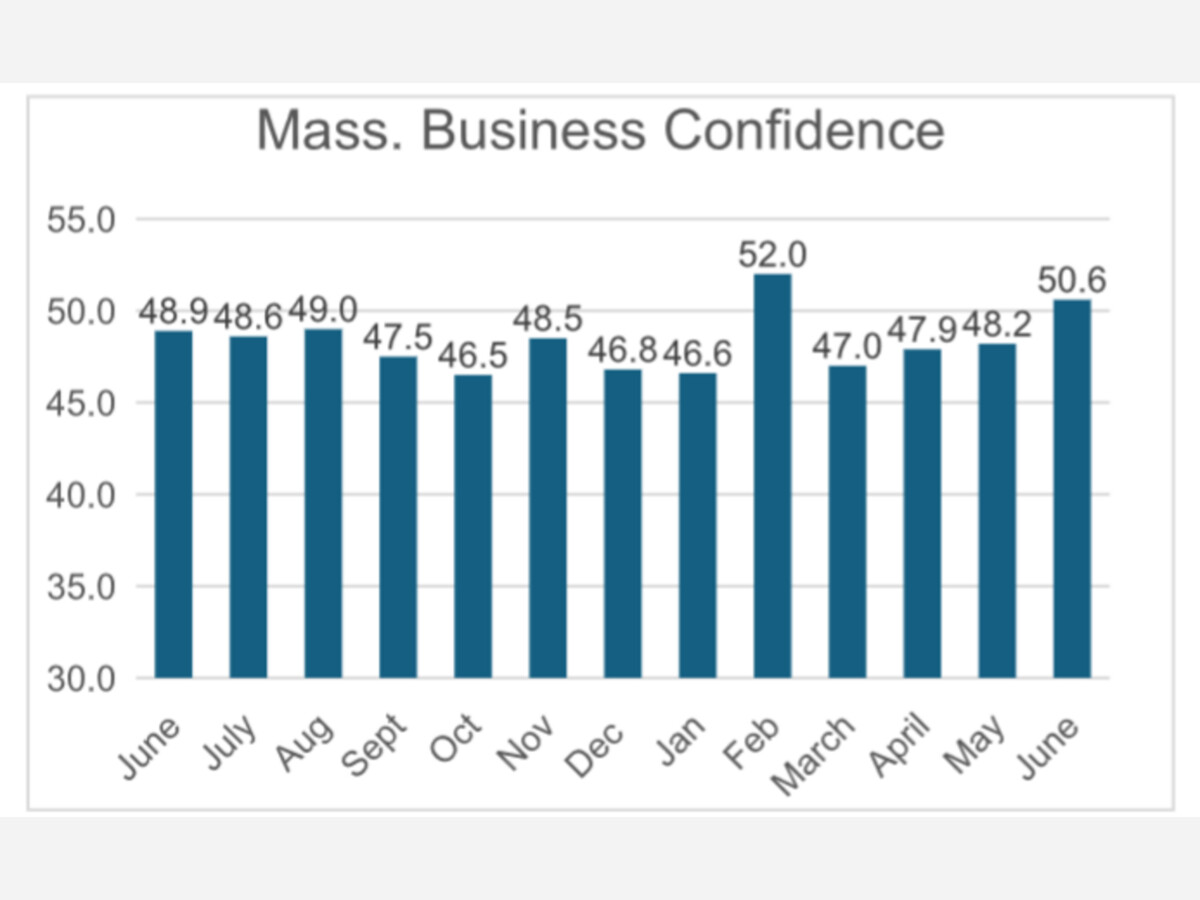
Massachusetts employers last month turned optimistic for the first time since February despite expressing concern about international conflicts and the cost of doing business at home.
The Associated Industries of Massachusetts Business Confidence Index (BCI) gained 2.4 points to slip into optimistic territory at 50.6 on a 100-point scale. The increase left the Index 1.7 points better than its level of June 2025.
Massachusetts employers have been pessimistic for the better part of the year, but confidence has gained ground in each of the past three months.
Strengthening confidence may reflect the stability of the US and Massachusetts economies following several years of elevated inflation, aggressive interest rate increases, and shifting global economic conditions. Though economic growth has slowed compared with the rapid expansion experienced after the pandemic recovery, consumer spending continues to support overall economic activity.
“Economists generally expect moderate economic growth rather than a recession or a period of rapid expansion. The economy's performance will depend on whether inflation remains under control, interest rates gradually decline, productivity improves, and policymakers can maintain confidence among businesses,” said Sara Johnson, Chair of the AIM Board of Economic Advisors (BEA), which oversees the Business Confidence Index.
The news was not all good as employers said they continue to wrestle with inflation.
“We have seen staggering cost increases and supply chain impacts from the ongoing trade war and war with Iran,” wrote one manufacturer in western Massachusetts.
The AIM Index, based on a survey of more than 140 Massachusetts employers, has appeared monthly since July 1991. It is calculated on a 100-point scale, with 50 as neutral; a reading above 50 is positive, while below 50 is negative. The Index reached its historic high of 68.5 on two occasions, 1997-98, and its all-time low of 33.3 in February 2009.
Constituent Indicators
The constituent indicators that make up the Index generally improved during June.
The confidence employers maintain in their own operations surged 4.1 points to 55.1. The figure was 2.7 points better than 12 months ago.
The Massachusetts Index, assessing business conditions within the commonwealth, gained 0.4 point to 46.7, leaving it 0.5 point higher than in June 2025. The US Index measuring conditions throughout the country was the only element to lose ground, falling 0.9 point to 41.1 – almost even with its level of a year ago.
The Current Index, which assesses overall business conditions at the time of the survey, rose 2.6 points to 51.8 while the Future Index predicting conditions for the next six months increased 2.2 points to 49.5.
The Employment Index rose 5.8 points to close the month at 53.3 as companies in sectors such as health care, technology, advanced manufacturing, and skilled trades continued to compete for qualified workers. The Manufacturing Index gained 6.2 points to 52.6.
Medium-sized companies (52.6) were more confident than small companies (50.1) or large companies (50.0).
BEA Vice Chair Michael A. Tyler, CFA, said U.S. financial markets remain broadly positive, although investors are balancing strong corporate performance against persistent economic and geopolitical risks.
“Equity markets continue their upward trend. The rally, initially driven by large technology companies and artificial intelligence investments, has broadened to include healthcare, industrials, and financial stocks,” Tyler said.
“The bond market reflects a more cautious outlook. Treasury yields remain elevated as investors assess the outlook for inflation and monetary policy.”
Energy Costs
AIM President and CEO Brooke Thomson, also a BEA member, noted that Massachusetts employers continue to struggle with the high cost of doing business in the commonwealth, especially for critical inputs like energy. The Massachusetts Senate and House of Representatives have both passed versions of an omnibus energy bill this session.
“AIM appreciates the House of Representatives’ focus on energy affordability and the meaningful steps its bill took to lower costs for ratepayers. While the Senate’s redraft shares many worthy goals, we are disappointed that the same emphasis on near-term affordability was not carried through,” Thomson said.
“All of our goals are important, but if we can’t afford to keep the lights on, we will not be successful in ushering in a sustainable energy future. AIM looks forward to working closely with the conference committee on a final bill that delivers cost savings; preserves the safety, reliability, and choice upon which families and businesses count; and makes the most promising initiatives a reality.”
The monthly Business Confidence Index, initiated by AIM's Board of Economic Advisors in July 1991, is based on a survey of AIM member companies across Massachusetts, asking questions about current and prospective business conditions in the state and nation, as well as for respondents' own operations. On the Index's 100-point scale, a reading above 50 indicates that the state's employer community is predominantly optimistic, while a reading below 50 points to a negative assessment of business conditions. Several component sub-indices are derived by analyzing responses to selected questions or those of groups of respondents.



Sunny, with a high of 71 and low of 51 degrees. Sunny in the morning, clear during the afternoon and evening,